
Lines of Communication: A Cooperative Learning Strategy for Student Discussions
The Lines of Communication strategy is a cooperative learning activity where students form two lines facing each other and discuss questions or review concepts with a partner. After each discussion, one line moves so students have a new partner. This simple rotation allows students to interact with multiple classmates while reviewing ideas from the lesson.
Teachers often use Lines of Communication during direct instruction or review activities because it encourages discussion, movement, and participation. Students practice explaining their thinking while hearing different responses from classmates.
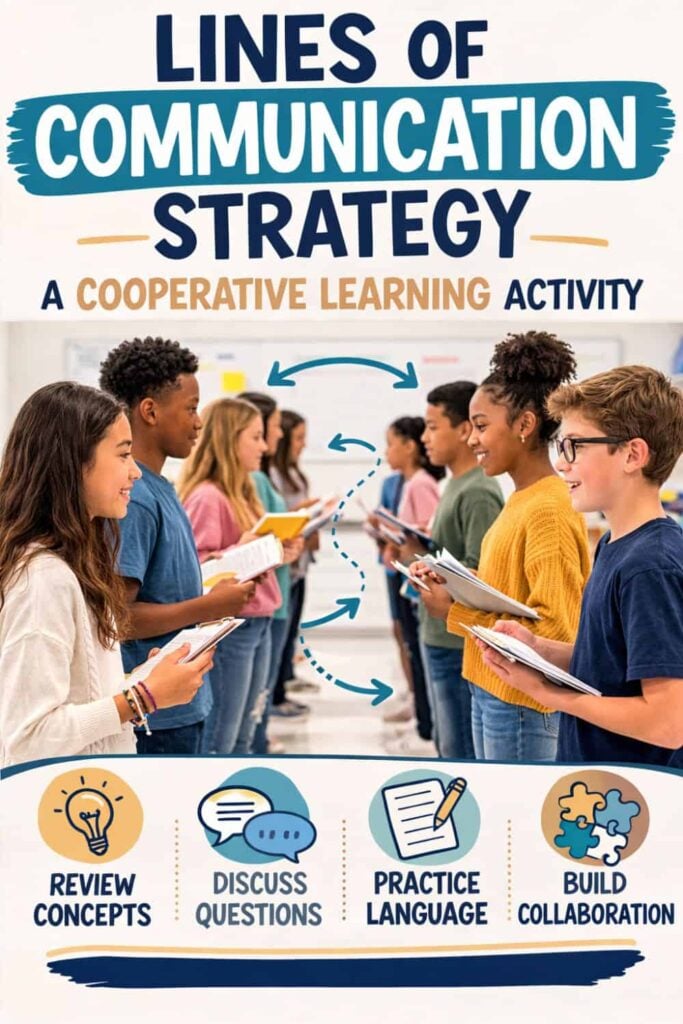
This strategy works well for reviewing concepts, practicing academic language, and discussing questions related to reading, math, science, or social studies lessons.
This strategy is one example of many cooperative learning strategies teachers can use to help students discuss ideas and review concepts during lessons.
What Is the Lines of Communication Strategy?
The Lines of Communication cooperative learning strategy is a structured discussion routine where students stand in two lines facing each other. Each student has a partner directly across from them.
The teacher asks a question or gives a prompt related to the lesson. Students discuss their answers with their partner for a short period of time. After the discussion, one line moves down so that students have a new partner.
The process repeats with a new question or prompt.
This structure helps students:
- practice explaining their thinking
- hear multiple perspectives
- review concepts from a lesson
- stay actively engaged through movement
Because students talk with several partners, they repeat and strengthen their understanding of the content.
How the Lines of Communication Strategy Works
The routine is simple and can be introduced quickly once students understand the expectations.
1. Students Form Two Lines
Divide the class into two groups. Students form two parallel lines facing each other, so each student has a partner directly across from them.
2. The Teacher Asks a Question or Prompt
Provide a question or task connected to the lesson.
Examples include:
- explaining the main idea of a passage
- describing a science concept
- explaining how a math problem was solved
- sharing an idea related to a writing prompt
3. Students Discuss With Their Partner
Students talk with their partner and explain their ideas. Both students should have an opportunity to respond.
4. One Line Moves
After the discussion, the teacher signals for one line to move down one space. Students now have a new partner.
The teacher then provides another question or prompt, and the process repeats.
Classroom Setup for Lines of Communication
The setup for Lines of Communication is very similar to Inside Outside Circle.
In my classroom, I place two colors of duct tape on the floor and write numbers on each spot. The colors help students quickly identify which line they belong to.
For example:
- one color marks line A
- the second color marks line B
Students stand on their numbered spots so that each number faces its partner. For example, student 1 faces student 2, student 3 faces student 4, and so on.
I usually weave the lines between the desks so students have room to stand and rotate without moving furniture.
Once the spots are placed on the floor, students learn the routine quickly and the activity becomes easy to run during lessons.
When to Use Lines of Communication in the Classroom
The Lines of Communication structure works well for many types of classroom discussions.
Teachers often use it for:
- reviewing key ideas from a lesson
- practicing academic language
- discussing reading comprehension questions
- sharing problem-solving strategies
It also works well as a quick review activity before a quiz or at the end of a lesson.
Since students repeat the discussion with multiple partners, the activity gives them several opportunities to explain their thinking.
Pairing Lines of Communication With Quiz Quiz Trade
Lines of Communication can easily be combined with Quiz Quiz Trade to add variety to the activity.
To use this variation, give each student a question card, vocabulary card, or sentence frame. When students meet a partner, they ask their question and listen to their partner’s response.
After both students respond, they trade cards before one line moves to a new partner.
This approach allows students to review many different questions during one activity while still using the same cooperative learning structure.
Teachers often use this variation for:
- vocabulary practice
- science concept review
- math fact practice
- practicing sentence frames
Students stay engaged because they interact with new partners and new questions throughout the activity.
Lines of Communication vs Inside Outside Circle
Lines of Communication and Inside Outside Circle are very similar cooperative learning strategies. Both allow students to rotate through partners while discussing questions.
The main difference is the formation.
Lines of Communication
- students stand in two straight lines facing each other
- one line moves after each discussion
Inside Outside Circle
- students stand in two circles
- one circle rotates around the other
Both strategies encourage movement and repeated discussion. Teachers often choose Lines of Communication when classroom space makes it easier to form lines rather than circles. I use both in my classroom for the variety.
Tips for Using Lines of Communication Successfully
A few simple routines can help this activity run smoothly.
- Model the discussion expectations before starting.
- Give students a clear time limit for each discussion.
- Signal when it is time to rotate partners.
- Encourage both students to share their thinking.
Once students understand the routine, Lines of Communication becomes a quick and effective way to add discussion and movement to classroom lessons.
Using the Lines of Communication Strategy in Your Classroom
The Lines of Communication strategy is an easy way to incorporate cooperative learning into classroom lessons. Students practice explaining ideas, listening to classmates, and reviewing important concepts while interacting with multiple partners.
With a simple setup and clear routines, Lines of Communication can become a regular classroom discussion activity. Whether students are reviewing vocabulary, discussing reading questions, or explaining math strategies, this cooperative learning structure keeps students engaged and actively involved in the learning process.
Jessica BOschen
Jessica is a teacher, homeschool parent, and entrepreneur. She shares her passion for teaching and education on What I Have Learned. Jessica has 16 years of experience teaching elementary school and currently homeschools her two middle and high school boys. She enjoys scaffolding learning for students, focusing on helping our most challenging learners achieve success in all academic areas.