
Inherited Traits vs. Learned Behaviors: Examples and Teaching Ideas for 3rd Grade
Teaching inherited traits vs. learned behaviors is one of the core concepts in 3rd grade life science under NGSS 3-LS3. Inherited traits are characteristics animals are born with, passed down through genes. Learned behaviors are actions animals develop after birth through experience or observation. This post breaks down both concepts with animal examples students recognize, suggests anchor chart ideas, and links to a sorting activity you can use in your classroom.
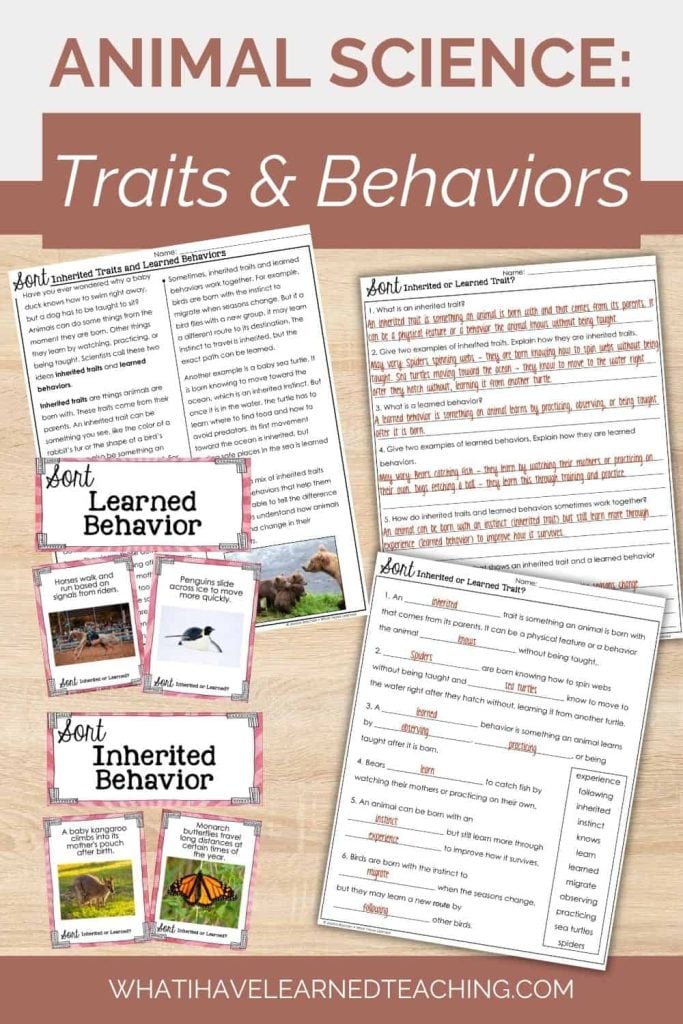
Inherited Traits vs. Learned Behaviors: Quick Examples
Inherited traits (the animal was born with these):
- Eye color
- Body size
- Fur color and pattern
- Beak shape in birds
Learned behaviors (the animal developed these over time):
- A dog sitting on command
- Birds learning a migration route
- Chimps using sticks as tools
- A cat learning to use a pet door
Quick test: Ask “Was the animal born with it?” If yes, it’s an inherited trait. If the animal had to observe, practice, or be taught, it’s a learned behavior.
Below are 10 examples for each category, a comparison chart, and a classroom sorting activity.
What Is the Difference Between Inherited and Learned Traits?
The difference between inherited and learned traits is how they develop. Inherited traits are passed from parents through genes and are present at birth. Learned behaviors are developed after birth through experience, practice, or observation. Inherited traits come from genes, while learned behaviors develop through life experiences.
Key Vocabulary
Trait – A characteristic or feature of a living thing, such as fur color, eye color, or behavior.
Heredity – The passing of traits from parents to offspring through genes.
Gene – A unit of inherited information found in DNA that determines specific traits.
Inherited Trait – A characteristic an organism is born with that comes from its parents.
Learned Behavior – An action or skill developed after birth through experience or observation.
Environment – The surroundings and conditions in which an organism lives and grows.
Variation – Differences in traits among individuals of the same species.
Inherited vs Learned Traits Comparison Chart
Inherited traits and learned behaviors both shape how animals look and act, but they develop in different ways. Inherited traits are passed from parents through genes and are present at birth, while learned behaviors are developed through experience, practice, or observation. The chart below highlights the key differences between inherited and learned traits in a clear, side-by-side comparison.
| Inherited Traits | Learned Behaviors |
|---|---|
| Passed from parents | Acquired after birth |
| Determined by genes | Developed through experience |
| Present at birth | Learned over time |
| Often physical features | Often actions or skills |
| Example: tiger stripes | Example: lion learning to hunt |
Inherited traits are determined by genes and present at birth. Learned behaviors develop after birth through experience.
Now let’s look more closely at each type of trait.
What Are Inherited Traits?
Inherited traits are physical characteristics or natural abilities passed from parents to offspring through genes. These are features or abilities an animal is born with, and they don’t need to be taught.
10 Examples of Inherited Traits
- A tiger’s stripes
- A rabbit’s long ears
- A bird’s beak shape
- A dog’s fur color
- A turtle’s hard shell
- A giraffe’s long neck
- A duck’s webbed feet
- A cat’s eye color
- A zebra’s stripe pattern
- A hedgehog’s sharp quills
These traits help animals survive in their environments. A giraffe’s long neck, for example, is inherited, allowing it to reach leaves high up in trees.
What Are Learned Behaviors?
Learned behaviors are actions or reactions that animals acquire through experience, practice, or observation. These behaviors are not encoded in their DNA; they are acquired after birth.
10 Examples of Learned Behaviors
- A young otter learning how to open clams from its mother
- A lion cub learning how to hunt by watching adult lions
- A dog learning to sit or roll over when given a command
- Birds adjusting their migration routes based on food or weather
- A bear learning where humans leave trash
- A chimpanzee using tools to gather food
- A parrot learning to mimic human speech
- A dolphin learning tricks through training
- A puppy learning where to go to the bathroom
- Wolves learning pack hunting strategies
Learned behaviors enable animals to adapt to their environment in ways that inherited traits alone may not accommodate.
Want to go deeper on just learned behaviors? My post on learned behaviors, their types, and examples covers the different ways animals learn, like imprinting and observation, plus examples in humans as well as animals.
How the Environment Influences Traits
Some traits are influenced by both heredity and environment. For example, a dog may inherit the ability to grow thick fur, but climate affects how thick that fur becomes. Similarly, animals may inherit instincts, but experience strengthens those behaviors over time.
For example, two plants may inherit the same genetic traits, but differences in sunlight, water, or soil can affect how tall they grow. In animals, inherited instincts may be strengthened or weakened by experience.
How to Teach Inherited Traits vs. Learned Behaviors in 3rd Grade
Mastering the difference between inherited and learned traits prepares students for a deeper study of genetics, variation, and environmental influence in upper elementary and middle school science.
1. Animal Sorting Activity: Create cards with animal pictures and actions, then have students sort them into “Inherited Trait” or “Learned Behavior” categories. For example, a baby deer standing shortly after birth is an inherited trait, but a dog fetching a ball is a learned behavior.
If you’d rather use a ready-made resource, the sorting activity below includes color sorting cards for table groups, a cut-and-paste option for individual practice, differentiated response pages, and an answer key. It’s designed for 3rd grade and aligned to NGSS 3-LS3.
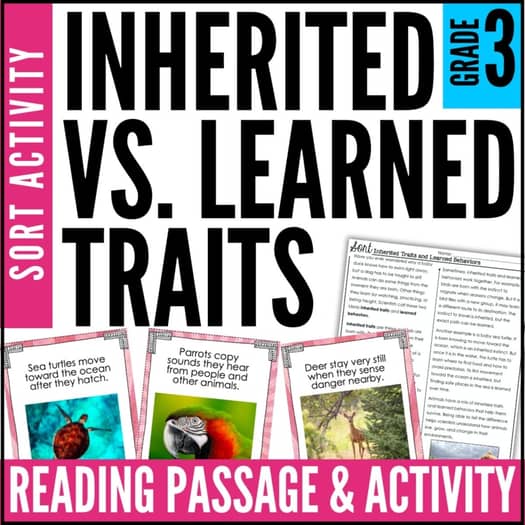
Help your students easily understand the difference between inherited traits and acquired behaviors with this engaging, hands-on sorting activity!
2. Class Discussion: Choose a familiar animal, such as a cat or dog. Ask students:
- “What traits was this animal born with?”
- “What things did it have to learn?”
3. Anchor Chart Creation: Work with your class to build a chart with two columns: Inherited Traits and Learned Behaviors. Add new examples throughout your science unit.
4. Short Research Project: Assign students an animal to study. Ask them to find one inherited trait and one learned behavior for their animal. Students can share findings through posters or short presentations.
5. Integrate Writing: Have students write a paragraph about an animal of their choice, describing one inherited trait and one learned behavior it exhibits.
Here’s another quick way to compare inherited traits and learned behaviors:
| Inherited Trait | Learned Behavior |
|---|---|
| Fur color in wolves | How wolves hunt in packs |
| Stripes on zebras | Migration paths learned by following older zebras |
| Webbed feet in ducks | Finding safe nesting spots |
Understanding the difference between inherited and learned traits helps students build a strong foundation in life science and heredity. These concepts prepare students for a deeper study of genetics, variation, and environmental influence in later grades.
Anchor Chart: Inherited Traits vs. Learned Behaviors
An anchor chart is one of the easiest ways to make this concept stick. A simple two-column layout works well: one column for inherited traits and one for learned behaviors. Here is what to include on each side:
Inherited Traits column
- Definition: passed from parents through genes, present at birth
- Key question: “Was the animal born with it?”
- Examples: tiger stripes, bird beak shape, duck webbed feet, rabbit long ears
- Often physical features
Learned Behaviors column
- Definition: developed after birth through experience, practice, or watching others
- Key question: “Did the animal have to learn it?”
- Examples: lion cub learning to hunt, dog learning sit/stay, otter learning to open clams
- Often actions or skills
Post the chart at the start of the unit and add student-generated examples throughout the week. By the end of the unit, students can point to animals on the chart and explain their reasoning, which is exactly the kind of evidence-based thinking that NGSS 3-LS3-1 asks for.
Jessica BOschen
Jessica is a teacher, homeschool parent, and entrepreneur. She shares her passion for teaching and education on What I Have Learned. Jessica has 16 years of experience teaching elementary school and currently homeschools her two middle and high school boys. She enjoys scaffolding learning for students, focusing on helping our most challenging learners achieve success in all academic areas.