
Expanded Form Multiplication: The Expanded Algorithm
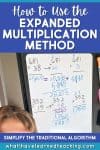
Expanded form multiplication, also called the expanded algorithm, gives students in grades 3 through 5 a way to work through multi-digit problems without getting lost in every step of the traditional algorithm. Instead of tracking the whole problem at once, students break numbers into their place values and multiply one part at a time, then add the partial products together. This post walks through the prerequisite skills, a step-by-step example, and a short video.

When my son was in third grade, he struggled with multi-digit multiplication. The multiplication problems had too many digits, and the traditional algorithm was too complicated for him to keep track of all of the pieces. I simplified the process for him by using the expanded multiplication method.
Here is how we used the expanded multiplication method and place value strategies for multi-digit multiplication.
What Is the Expanded Algorithm for Multiplication?
The expanded algorithm for multiplication, also called expanded form multiplication or the expanded multiplication method, is a strategy where students break one or both numbers into their place values and multiply each part separately. Rather than working through the traditional algorithm all at once, students handle one piece at a time and then add the partial products together at the end.
This approach works especially well for students in grades 3 through 5 who are overwhelmed by the traditional algorithm. It makes the multiplication visible and keeps the place value thinking front and center throughout the problem.
Prerequisite Skills for Expanded Multiplication
Students need a solid understanding of a few skills before successfully using the expanded multiplication method.
Students need to be able to:
- Write numbers in expanded form
- Multiply multi-digit by one-digit numbers (eg, 345 x 3)
- Multiply a multi-digit number by tens and hundreds (eg, 345 x 40 or 345 x 300) using quick place value strategies. Understanding WHY those quick strategies work is beneficial, although just functional knowledge is sufficient.
- Line up numbers when adding larger numbers
Writing Numbers in Expanded Form
Writing numbers in the expanded form is a fundamental skill that lays the foundation for performing expanded-form multiplication. It involves breaking down a number into its digits and expressing each digit in terms of its place value.
For instance, 147 is 100 + 40 + 7.
Multiply a Multi-Digit Number by Tens and Hundreds
Students must understand how to multiply a multidigit number by tens and hundreds using the zero placeholder in their answers.
For instance, students must know how to solve 178 x 30 using 0 as a placeholder as a shortcut.
Line Up Numbers when Adding
Since the calculations will result in larger numbers, students must be able to line up the digits when adding large numbers.
For example, students must be able to line up 13,437 and 2,467 when adding vertically.

How to Solve Math Problems Using the Expanded Multiplication Method
Here’s a step-by-step look at the process exemplified by his work:
- Breaking It Down: Begin by expanding one number. In the example above, 38 is expanded into 30 (or 3 tens) and 8 (or 8 ones).
- Multiplication in Parts: Multiply 681 by 30 (or 3 tens), placing the result, 20,430, neatly below the problem. Then, multiply 681 by 8 (the ones place) and write down 5,448 under that problem.
- Combining the Parts: Carefully add these two products together. The sum of 20,430 and 5,448 is 25878.
The expanded multiplication method works especially well for students who benefit from visual aids and a clear, step-by-step path through complex problems.
Here is another example of this method.

Video of Expanded Multiplication
Here is a video of multiplying a three-digit number by a two-digit number using this method.
Why use the Expanded Multiplication Method?
The expanded multiplication method helps simplify the traditional algorithm and has other benefits.
Building Blocks for Larger Calculations
As students progress in mathematics, they encounter increasingly large numbers and more complex problems. Being comfortable multiplying by tens and hundreds using the expanded method prepares them for these challenges, enabling them to break down and simplify these larger problems.
Enhances Mental Math Skills
This strategy aids in developing mental math skills. Understanding how to multiply by tens and hundreds efficiently allows students to perform calculations more quickly and accurately in their heads. This skill is useful both in academic settings and in everyday life.
Understanding of Mathematical Properties
This method introduces students to the distributive property of multiplication, a fundamental principle they will use throughout their mathematics study. By expanding numbers and multiplying them in parts, students see how multiplication can be distributed to simplify problems.
Preparation for Algebra
The expanded multiplication method lays the groundwork for algebraic thinking. It teaches students to manipulate and break down numbers in ways that are analogous to working with algebraic expressions.
Confidence with Numbers
Mastery of these concepts builds confidence. Students who are comfortable multiplying large numbers feel more confident in their math skills overall, which can lead to better performance in math and a more positive attitude toward the subject.
The ability to multiply multi-digit numbers by tens and hundreds using the expanded method not only strengthens students’ understanding of basic arithmetic but also sets the foundation for more advanced mathematical concepts. If you have students struggling with the traditional algorithm for multiplying multi-digit numbers, consider using the expanded multiplication method to simplify the problems.
Jessica BOschen
Jessica is a teacher, homeschool parent, and entrepreneur. She shares her passion for teaching and education on What I Have Learned. Jessica has 16 years of experience teaching elementary school and currently homeschools her two middle and high school boys. She enjoys scaffolding learning for students, focusing on helping our most challenging learners achieve success in all academic areas.