
What is the Difference Between Decodable Text and Predictable or Patterned Text?
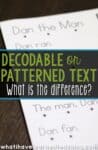
When you sit down to plan what you’re teaching for your small group reading instruction, how do you decide the kind of text you are putting in front of your students? In making an informed, strategic decision about the type of text to use in the classroom, it is helpful to understand the difference between decodable text and predictable or patterned text.
What are the key attributes of each type of text, when should you use them, and how should you use them in your classroom?

Early readers need a lot of exposure to text. There is no doubt about that. The kind of text you primarily use with students will be based on many factors, including what you have readily available in your classroom, your personal philosophy on early reading instruction, and the focus of your school district. Both decodable and predictable text are controlled for certain reading features, but they are controlled for two different purposes.
The type of text early readers are exposed to needs to be easy enough for them to read. It will be controlled for something, whether the phonics pattern, the sight words, or the sentence structure. Students need to feel successful and motivated when reading a text because they are applying the reading skills you have taught them. Controlled text helps students succeed at reading by giving them small chunks of text they can read.
Early readers encounter three types of text: decodable text, predictable or patterned text, and sight word text. Below, I will discuss decodable and predictable or patterned text in depth because they are most prevalent in our classrooms today. For the most part, the definitions and attributes of decodable and predictable or patterned texts are in the names themselves.
What is Decodable Text?
Decodable text is, well, decodable (duh). It is controlled for different phonetic sounds and follows a general scope and sequence. Each decodable text has a specific phonetic pattern that is clearly identifiable and repeated. Students read the text to practice the phonics pattern for mastery. The same phonics patterns are repeated over and over again in the same text or within a set of texts that give students ample practice in the phonics pattern.
Decodable text can focus on word families or specific sounds. For instance, students could read decodable text that focuses on the -at family or the -en family of words. Most of the words in the text will match that phonics pattern. Likewise, a decodable text could also focus on words spelled with -oi and -oy. There may be a variety of other letters in the words, but they all have the same sound pattern.
The main point is that decodable text is controlled for the phonics pattern in the text.
Here is an example of a decodable text:
Pat sat on the mat.
The fat cat sat.
Pat and the cat sat.
Can you pick out the decodable words vs. the sight words?
What is the purpose of Decodable Text?
The purpose of decodable text is to give students a lot of practice with specific phonics patterns. Ideally, the newly taught phonics pattern will be emphasized heavily while the previously taught phonics patterns are reviewed throughout the texts. Decodable text shows students that sounds can be put together to form words.
Decodable text should be used during small group instruction to provide practice for students to read by sounding out the words. It is the application of the phonics that has been taught.
Most decodable text does not have a lot of meaning. Often, when put together, the sentences may have a thread of similarity and are related, but comprehension is not the focus of decodable text. Yes, you can ask some comprehension questions about the text because of that thread of meaning, but the majority of time within your small group is spent reading the text and sounding out the words.
What about sight words? Decodable text does have sight words. However, the words used in these texts are usually only the most common sight words with irregular spellings. The focus is on decoding, not memorizing. The text has few sight words necessary to link the words together. Also, decodable sight words are generally not taught as sight words. For instance, “in” may not be taught as a sight word because it is decodable.
Decodable texts teach students to depend on sounding out words and their first approach. When students encounter a word they don’t know, they will first try to sound it out.
Should decodable text include comprehension questions?
Maybe. It depends on the ability of the text to hold content. Most decodable text is written to practice specific phonics patterns. As such, it is very difficult to create a well-written story and thus to ask good comprehension questions. You’re not getting much depth of thinking when you work on comprehension with decodable text, so in a way, it could be a waste of time.
Picture a see-saw in your head. Do you remember how a see-saw works? One side is up and one side is down. Now, picture the see-saw with one side focused on comprehension and the other side focused on developing phonics skills. When the phonics side is down, your focus is on teaching students to decode words and learn the alphabetic patterns in our phonics system. The focus is not comprehension. It may be a by-product or something you can tack onto the end of your lesson. However, the majority of your time should be spent on developing phonics skills.
Now, picture the comprehension side of the see-saw being the focus. When you focus on comprehension, decoding can be a barrier to students making connections between the ideas in a story or the facts in a book. They spend too much time decoding and don’t hold onto the meaning of the words.
What is Predictable or Patterned Text?
Predictable or patterned text at the early level repeats the same sentence pattern multiple times with one or two changes in each sentence. Often this small change is represented by a picture. Each predictable text has a different pattern for the student to read and the pattern is generally above the student’s phonetic reading level.
What is the Purpose of Predicable or Patterned Text?
The purpose of predictable or patterned text is to give multiple repetitions of words and phrases so that students memorize the patterns and can predict the picture clue. The picture clue at the end of the sentence relies heavily on context where students must use the sentence pattern and the picture to decipher the word.
What do students learn to do with predictable or patterned text? Students learn to memorize a sentence structure and learn to use context clues to figure out a picture. Patterned text teaches students to read and comprehend by memorizing words within a sentence pattern and looking at a picture. Students do not learn to sound out words using patterned text, but to memorize and look for context. Does that mean that phonics isn’t taught? No. Phonics could be taught at some point during the day, but the phonics skills that are taught are not necessarily practiced while reading predictable or patterned text.
Because of the heavy emphasis on context, which includes vocabulary and sentence structure, English learners often have difficulty reading patterned text. Although they can memorize a sentence pattern they may have difficulty predicting or figuring out picture clue.
Predictable or patterned texts teach students to use context to figure out words. When students encounter an unknown word, they will try to figure out the word using context. Students may use the initial consonant or a part of the word and then guess the rest of it. Or they may use the words around it to figure out the unknown word.
What are sight word texts?
There is one more type of text that young readers may encounter at school. Sight word texts have a lot of high-frequency sight words. The sight words are taught to students and then students use the text to practice reading the words. Sight word texts aren’t used too much in classrooms today, but they were popular 30 years ago (or more!)
Here is an example of a sight word text:
Look there!
Can you see it?
I can see it, too.
Come see with me.
What kind of text should you use in your classroom?
The decision about which type of text to use in your classroom must be made within the context of your classroom. You may have one kind of text available to you, which would make planning and teaching much easier. Or maybe your district assessment matches one type of text. Then there is your teaching philosophy. Which type of text matches the way you want to teach?
A couple years ago, I was at a school that didn’t have phonics readers available for me to use during small groups, however, we had a whole library full of predictable text. So, what did I use? I used what I had available to me. In this district, our assessment was also based on a predictable text, so my instruction had to align with the assessment as well.
Research has shown that, while good for teaching comprehension strategies and print concepts, predictable text does not help students develop decoding strategies. Research also shows that context is not a consistent and dependable strategy to use when figuring out unknown words. It works within the predictable text, because they’re controlled text, but in real-world books, context often does not work as a reading strategy. Should context never be taught? I’m not saying that. But, I do believe that a student’s first approach to a word they can’t read should be phonics.
What is the main difference between decodable and patterned or predictable text? Decodable text matches your phonics instruction and gives students practice sounding out words. Predictable or partnered text teaches students to memorize a pattern and look for context clues to figure out unknown words. It does not match your phonics instruction.
What it comes down to is the skills you are teaching students. How do you want them to attack an unknown word? What do you want them to do first? Do you want students to try to sound it out using the phonics skills you have taught or do you want students to use context to figure out the word? The text you use with students during your small group reading instruction will influence how students read words.
What do you want your students to do when they come to an unknown word?

If you’re interested in some decodable readers that are highly controlled for phonics pattern and sight words, check out these Phonics Readers (available on my website and on TpT). There are three stories per word family and each story has a practice page with phonics and sight word practice. They’re a great resource for small group reading or to send home to parents.
Do you want to try out my Blending Cards? Pick up the Short A set by signing up below.


A great read! I am currently switching to using decodable texts rather than predictable with my kinder class which has a very high percentage of non English speaking students. How do record your reading with students? The recording sheets I have are more suitable for predictable texts with behaviours I’m looking for listed down one side as a guide. I am new to the decodable reading world and am trying to put the puzzle pieces together.
Great questions! For informal readings with students, I tend to use a plain piece of paper and record checks for words correct and record errors as they occur. My checks mimic the text the student is reading, so if a line has 5 words, my paper would have 5 checks that mimic that line. That way, I can go back and reference the text as needed.
This gives me a good indication if the text is too difficult for the student and lets me know which phonics patterns we still need to work on. Plus, I always have a blank piece of paper handy!
Do you sell the text itself so I can adjust it to my students needs .
I sell decodable texts for CVC Words and Short Vowels. They are not editable.
Wonderful read & insights.
Hi Jessica,
Can you please share the research behind this quote:
“When planning your lessons, decide to focus on that one thing. Let the other be a by-product, but don’t focus on both decoding and comprehension at the same time.”
Since we have 70 years of research to base our decisions on now, I am only implementing new ways of doing things in my classroom if there is research to prove it is a better way.
Thanks for your insight & sharing what you have learned along the way!
mw
This is a concept of cognitive load. People can only concentrate intensely on one thing at a time. Do you remember trying to study for a subject in college and needing to really focus? If you’re intensely concentrating on something, you tune out all of the other things around you to absorb as much information as possible. Kids are the same way. They can concentrate on one thing at one time, if it’s a new concept. This does not mean that you don’t teach comprehension, but that you do it at a separate time than you are teaching decoding, even if that time is a few minutes later. You can ask comprehension questions of a decodable text that has just be read, but finish the teaching and learning of the phonics skill first, then move onto the comprehension. The idea is to focus on one area at one time.