
How to Create a Classroom Daily Schedule for Elementary Students

Setting up your classroom daily schedule at the start of the year is one of those tasks that sounds manageable until you’re actually doing it. You have reading, math, writing, science, social studies, specials, recess, lunch, transitions, and whatever else your school requires — and somehow it all has to fit into six hours.
The good news is that a solid daily schedule doesn’t have to be built from scratch every year. Once you understand the key decisions to make and how to structure your blocks, the process gets much easier. This post walks through how to build a daily schedule for your elementary classroom, what to prioritize, and how to create something flexible enough to actually survive contact with a real school day.
How to Make a Daily Classroom Schedule
Start by mapping out the non-negotiables: arrival, reading block, math block, lunch, recess, specials, and dismissal. These anchor points determine everything else. Once you know when your fixed commitments land, you can fit writing, science, social studies, and any additional blocks into the remaining time.
Protect your reading and math blocks first. These are your two longest and most cognitively demanding subjects, and they work best when scheduled during peak attention hours — typically mid-morning for most elementary students. Schedule specials and lunch around them rather than the other way around.
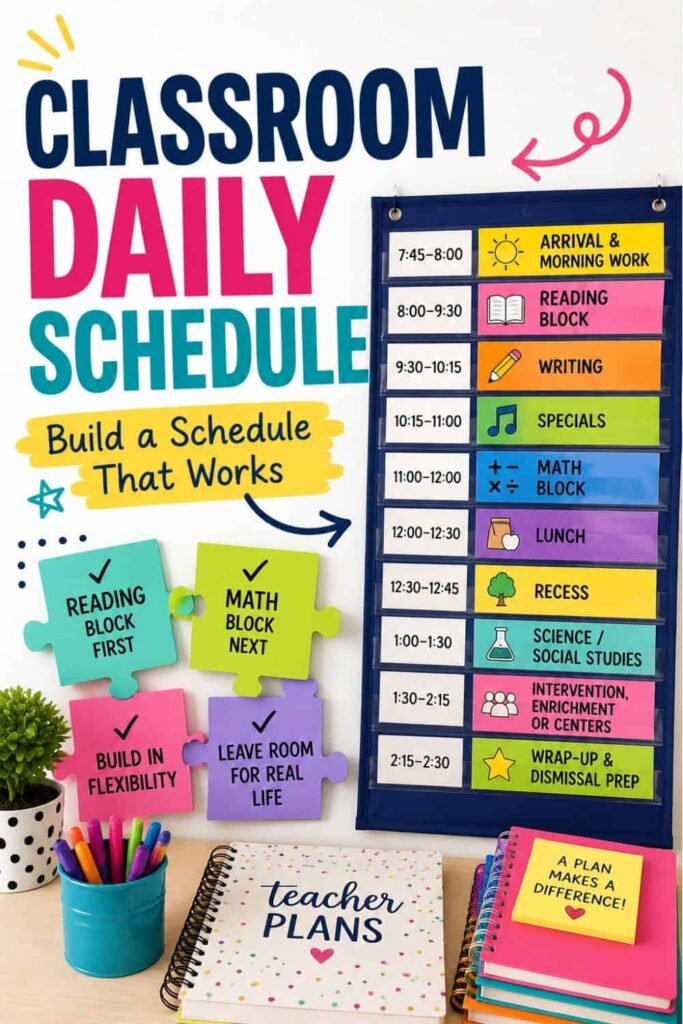
A simple starting framework for an elementary classroom daily schedule might look like this:
- 7:45–8:00 — Arrival and morning work
- 8:00–9:30 — Reading block (including small group time)
- 9:30–10:15 — Writing
- 10:15–11:00 — Specials
- 11:00–12:00 — Math block
- 12:00–12:30 — Lunch
- 12:30–12:45 — Recess
- 1:00–1:30 — Science or social studies
- 1:30–2:15 — Intervention, enrichment, or centers
- 2:15–2:30 — Wrap-up and dismissal prep
Your school’s fixed specials and lunch times will shift these blocks, but the principle stays the same: reading and math get the best hours, everything else fits around them.
A predictable schedule is also one of the most underrated tools for classroom management. When students know what comes next, many transition problems disappear on their own.
Questions teachers can consider when crafting their daily routine
- What are the mandatory activities? Identify the non-negotiable activities that are predetermined for you, like lunch and recess that must be included in the schedule.
- Which subjects require the most focus? Consider the subjects or topics that need extra time or concentration. Should these be scheduled for when students are most alert?
- When are students most active and attentive? Some students may be more energetic in the morning, while others may peak in the afternoon. How can your schedule accommodate these differing energy levels?
- How much time is needed for transitions between activities? Avoid rushing from one activity to another by allocating enough time for smooth transitions.
- How can you incorporate breaks? Breaks are essential for helping students reset and absorb information. How many breaks are needed, and when should they occur?
- What kind of activities can you include for diverse learners? Consider the different learning styles in your classroom. How can your schedule incorporate activities that cater to these varying needs?
- Is there room for flexibility? Unforeseen circumstances or special events may require changes to the routine. Does your schedule allow for such adjustments?
- How will you communicate the routine to students? A well-understood routine is a followed routine. How will you ensure students are aware of and understand their daily schedule?
- Are there opportunities for student input? Including students in the planning process can foster a sense of ownership and responsibility. How can you involve students in shaping the daily routine?

Focus on Student Engagement
Create schedules that allow for maximum student engagement. This can look like collaboration among students, providing choices and varying how students interact with one another. By enabling students to work together on projects, participate in group discussions, and even lead their own peers, they can take ownership of their learning in a whole new way.
Consider incorporating activities that allow students to move around and use different learning styles, such as hands-on experiments or interactive games. Keeping students engaged and interested in the lessons makes them more likely to retain the information and enjoy learning.
Build in Flexibility, Downtime, and Consistency
Learning doesn’t always go as planned. Unexpected events and changes in the curriculum can throw off even the most organized and well-planned lessons. It’s important to build flexible structures to accommodate these changes.
At the same time, building in downtime throughout the day gives your students short periods of time to decompress. This is especially helpful after a lesson that uses a lot of brain power.
Consistency is key—students thrive when they know what to expect. However, be flexible in adjusting the routine to meet the unique needs of your students and to accommodate special events or unexpected situations.
Tips for Creating a Consistent and Flexible Classroom Schedule
- Use of Small Groups or Partners: Divide students into small groups based on their learning styles, interests, or skill levels. This allows for targeted instruction and fosters collaboration among peers.
- Implementation of Centers: Set up various learning centers around the classroom. Each center can focus on a different subject or skill, allowing students to rotate between them. This provides a variety of learning experiences and caters to different learning styles.
- Incorporation of Brain Breaks: Allow for short breaks in between lessons or activities to give students a chance to refresh their minds and bodies. This can include stretching, dancing, or even mindfulness exercises.
- Buffer Time at the End of the Day: Designate a time slot at the end of each day for students to complete unfinished work, seek help, or explore areas of interest. This ensures that no student is left behind and caters to individual learning paces.
- Begin the day with morning work or journal activity: This allows students to ease into the day and have a quiet, focused activity while you take attendance and prepare for the day’s lessons.
- Incorporate Specials and Enrichment Activities: Include time slots in your schedule for special classes such as art, music, or physical education. These subjects are just as important as academic ones and should not be treated as optional or easy to skip. Build them in as fixed anchors, the same way you would reading and math.
- Flexible Seating Arrangements: Incorporate different seating arrangements in your classroom. This can range from traditional desks to informal arrangements with cushions or standing desks. This provides a comfortable learning environment and can be adjusted based on the activity or lesson.
- Tech-Enabled Learning: Leverage technology to create flexible learning experiences. This could include educational apps, online platforms, or interactive whiteboards. This allows for personalized learning and can adapt to the pace and preferences of each student.
- Differentiated Instruction: Tailor your teaching to meet the unique needs of each student. This can involve differentiating content, process, product, or learning environment based on student readiness, interest, or learning profile.
- Student-Led Learning: Allow students to lead their learning by setting goals, choosing activities, or leading discussions. This fosters autonomy and responsibility.
A classroom daily schedule is one of the most practical tools you have for making the school year run smoothly. When students know what to expect, transitions get easier, behavior improves, and you spend less time managing the day and more time teaching.
It will take some adjusting in the first few weeks, and that’s normal. Build in the flexibility to shift things when they’re not working, and don’t be afraid to ask your students what’s working for them, too. The best schedules are ones that get tweaked, not ones that stay perfect on paper.

Thank you for sharing your schedule. Looking at how other teachers organize their time really helps me.
Cheryl
KinderIrick