
Types of Landforms Sort: Building Up or Eroding for 2nd Grade
Teaching second graders about weathering and erosion can feel abstract — until students are physically holding cards showing the Grand Canyon, Mount Everest, and a river delta, deciding for themselves which forces shaped each one.
This Types of Landforms Sort is a hands-on science station that brings Earth’s systems to life for 2nd graders, asking them to think critically about whether each landform is being built up or worn away. It’s part of the Shape of Our World Science Stations unit, aligned with NGSS 2-ESS1.C and 2-ESS2.A.
What Students Learn about Weathering & Erosion
Students read a short informational passage before sorting, giving them the background knowledge they need to make sense of the cards. Key concepts covered include:
- Landforms are natural features on Earth shaped by forces from inside and outside the planet
- Earth is made of layers: inner core, outer core, mantle, and crust
- The crust is broken into plates that move because they float on the mantle
- Moving plates build up landforms like mountains, volcanoes, and ocean ridges
- Weathering breaks down rock and soil into smaller pieces over time
- Erosion carries those pieces away through wind, water, and ice
Types of Landforms Sort Activity Overview
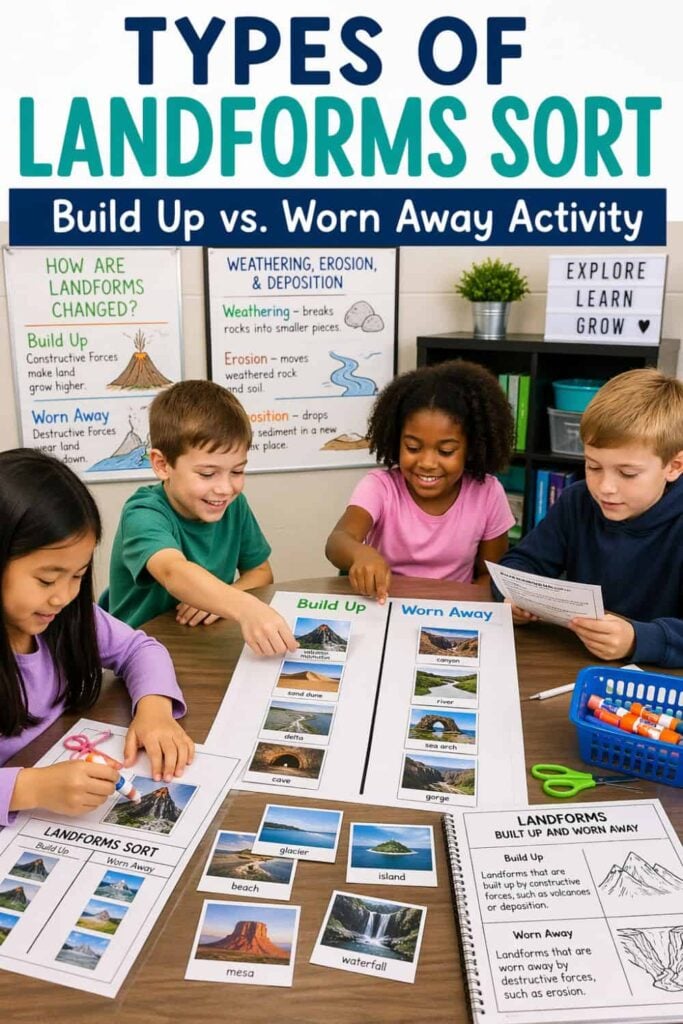
Students read the passage independently or with a partner, then sort 15 real-world landform cards into two categories: Build Up or Worn Away. Each card includes a photograph and a short description explaining the forces at work — from Mount Everest growing 4 mm per year as two plates collide, to the Grand Canyon carved slowly by the Colorado River, to Australian rocks shrinking over centuries from wind and water.
Materials needed:
- Directions card
- Sort cards (color version for table groups)
- Scissors and glue
- Response sheet
- Science journal (optional)
- Answer key
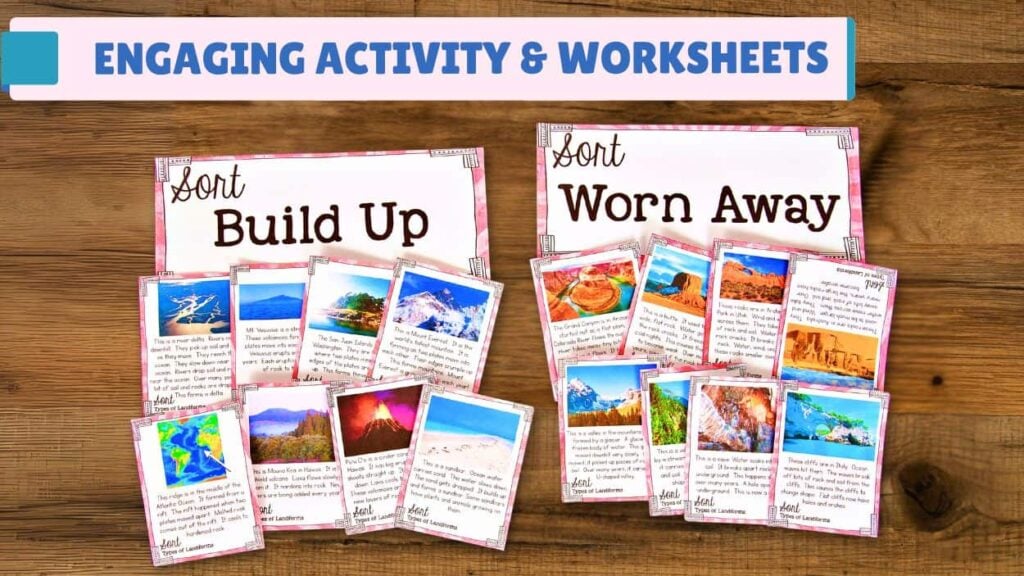
There are two ways to run the sort. For table groups, students use the full-color sorting cards and work collaboratively to place each landform. For individual practice, students use the black-and-white cut-and-paste version, cutting out each card and gluing it into the correct column on their response sheet. Both options work beautifully in a station rotation — or you can use the color sort as a whole-class introduction before students complete the cut-and-paste independently.
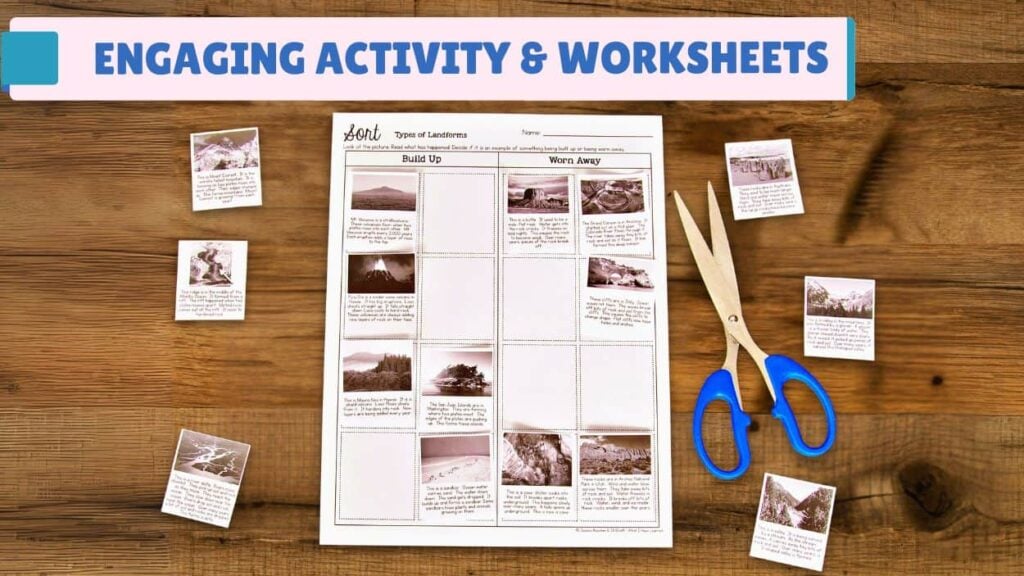
A Google Slides version is also included, with the reading passage and digital sort cards. The Google Form provides the differentiated questions in a digital format, making this activity easy to assign in Google Classroom.
Student Sheets and Questions
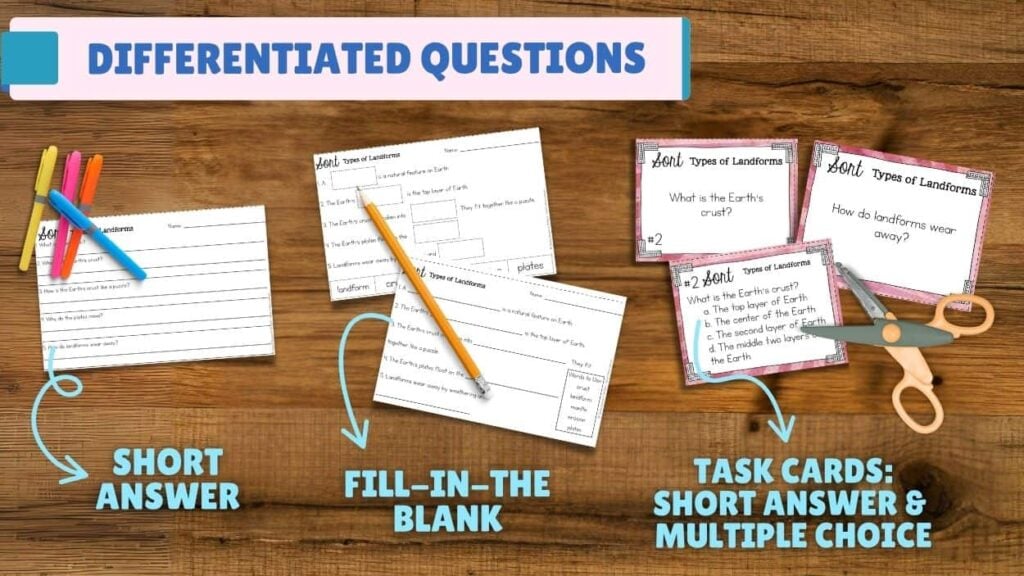
After sorting, students respond to questions in one of three differentiated formats — you choose which best fits your students:
The short answer asks students to respond in their own words to five questions, including “What is a landform?” What is the Earth’s crust? How is the crust like a puzzle? Why do plates move? How do landforms wear away? This format works well for students who are ready to write independently and explain their thinking.
Fill-in-the-blank gives students the same five questions with a word bank (landform, crust, plates, mantle, erosion). This is a strong scaffold for students who understand the concepts but need support with written expression.
Multiple-choice task cards present each question with four answer choices. These are great for small-group discussion or as a quick individual check-in — students can respond on task cards or in their science journals.
All three formats cover the same five key questions, so you can easily mix and match within a class.
What This Looks Like in the Classroom
- Set up the color sort cards at a table station during science rotations; students work in groups of 3–4 to discuss and sort while you pull small groups elsewhere
- Use the whole-class version as a shared experience first, then send students to their seats with the cut-and-paste version to sort independently and respond to questions
- Assign the Google Slides version in Google Classroom for students working at home or during a sub day — the digital sort cards make it fully self-contained
Why This Activity Works So Well
1. Real Photographs Make the Science Concrete
Every sort of card features an actual photograph of the landform described — Mount Everest, Arches National Park, the San Juan Islands, and Mauna Kea. Second graders aren’t sorting abstract concepts; they’re making decisions about real places on Earth. That connection to the real world is what makes the content stick.
2. The Reading Passage Builds Background Knowledge First
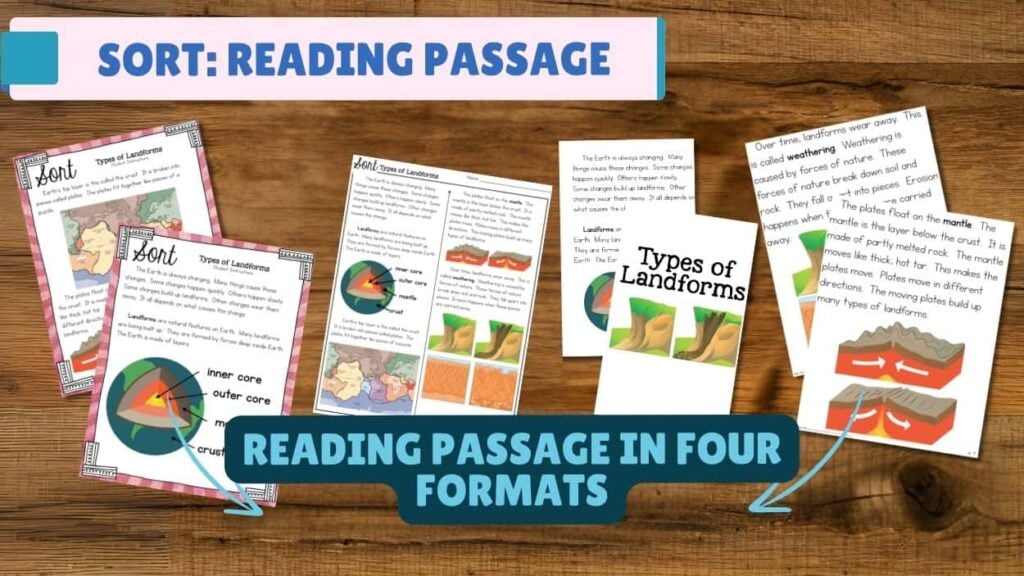
Students don’t just sort cards cold. The informational passage walks them through Earth’s layers, how plates move and build landforms, and how weathering and erosion wear them down. By the time they pick up the first card, they have a framework for making sense of what they’re seeing. This also gives the activity a strong literacy connection, supporting informational reading at the 2nd-grade level.
3. Vocabulary Is Embedded, Not Bolted On
Key vocabulary terms like landform, mantle, weathering, and erosion appear in bold throughout the reading passage. Students encounter them in context before they appear in the response questions, which means the fill-in-the-blank and short-answer formats actually reinforce word learning rather than just testing it.
4. NGSS Alignment Is Built In
This station directly addresses 2-ESS1.C (The History of Planet Earth), 2-ESS2.A (Earth Materials and Systems), 2-ESS2.B (Plate Tectonics), and 2-ESS2.C, along with ELA reading standards RI.2.1, RI.2.3, RI.2.4, RI.2.5, and RI.2.7. You’re not just doing a fun activity — you’re documenting standards coverage at the same time.
Easy Differentiation Ideas
For additional support:
- Pair the fill-in-the-blank response sheet with the word bank option so students can focus on understanding rather than recall
- Read the informational passage aloud as a group before students sort independently
- Use the QR code or MP3 link to play an audio recording of the reading passage for students who benefit from hearing it read aloud
For extension:
- Have students write a sentence explaining why they placed each card in their chosen category, using evidence from the passage
- Challenge students to find another real-world example of a landform being built up or worn away and describe it using the same language as the cards
- Ask students to rank the worn-away landforms from fastest to slowest process and justify their reasoning

Purchase this science station individually on TPT.
Bringing It All Together
By the end of this station, students can explain the difference between landforms that are being built up and those that are being worn away, name the forces responsible for each process, and connect real places on Earth to the scientific concepts behind them. It’s the kind of activity that generates real conversation — second graders are genuinely surprised that Mount Everest is still growing, and that the Grand Canyon is still being carved right now.
This activity is part of the Shape of Our World Science Stations for 2nd Grade.
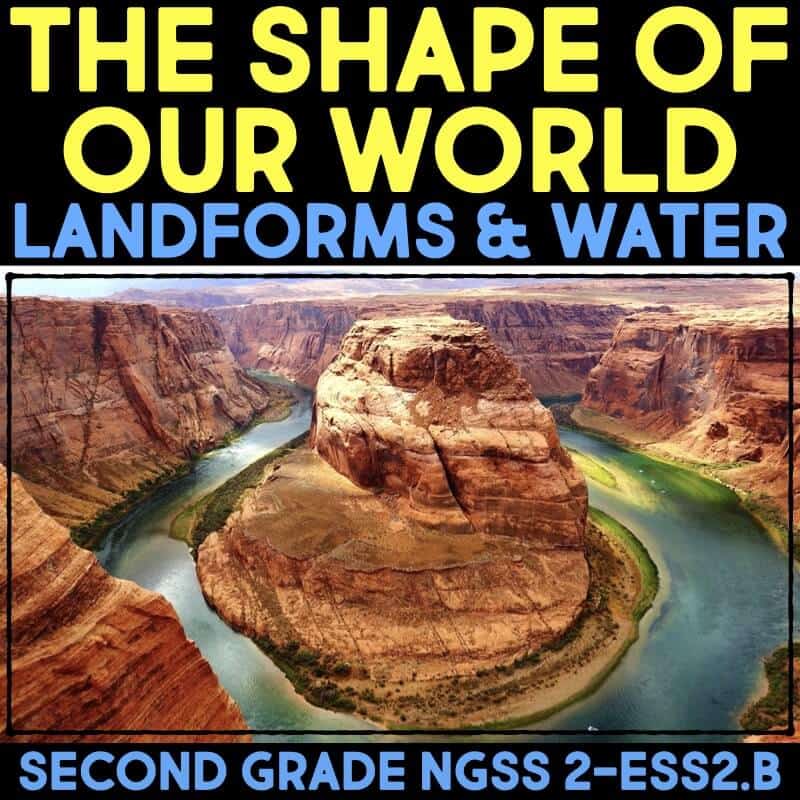
The Shape of Our World – Second Grade Science Stations
In this set of science stations, students learn how maps show where things are located and how to map the shapes and types of land and water in any area. It includes 8 different science stations where students deepen their understanding of maps, the globe, reading maps, plates, bodies of water, and landforms. All stations in this set meet the DCI 2-ESS2.B and incorporate ETS1.C.
Jessica BOschen
Jessica is a teacher, homeschool parent, and entrepreneur. She shares her passion for teaching and education on What I Have Learned. Jessica has 16 years of experience teaching elementary school and currently homeschools her two middle and high school boys. She enjoys scaffolding learning for students, focusing on helping our most challenging learners achieve success in all academic areas.