
Make Three-Digit Addition Click with Hands-On Puzzle Practice
Three-digit addition can be a tricky concept for students—especially when regrouping comes into play. Some students understand the standard algorithm but struggle to visualize why it works. Others can talk through the math but need more practice to build fluency.
That’s where these Three-Digit Addition Number Puzzles come in! Designed to support second and third graders, these puzzles help bridge the gap between abstract addition and concrete understanding—while keeping learning fun and interactive.
Whether you’re working in small groups, setting up independent math centers, or looking for review activities, these puzzles are a perfect way to reinforce key strategies.
What’s Included in the Three-Digit Addition Puzzle Set
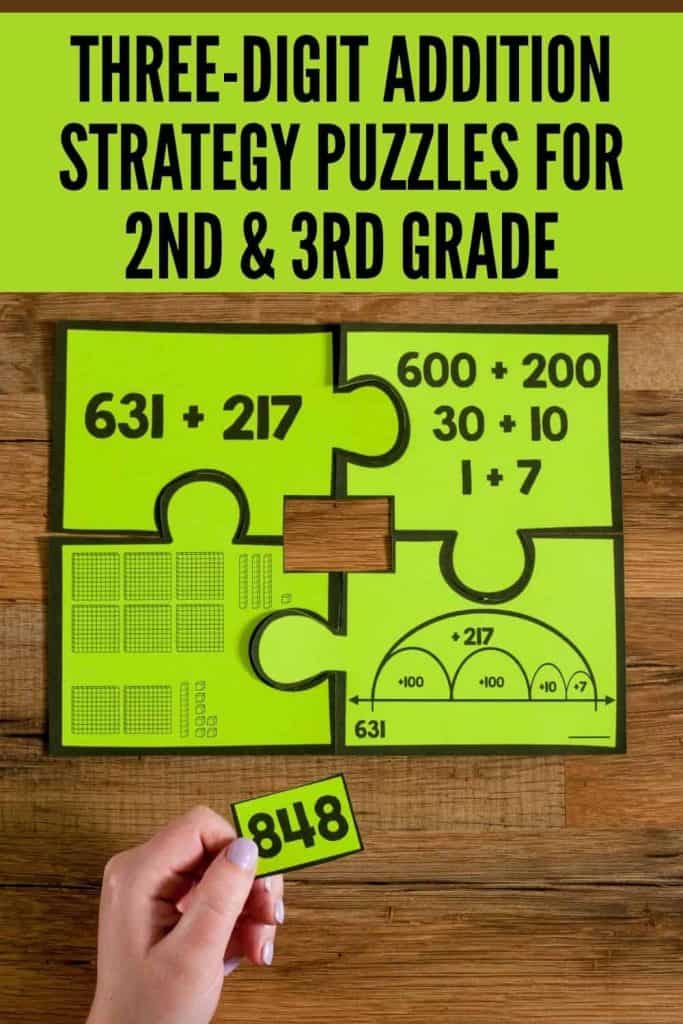
This no-prep math activity includes a variety of puzzle cards that challenge students to solve and match addition problems using different models and strategies. Here’s what you’ll find:
- Full-color puzzle cards featuring:
- Standard algorithm (e.g. 631 + 217)
- Expanded form (e.g. 600 + 200, 30 + 10, 1 + 7)
- Base-10 block representations
- Number line models for mental math
- Final sum
- Problems with and without regrouping so you can differentiate based on your students’ needs.
- 40+ complete puzzles covering a wide range of three-digit combinations
Each puzzle is made up of 5 pieces. Students must match all four representations correctly to complete the puzzle. It’s a great way to reinforce multiple methods of solving and deepen students’ understanding of place value.

Three-Digit Addition Number Puzzles Number Puzzles
These Number Puzzles for Third Grade engage students in solving problems using a variety of equations, models, and strategies. Most puzzles include a context, a model / drawing, an equation, and an “answer”.
👩🏫 Teacher Tips for Using the Addition Puzzles
Want to get the most out of your puzzle sets? Here are a few pro tips to make these math centers work smarter, not harder:
- Start simple. Begin by giving students just two puzzle pieces to match—like the equation and the base-10 blocks—before moving up to all four. This scaffolding builds confidence and understanding.
- Use whiteboard markers. If you laminate the puzzles, students can draw their jumps on the number line or jot down notes directly on the cards. It turns a printable into a reusable tool!
- Color-code your sets. Print each set on different colored cardstock to keep the puzzles organized by skill level or strategy. This makes cleanup easier and lets you differentiate on the fly.
- Keep an answer key nearby. Let students self-check their work by including a completed puzzle as a reference. It’s a great way to build independence without constant hand-raising.
- Turn it into a game. Time students or partners to complete a puzzle and challenge them to beat their best time. It adds a little excitement while reinforcing accuracy and fluency.

🎯 Classroom Differentiation Ideas
One of the best things about these number puzzles is how easily they can be differentiated. Whether you have students who need a little extra support or those who are flying through regrouping, there’s a way to make it work for everyone.
- No Regrouping First: Start students who are still learning the concept of place value with no-regrouping puzzles. Once they’re confident, introduce puzzles that require carrying over.
- Tiered Puzzle Sets: Group puzzles by complexity. Assign easier puzzles for review or intervention, and more challenging ones for enrichment or fast finishers.
- Strategy Focus Groups: Use the puzzles to target specific addition strategies. For example, one group may focus on base-10 blocks while another works on number lines or expanded form.
- Student Choice: Let students choose which puzzle type they feel most confident working with. Ownership builds motivation!
- Pair High/Low: Have students work in pairs, with one student strong in computation and the other in modeling or visualization. They’ll teach each other along the way!

How to Use These Puzzles in Your Classroom
These puzzles are super flexible and can be used in a variety of ways throughout your math block:
✅ Math Centers
Set out a few puzzles at a time in a center. Students can work independently or in pairs to match the cards and check each other’s reasoning.
✅ Small Group Instruction
Use these puzzles as guided practice with students who need a little extra support. You can even focus on just two or three representations at a time to target specific strategies like expanded form or number lines.
✅ Early Finishers
Keep your early finishers engaged and challenged by offering these puzzles as an extension activity. They’re self-checking and easy to manage.
✅ Interactive Bulletin Board
Create a giant puzzle wall! Display mixed-up puzzle pieces and let students match them during transitions or morning work time.
✅ Intervention or RTI
Because the puzzles break down strategies visually, they’re ideal for reteaching or reviewing with students who need more conceptual support.
Pro tip: Print on colored paper, laminate for durability, and store sets in labeled envelopes or plastic bags for quick grab-and-go use.
Why Teachers Love These Addition Puzzles
Teaching three-digit addition can feel overwhelming, especially when students come to you at different levels. These number puzzles give students multiple entry points—whether they’re visual learners, strong in computation, or still building their confidence.
They promote:
- Place value understanding
- Regrouping fluency
- Math talk and reasoning
- Hands-on engagement
And best of all? They’re low prep for you and high impact for your students.
Three-Digit Addition Number Puzzles Number Puzzles
These Number Puzzles for Third Grade engage students in solving problems using a variety of equations, models, and strategies. Most puzzles include a context, a model / drawing, an equation, and an “answer”.
Ready to Try Them?
You can grab the full set of Three-Digit Addition Number Puzzles in my Teachers Pay Teachers store and start using them right away. Whether you’re introducing regrouping, reviewing strategies, or differentiating your instruction, these puzzles are a classroom favorite you’ll come back to again and again.
Jessica BOschen
Jessica is a teacher, homeschool parent, and entrepreneur. She shares her passion for teaching and education on What I Have Learned. Jessica has 16 years of experience teaching elementary school and currently homeschools her two middle and high school boys. She enjoys scaffolding learning for students, focusing on helping our most challenging learners achieve success in all academic areas.