
How to Teach Sentence Fluency in Grades 2–5
If you’ve ever read a student’s writing and thought, “I can tell what they’re trying to say, but it just doesn’t sound right,” you’re noticing a sentence fluency problem. Sentence fluency is one of the core traits of strong writing, and it rarely improves on its own, no matter how much time students spend writing.
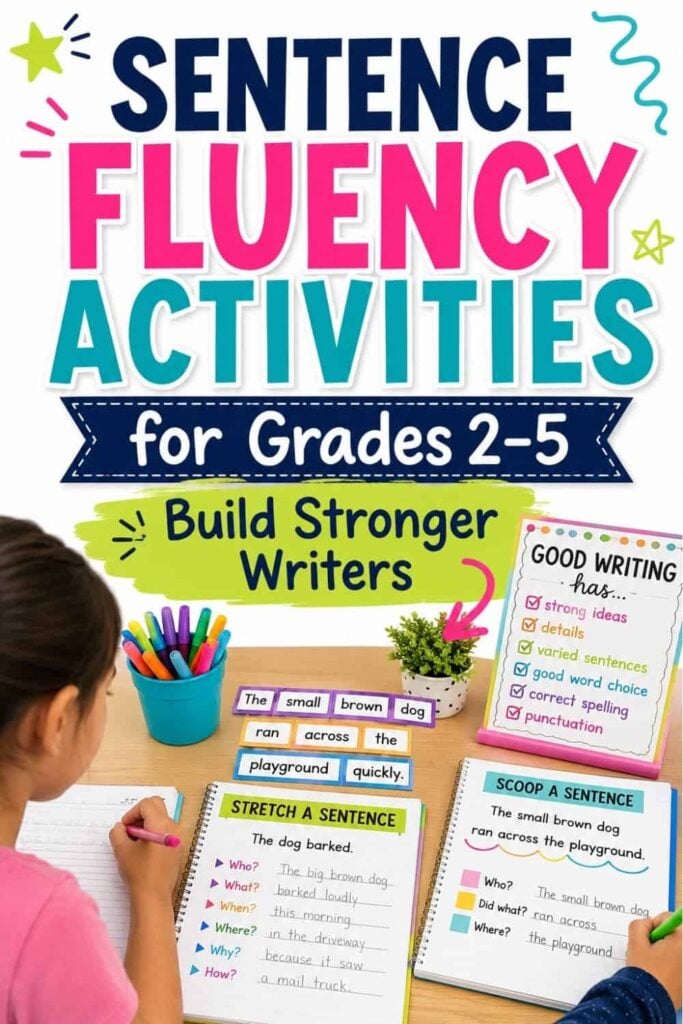
In this post, I’ll break down what sentence fluency really means, why students in grades 2–5 so often struggle with it, and which instructional strategies actually move the needle.
What Is Sentence Fluency in Writing?
Sentence fluency is the quality that makes writing easy to read aloud and easy to follow. Fluent sentences vary in length and structure, start in different ways, and carry meaning without feeling choppy or overloaded. It isn’t just about correctness. A sentence can be grammatically perfect and still feel flat.
In elementary classrooms, sentence fluency shows up when students read their writing aloud without stumbling, when a paragraph moves naturally from one idea to the next, and when the writing sounds like a voice rather than a list. It’s one of the six key traits in the six traits of writing framework, which identifies sentence fluency as a separate skill, distinct from grammar and word choice.
Sentence fluency is also not the same as sentence length. Longer isn’t always better. A short sentence placed deliberately can land harder than a long one. What matters is that sentences work together intentionally, and that each one carries its weight.
Why Students Struggle with Sentence Fluency
Most students struggle with sentence fluency, not because they lack ideas, but because they have never really examined how sentences work from the inside out. Writing time often jumps straight from brainstorming to drafting, with very little time spent analyzing what makes a sentence effective. When the goal is always to fill the page, the quality of individual sentences rarely improves.
Grammar instruction can make things worse when it stays disconnected from real writing. A student can correctly identify a noun on a worksheet and still have no idea how to use that skill when building a sentence of their own. Without direct instruction that connects grammar to sentence-making, students default to what feels safe: short, repetitive patterns. Or they swing the other direction and pile several ideas into one tangled run-on.
Here is what struggling sentence fluency often looks like across grades 2–5:
- Most sentences follow the same subject-verb pattern (“The dog ran. The cat slept. The bird flew.”)
- Sentences lack detail about time, place, or reason
- Ideas run together without punctuation
- The writing sounds choppy when read aloud
- Students rely on “and then” to connect everything
What Effective Sentence Fluency Instruction Looks Like
Sentence fluency improves when students spend focused time working directly with sentences. This is different from asking students to write more or revise more independently. It means slowing down and examining a sentence: what it says, how it is built, and how it could be stronger.
Effective instruction might look like reading a sentence aloud together and naming what makes it work, breaking a sentence into meaningful chunks to see how the parts relate, or revising a simple sentence with a specific goal in mind. These routines do not need to take more than five to ten minutes. What matters is that they happen consistently. Students need repeated exposure to sentence-level thinking before it becomes something they do on their own.
The key shift is moving away from the assumption that fluency will develop through independent writing alone. It doesn’t. It develops through instruction that makes sentence structure visible and gives students specific tools to use.
Two Sentence Fluency Strategies Worth Building Into Your Routine
Scoop a Sentence
Scoop a Sentence is a sentence deconstruction strategy where students group words into meaningful phrases, the way a fluent reader’s eye naturally moves across text. Rather than reading word by word, students learn to scoop the words that belong together, which helps them see how sentence parts work and why word order matters.
This strategy builds sentence fluency by making structure visible. When students can see that “the small brown dog” is a unit and “in the backyard” is another, they begin to understand how phrases contribute to meaning. Over time, that understanding transfers into their writing. They stop producing fragments and run-ons because they can feel where meaningful chunks begin and end. For a full explanation of how to use this strategy, this post on Scoop a Sentence walks through the routine in detail.
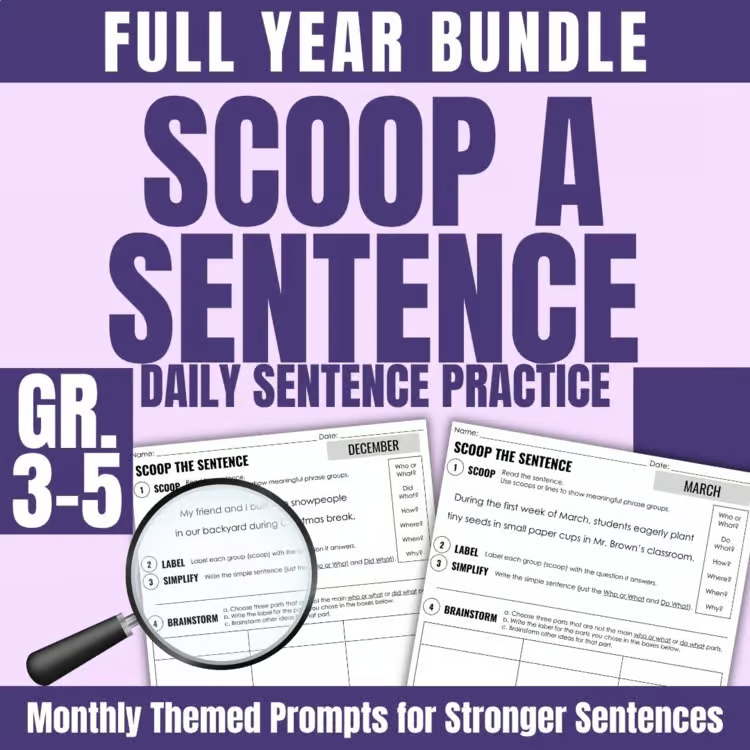
This yearlong Scoop a Sentence bundle provides engaging, seasonal activities that guide students step-by-step as they break down and rebuild sentences.
Stretch a Sentence
Where Scoop a Sentence teaches students to analyze and deconstruct, Stretch a Sentence teaches them to build. Students start with a simple two- or three-word sentence, such as “The dog barked,” and expand it by answering a set of guided questions: Who or what? Did what? When? Where? Why? How? The result is a sentence that carries real detail: “The big brown dog barked loudly at the mail truck in the driveway this morning because it was startled.”
More importantly, students learn to ask those questions themselves. Stretching becomes a revision habit, a way of looking at any sentence in their writing and asking what information is still missing. Stretch a Sentence works well across grades 2–5 because the complexity scales with the student. Second graders may stretch one sentence with a lot of teacher support; fifth graders can do it independently as part of a revision routine. For a full breakdown of how to teach this strategy by grade level, this post on how to teach stretch a sentence covers it in depth.
These two strategies work well together because they approach sentence fluency from opposite directions. Scoop a Sentence builds comprehension of how sentences work; Stretch a Sentence builds the production skills to write them. Used regularly, both help students develop the kind of sentence awareness that shows up across all their writing.

Stretch a Sentence Yearlong Bundle
Support students in writing stronger, more descriptive sentences with this Daily Sentence Stretching Bundle! With monthly themes and easy-to-use prompts, each worksheet guides students to expand a simple sentence using who, what, when, where, why, and how.
How Sentence Fluency Develops Across the Grades
Sentence fluency does not look the same in second grade as it does in fifth. Understanding the progression helps you set realistic expectations and target your instruction more precisely.
Second grade: Students are building basic sentence awareness, including what makes a sentence complete and how punctuation signals the end. Fluency instruction at this level means heavy modeling, sentence frames, and lots of reading aloud so students can hear the difference between choppy writing and smooth writing.
Third grade: Students are ready to start combining ideas and varying their sentence openings. Mini-lessons on starting sentences with a time phrase, a location, or a description, rather than always starting with the subject, give students new options without overwhelming them.
Fourth grade: The focus shifts to sentence variation within paragraphs. Students can practice writing a paragraph multiple ways and listen to which version flows better. Mentor sentences from published texts work especially well at this stage.
Fifth grade: Sentence fluency becomes a revision skill. Fifth graders can analyze their own writing for choppiness or repetition and revise with intention. They are ready to talk about style: when a short sentence is more powerful than a long one, and why.
Building a Sentence Fluency Routine That Sticks
Short, predictable routines do more for sentence fluency than occasional long lessons. Five to ten minutes of sentence-level practice each day, whether that’s reading a mentor sentence together, stretching a simple sentence as a class, or scooping a sentence from a shared text, builds the kind of familiarity students need to apply these skills in their own writing.
The goal is to make sentence thinking a normal part of your writing block, not a separate unit that appears once and disappears. When students regularly talk about how sentences work, they start to notice the same things in their reading and bring that awareness back to their writing. Consistency matters more than any single lesson.
Looking for a ready-made daily routine? The Sentence Stretching Yearlong Bundle includes monthly, theme-based sentence prompts with built-in brainstorming supports and grammar practice. It takes just a few minutes a day and builds sentence fluency across the full school year.
Stretch a Sentence Yearlong Bundle
Support students in writing stronger, more descriptive sentences with this Daily Sentence Stretching Bundle! With monthly themes and easy-to-use prompts, each worksheet guides students to expand a simple sentence using who, what, when, where, why, and how.
Final Thoughts
Teaching sentence fluency does not require longer writing blocks or complicated lessons. It requires consistent, intentional time spent working with sentences. When students learn to analyze, stretch, and rebuild sentences with purpose, those skills carry into every piece of writing they create. That is where strong writing starts.
Jessica BOschen
Jessica is a teacher, homeschool parent, and entrepreneur. She shares her passion for teaching and education on What I Have Learned. Jessica has 16 years of experience teaching elementary school and currently homeschools her two middle and high school boys. She enjoys scaffolding learning for students, focusing on helping our most challenging learners achieve success in all academic areas.