
Scoop a Sentence: A Reverse Sentence Stretching Activity for Building Fluency
Teaching sentence structure is tricky in elementary classrooms. Some students write short, bare sentences, while others create long run-ons that wander off course. Scoop a Sentence is a hands-on grammar and sentence fluency activity that helps students understand how sentences are built and how each part affects meaning.
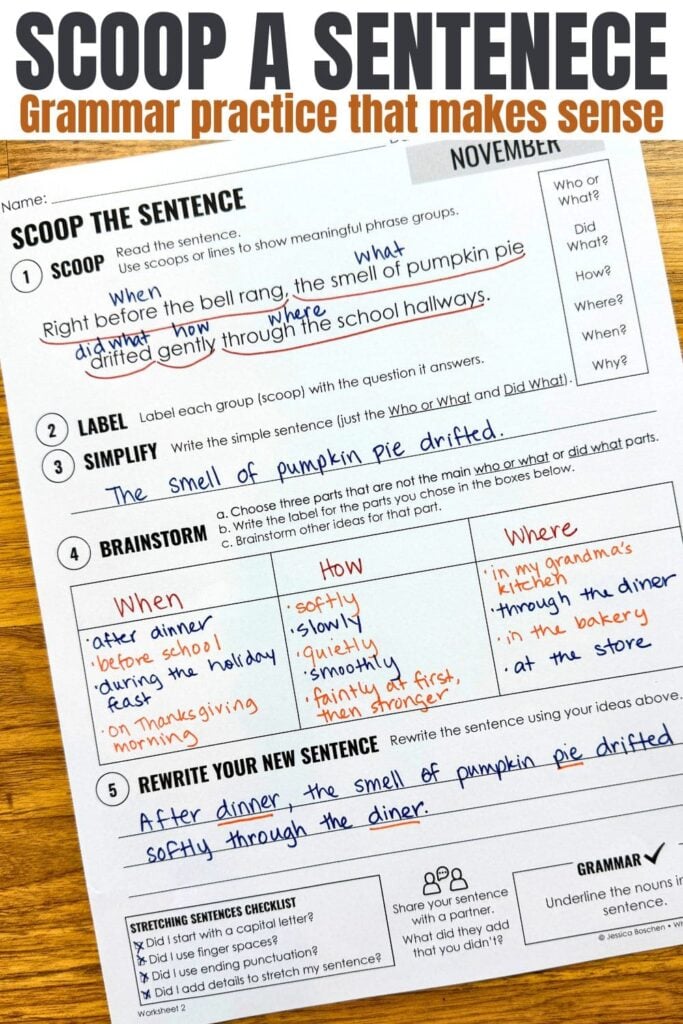
Instead of asking students to “write better sentences,” Scoop a Sentence shows them how sentences work. Students break apart a mentor sentence, label each phrase by purpose, simplify it, and then rewrite it with new details. This structured routine builds grammar awareness, sentence fluency, and confidence with sentence writing — all in a short daily format.
Whether used for daily grammar practice, writing warm-ups, or literacy centers, Scoop a Sentence makes learning sentence structure fun, visual, and easy to teach.
Scoop a Sentence Sentence Fluency Activity
Scoop a Sentence is a hands-on sentence fluency and grammar activity designed to help grade 3-5 elementary students understand how sentences are built. This daily sentence practice helps students organize ideas, improve sentence structure, and strengthen grammar skills in a clear, visual way.
Perfect for writing warm-ups, grammar lessons, or literacy centers, Scoop a Sentence gives students a repeatable routine they can use all year. By breaking sentences into meaningful parts and rebuilding them with purpose, students develop stronger sentence awareness that carries over into their writing, reading, and speaking.
What is a Sentence?
Scoop a Sentence is a sentence-building strategy that works in reverse of traditional sentence expansion. Students start with a complete mentor sentence and “scoop” words into meaningful groups based on what each part tells—such as who or what, did what, when, where, why, or how. Once the sentence is broken down, students simplify it to its core idea and then rebuild it with new details.
This reverse approach helps students see how sentence parts fit together before they try to write their own. By analyzing a well-written sentence first, students gain clarity about structure, phrasing, and purpose. The result is stronger sentence fluency and a better understanding of how small changes in wording can change meaning.
What’s Included in the Scoop a Sentence Resource
This activity flips your favorite Stretch a Sentence routine on its head. Instead of starting with a short idea and expanding it, students begin with a complete mentor sentence and break it down into meaningful parts. Then, they rebuild their own version step by step. It’s a perfect balance of structure and creativity—like sentence surgery, but without the scalpel.
Each Scoop a Sentence page includes everything students need for a quick, focused grammar and writing routine:
- A mentor sentence with seasonal or thematic vocabulary
- A “Scoop and Label” section to group words into meaningful chunks and label what they tell (Who or What? Did What? When? Where? Why? How?)
- A simplify box where students find the base subject and verb
- A brainstorming grid for generating new ideas to replace parts of the sentence
- A rewrite section for students to craft their own creative sentence
- A grammar task and checklist to reinforce conventions
- A partner share prompt to encourage discussion and oral language practice
Each month includes a fresh set of mentor sentences, so your students can build sentence fluency year-round while keeping lessons relevant to the season.
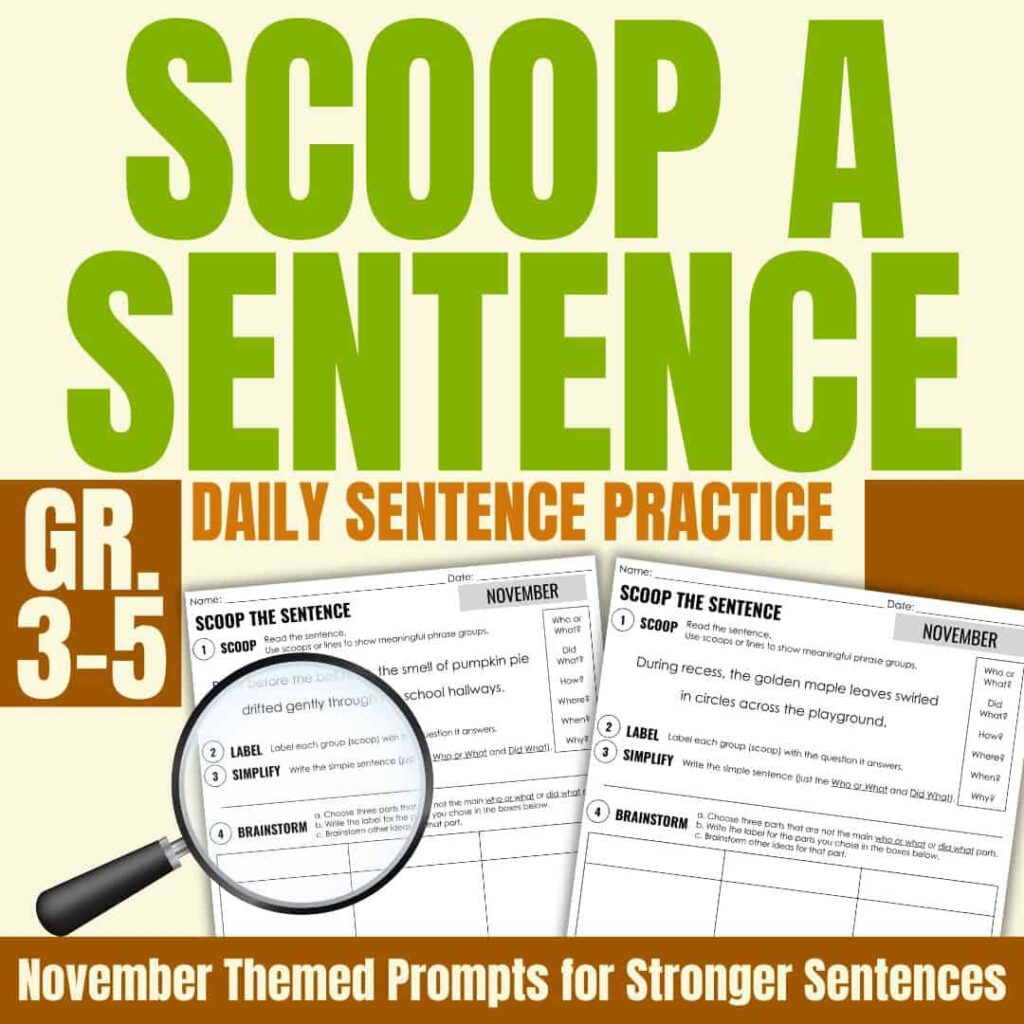
If you want to use Scoop a Sentence consistently without creating your own materials, the monthly Scoop a Sentence sets make it easy. Each month includes ready-to-use mentor sentences with seasonal themes, a consistent routine students recognize, and print-and-go pages that fit smoothly into daily grammar or writing time. These monthly sets are ideal for teachers who want a consistent sentence routine without having to plan new examples each week.
How the Scoop a Sentence Routine Works
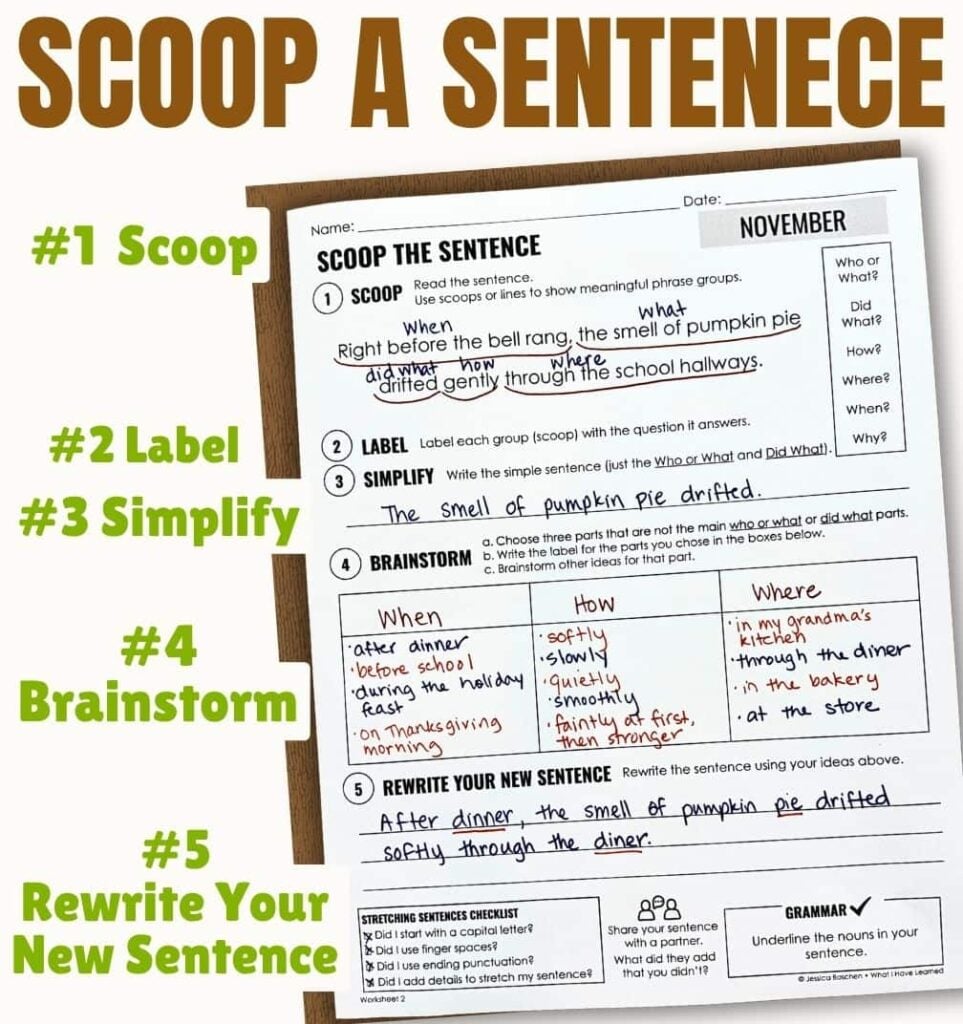
The Scoop a Sentence routine walks students through the entire process:
- Read & Visualize – Students read the sentence and picture the scene.
- Scoop & Label – They “scoop” groups of words that belong together and label each with the correct question.
- Simplify – Students write the basic “Who or What + Did What” version of the sentence.
- Brainstorm – Using the provided grid, they think of new “When,” “Where,” and “How” phrases to make their own version.
- Rewrite – Finally, students rebuild the sentence with their new details and share it with a partner.
It’s an easy-to-follow process that builds confidence while strengthening grammar awareness and writing fluency.
Why Teachers Use Scoop a Sentence for Grammar and Writing
Scoop a Sentence helps students:
- See how sentence parts fit together
- Understand what each phrase contributes to meaning
- Improve phrasing and rhythm when reading aloud
- Strengthen their understanding of grammar and syntax
- Transfer sentence-level skills into more complex writing
It’s a hands-on, visual, and repeatable routine that turns abstract grammar concepts into something concrete. Plus, students love it—especially when they realize how many ways one sentence can be rewritten!
Classroom Uses and Lesson Ideas
Here are a few simple ways to fit Scoop a Sentence into your day:
- Whole-Class Mini-Lesson – Model “scooping” a sentence under the document camera and color-code the parts.
- Small Group or Centers – Have students work together or independently to complete one page.
- Morning Work or Bell Ringer – A quick daily warm-up that reinforces syntax and grammar.
- Grammar or Fluency Focus – Highlight phrasing, rhythm, and how word order affects meaning.
- Homework or Independent Practice – Reinforce sentence structure at home in a low-stress way.
You can even pair Scoop a Sentence with your Stretch a Sentence activities to show how writers expand and refine ideas from both directions.
Pairing Scoop a Sentence With Stretch a Sentence
Scoop a Sentence and Stretch a Sentence work best when used together, since each supports a different part of sentence development. Stretch a Sentence helps students add details to a simple idea, while Scoop a Sentence helps them understand how those details function inside a complete sentence.
When students use Scoop a Sentence, they learn to recognize sentence parts, notice how phrases answer specific questions, and see how word order affects meaning. That understanding makes it easier for them to stretch their own sentences with intention instead of guessing what to add. Students move from breaking down strong mentor sentences to building their own with clarity and purpose.
Many teachers use Scoop a Sentence early in the week to analyze and organize sentence structure, then shift to Stretch a Sentence later to help students apply those skills in their own writing. Together, the two routines give students practice working with sentences from both directions—simplifying, expanding, and refining ideas—without overwhelming them or adding extra prep.
The Big Takeaway
Teaching sentence fluency doesn’t have to feel like herding commas. Scoop a Sentence makes grammar interactive, visual, and—dare we say—fun. Students learn how to deconstruct and reconstruct sentences while gaining a deeper understanding of how language works.
If your class loves Stretch a Sentence, they’ll scoop this one right up.
If you want to use Scoop a Sentence consistently without creating your own materials, the monthly Scoop a Sentence sets make it easy. Each month includes ready-to-use mentor sentences with seasonal themes, a consistent routine students recognize, and print-and-go pages that fit smoothly into daily grammar or writing time. These monthly sets are ideal for teachers who want a consistent sentence routine without having to plan new examples each week.
Jessica BOschen
Jessica is a teacher, homeschool parent, and entrepreneur. She shares her passion for teaching and education on What I Have Learned. Jessica has 16 years of experience teaching elementary school and currently homeschools her two middle and high school boys. She enjoys scaffolding learning for students, focusing on helping our most challenging learners achieve success in all academic areas.