
Science in the Kitchen: Fun Food Experiments – Easy and Safe Experiments for Kids with Everyday Kitchen Items
It’s tough being a parent in 2023! Finding meaningful activities for your kids is a challenge, given that every child will compare your suggestion with time spent on an iPad or watching YouTube. In the heart of your home, the kitchen can be a place of exciting discovery that doubles as an incredible science lab. As Albert Einstein wisely stated, “Play is the highest form of research.” So, let’s roll up our sleeves, dive into the kitchen, and start exploring science in the kitchen!
From understanding how yeast ferments, to seeing how oil and water interact, there are countless fun food experiments children can perform safely and effortlessly using everyday kitchen items. Not only will these experiments ignite their curiosity, but they will also foster a love for science that could extend well into adulthood and potentially lead to a career in science. These activities could be done recreationally or even serve as fulfilling virtual or homeschool requirements in science.
Here are a few experiments for younger students, perfect for budding scientists!
1. Dancing Raisins Experiment
This simple yet engaging experiment introduces kids to the concept of gas, buoyancy, and density. You’ll need clear soda ( Sprite or 7-Up will do the job) and raisins.

Steps:
- Pour soda into a glass.
- Drop a few raisins into the glass.
In no time, the kids will see the raisins “dancing.” The carbon dioxide gas in the soda causes this. The gas bubbles attach to the raisins, making them less dense, so they float to the top. Once they reach the surface, the gas bubbles pop and the raisins sink again, hence, the “dancing” effect. For comparison, have your kids try this experiment with regular water and put both glasses side by side. They will quickly see how powerful carbon dioxide can be.
2. Edible Rock Candy
This sweet experiment teaches kids about saturation and crystallization. You’ll need a glass of water, cane sugar, a string, a clothespin, and a few days of patience.

Steps:
- Saturate the water with sugar. A 3:1 ratio of sugar to water is recommended.
- Attach the string to the clothespin and dip it into the saturated sugar water.
- Consider adding fruit juice to give the candy flavoring.
- Leave the string in the water and wait for a few days.
As the water evaporates, sugar crystals will start to form on the string, creating an edible science experiment that’s as fascinating as it is tasty!
3. Magic Milk Color Explosion
This vibrant experiment showcases the reaction between soap and fat in milk. You’ll need a plate, milk, food coloring, and dish soap. Keep in mind, whole milk works best since it contains more fat.

Steps:
- Pour milk onto a plate, just enough to cover the bottom.
- Add drops of different food colorings to the milk.
- Dip a cotton swab in dish soap, then touch the milk with the soapy end.
Watch in awe as the colors explode and swirl around the plate, creating a stunning display. The soap breaks down the fat in the milk, causing the food coloring to scatter, creating this exciting effect.
4. Homemade Bread Experiment
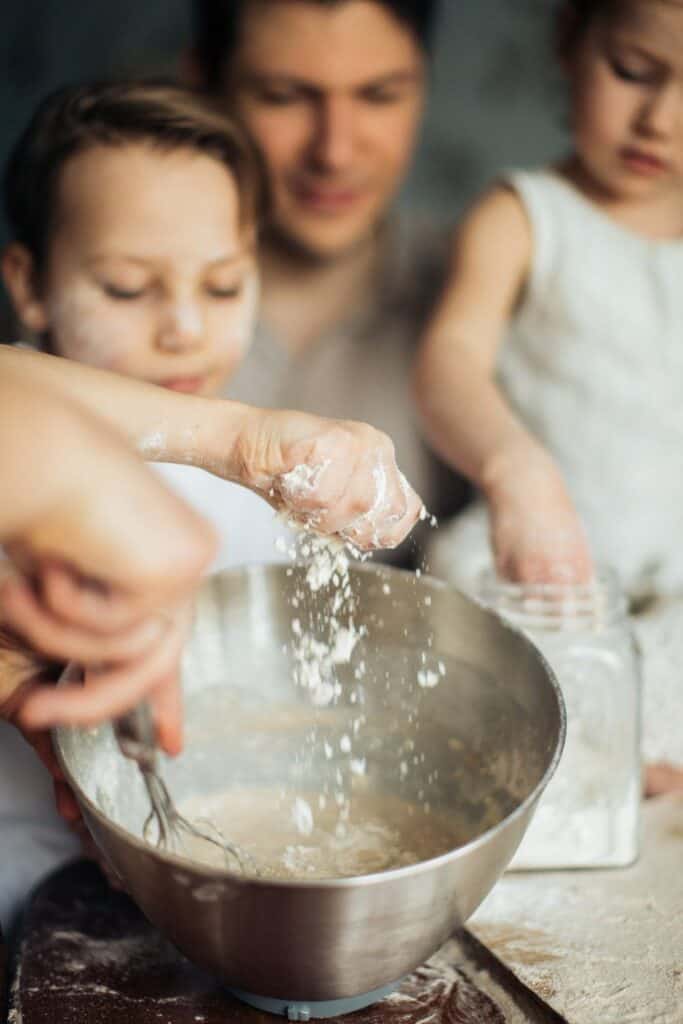
Baking bread at home can be a magical science experiment that explains how yeast works through fermentation. All you need is bread flour, yeast, water, salt, and a bit of olive oil. (sugar optional)
Steps:
- Let’s start with 3 cups of all-purpose flour, 2 ½ tablespoons of yeast, 1 ½ teaspoons of salt, 1 cup of warm water, and 3 tablespoons of olive oil. If you prefer your bread to be a bit sweet you could add 3 tablespoons of sugar.
- Mix all ingredients to make a dough. This shouldn’t take longer than 5-10 minutes.
- Let it sit and watch as the dough expands!
- Bake for 25-30 minutes at 375 degrees.
- Dig in!
Yeast, a type of fungus, eats the sugars in the flour and produces carbon dioxide gas and alcohol, causing the dough to rise. Baking then kills the yeast, evaporates the alcohol, and leaves the gas, which gives the bread its fluffy texture.
These four food experiments for kids encourage hands-on learning, creating an engaging and educational playground right at home. They also promote exploration, spark curiosity, and cultivate a lifelong love for science—one kitchen experiment at a time.
For parents who would like to add a bit more creativity and structure to their child’s learning or homeschool curriculum, I recommend exploring these online classes for kids. 24HourAnswers also offers free trial lessons for students in need of 1-1 tutoring. When your child is in need, you can connect them with a tutor on this platform for virtually any subject. Rest assured they will learn from some of the best experts online.
About the Author
Julie has been an instructor at 24HourAnswers for over 10 years and specializes in working with students in Chemistry. For any Chem-related questions feel free to reach out to her! She loves working with students 1-1 and in group sessions.

Jessica BOschen
Jessica is a teacher, homeschool parent, and entrepreneur. She shares her passion for teaching and education on What I Have Learned. Jessica has 16 years of experience teaching elementary school and currently homeschools her two middle and high school boys. She enjoys scaffolding learning for students, focusing on helping our most challenging learners achieve success in all academic areas.