
Interactive Phonics Notebooks Using Traditional Worksheets
Phonics notebooks are one of my favorite ways to help students practice decoding and reading skills. They give a little bit of a twist to traditional phonics worksheets and plenty of practice that students need to read well.
Below is a great teacher tip that can be used with our Back to Basics Phonics Worksheets.

Cut Apart the Phonics Worksheets to use in Phonics Notebooks
We designed our Phonics Worksheets to be modular in such a way that teachers can cut them apart and use the pieces of the worksheets for interactive notebooks.
This is a great way to use up those extra worksheets that get copied. Or if students make a mistake on a part of the worksheet, the rest of it can easily be reused for these phonics activities.

There are solid lines across the phonics worksheets in rows and columns. Simply cut along the solid line to create isolated strips for each task.
If you have a parent or other classroom volunteer, this is a great project for them. Not all of the worksheets have the same lines, so they cannot be stacked together, but if you print multiples of a particular worksheet, those can be grouped together for cutting.

While cutting apart the worksheets, the word banks will get cut off. For most strips, the picture will provide enough context for many students to figure out the word that needs to be written. This is not the case for all strips. Provide students with a word bank if needed.
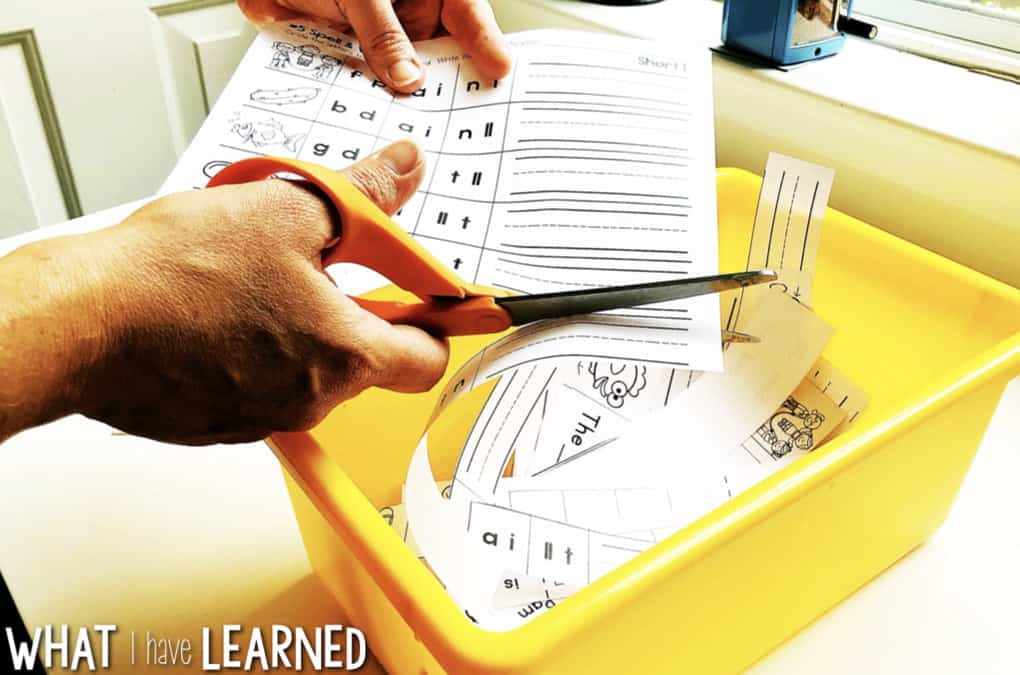
While only the Short I Worksheets are photographed here, this is a great opportunity to mix up the phonics activities so that students can practice multiple vowel patterns in one sitting. If students have learned both short a and short i cvc words, consider cutting up worksheets from both vowel patterns and mixing them up.

Glue, Read, Write, and Color
Put all of the worksheet pieces in a bin. Have students take out one strip at a time, do the work on the strip, and glue it to their phonics notebooks.
Students will need to know how to do the work on the worksheet. If this is their first encounter with this type of worksheet, have students do the work as a traditional worksheet before attempting to do it as an interactive phonics notebook task.

Cutting apart the worksheets into strips also give students another opportunity to do the work on the worksheet without them repeating the worksheet itself.
Most of the phonics worksheets have multiple pages. There are over 140 pages of Short A and Short I Worksheets that provide plenty of practice in a variety of CVC phonics patterns.
You could have students do one page as a traditional worksheet and cut apart the remaining worksheets for them to do as an interactive notebook activity.
Make the Phonics Activities a Bit More Interactive
To make the strips a bit more interactive, make a fold on the column line before cutting the strips. Students can glue down part of the strip and leave part of the work folded up. If you choose to do this, consider drawing a line down the area that needs to be glued.
In the above photo, on the “fin” strip, fold the space for writing the word and have that become a flap that students can unfold and read.
Back to Basics Phonics Worksheets
We have created a variety of phonics worksheets that give students ample practice in segmenting, blending, reading, and writing CVC words. Here are Short A Phonics Worksheets and Short I Phonics Worksheets in blog posts with links to all of the Phonics Worksheets.
All of the phonics activities complement our Blending Cards, as well as our Phonics Readers, which are another great tool for interactive notebooks.

I like everything about this sight. something is good for PreK-K-5th grade.