
 Atoms & Molecules Science Station BUNDLE
 NGSS Gravity Lessons – Gravity on Earth Fifth Grade Science Stations
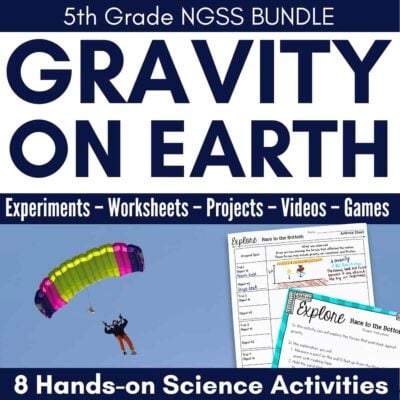
Fifth grade gravity science stations give students the chance to explore gravitational force, mass, distance, and planetary orbits through hands-on activities designed to run independently. While students work through stations, teachers can pull small groups or work with individual students — exactly the kind of structure that makes science stations worth the setup.

Because many of us have felt overwhelmed, these science stations are designed to help relieve some of that pressure. They might even put a little extra bounce in your step!
Through eight science stations, your students will better understand gravity, including mass, weight, and the pull of an object toward Earth’s center. All of these stations meet the Next Generation Science Standards for Fifth Grade (5-PS2-1).
Everything teachers need is included. These eight science stations teach and incorporate important skills through labs, experiments, videos, reading passages, and games.
Gravitational force in 5th grade builds directly on the contact forces and magnetic interactions students studied in 3rd grade. The physical science guide for elementary students traces that progression and covers all four 5th grade physical science standards.
Let’s take a closer look to find out what that looks like!
What’s Included in the Gravity Lesson Plans for 5th Grade?
Let’s start by going over what these science stations are actually about. In these NGSS gravity lesson plans for 5th grade, students learn about gravitational force. What’s the difference between weight and mass, and what do they have to do with gravity? How does air resistance play a role in an object’s reaction to the pull of gravity?
During these gravity experiments, students make observations, construct explanations, use evidence to support a claim, and design solutions to problems. The NGSS gravity lessons contain challenging material for fifth graders, with new words and concepts in easy-to-implement, interactive stations.
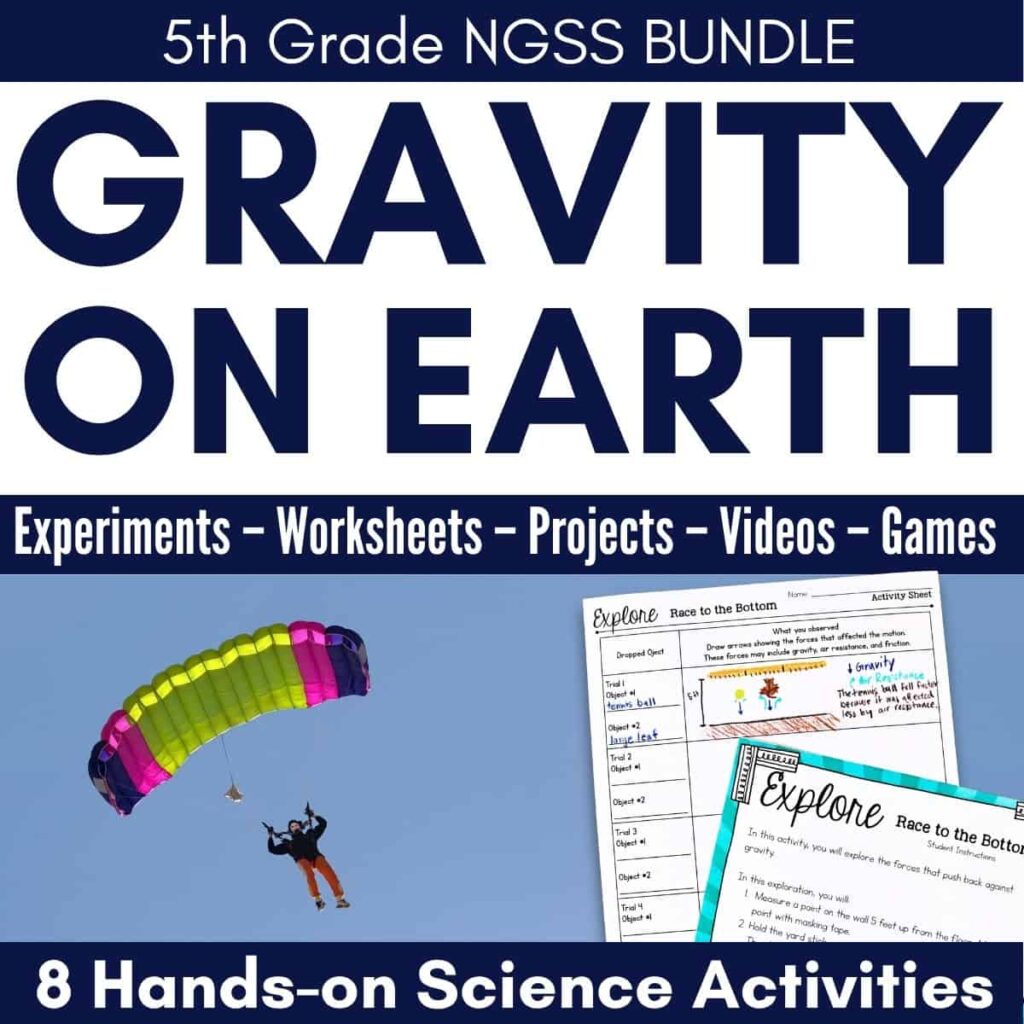
Gravity on Earth Science Stations – NGSS 5-PS2-1 Unit Bundle
Engage your 5th grade students with hands-on gravity science stations aligned to NGSS 5-PS2-1! This interactive unit includes 8 stations covering gravitational force, mass, weight, and more—plus digital Google Classroom™ components for easy implementation.
Focus on NGSS Standards for 5-PS2-1
Next Generation Science Standards are written to be “Three Dimensional.” The three dimensions are Performance Expectation, Disciplinary Core Idea, and Science and Engineering Practices/Crosscutting Concepts.
The Gravity on Earth Science Stations Unit focuses on these standards:
- Performance Expectation 5-PS2-1. Support an argument that the gravitational force exerted by Earth on objects is directed down.
- Disciplinary Core Idea:
- 5-PS2.B – The gravitational force of Earth acting on an object near Earth’s surface pulls that object toward the planet’s center.
- Science and Engineering Practice: Planning and Carrying Out Investigations
- Planning and carrying out investigations to answer questions or test solutions to problems in 3–5 builds on K–2 experiences and progresses to include investigations that control variables and provide evidence to support explanations or design solutions.
- Conduct an investigation collaboratively to produce data to serve as the basis for evidence, using fair tests in which variables are controlled and the number of trials considered.
- Planning and carrying out investigations to answer questions or test solutions to problems in 3–5 builds on K–2 experiences and progresses to include investigations that control variables and provide evidence to support explanations or design solutions.
- Crosscutting Concept: Cause and Effect
- Cause and effect relationships are routinely identified, tested, and used to explain change.
Big Idea Posters for Gravity on Earth
Big Idea posters are a great way to explain the core science ideas that students will learn in this unit of study.
Some of the Big Ideas include:
- The difference between Mass and Weight, and how both are related to gravity
- How Friction and Air Resistance relate to Gravity
- What Gravitational Force is

This unit includes six Big Idea Posters. Only the Gravity on Earth Unit Bundle includes the Big Idea Posters. Each individual station does not include the posters.
Gravity on Earth Vocabulary Cards
You need vocabulary cards in order to help your students understand what they’re reading about, right? The problem is, your students might not be thrilled. Maybe they’re a little intimidated by them, too. We have a solution that will make vocabulary cards appealing and exciting.

Included in the Gravity on Earth Unit Bundle are two sets of vocabulary cards. They are not available for each individual science station.
One set of vocabulary cards includes colorful pictures, words, and to-the-point definitions. Each card has cutting lines, which makes this set perfect for a matching game. Cut out the three sections (picture, word, definition), mix them all up, and let the fun begin!
Pro-tip: Laminate the cards, and you can use them year after year. Or, you can have your students glue them in their science notebooks.
The second set of cards is perfect for a science word wall. Each card comes with the word and definition in a larger font. It makes for great classroom reminders.
Differentiated Responses for Each NGSS Gravity Science Station
The old saying “one size fits all” has never proven true for anything. It’s especially not true when it comes to teaching children. That’s why these gravity science stations, including the Gravity on Earth Science Stations, offer five different ways for students to interact with each station. They include:
- short answer questions
- fill-in-the-blank questions without a word bank
- fill-in-the-blank with a word bank
- task cards with short answers
- task cards with multiple choice
All the variations are similar but require different levels of independence. The fill-in-the-blank is the easiest and is perfect for your students who struggle with reading. The short answer is the most difficult because it requires students to construct their own responses with little support.
Choose the format that best fits your classroom and students. Students are also encouraged to use their science journal task cards. Answer keys are included.
Some activities also include an activity sheet or worksheet in addition to the differentiated responses. This activity sheet is the station “work,” while the differentiated responses require students to think broadly about the topic and concept.
You can find examples of the questions in some of the images below.
Reading Passages for Gravity on Earth Science Stations
All stations, except the Watch and Play stations, include reading passages. Most reading passages are optional, but they build students’ background knowledge and reinforce key concepts. Use gravity reading passages in your lesson plans if your students do not have prior knowledge of the topic of the station.
The reading passages come in two formats. You’ll see both formats in the photographs below. Both versions have the same text, but different layouts.
- Full-page with color border
- Two-Column with a black border
See examples of the two formats in the images below.
Google Classroom Components
All of our fifth-grade science stations come with components that integrate easily with Google Classroom. Most stations include Google Forms and Google Slides.
- A Google Form™️ with Reading Passage & Differentiated Questions is available for the Watch, Investigate, Diagram, Read, Model, Explore, and Sort stations.
- Google Slides™️ with Activity Directions & Worksheets are available for Investigate, Diagram, Model, Explore, and Sort.
Most of the hands-on activities still require physical components, but we have provided the directions and recording sheets in Google Slides.
Watch a Video about Gravitational Forces
Perfect for the big classroom screen or personal devices, this station will have students watching a video or two about Gravity. One video covers gravitational force, while the other explains how mass, weight, and air resistance relate to gravity. We recommend picking one video, but if you have time, feel free to do both.
After watching, students will answer questions about the video. This station contains several worksheets with open-ended, short-answer questions, fill-in-the-blank sentences, and more. Task cards are also included.

This science station includes two videos. One video is pictured here.
Play a Game About Gravity on Earth
One of students’ favorite stations (of course…): The Play A Game Science Station! In this station, students will play a board game or complete a crossword puzzle or word search puzzle to reinforce what they have learned about gravity.
During the board game, students work together to answer questions and move along the board.
The set also includes a crossword puzzle and word search. There are two versions of the crossword puzzle: one with a word list and one without. The crossword puzzle and word search also come in digital formats. The digital form changes each time the page loads, so each student can work on their own version of the puzzles.
Investigate Gravity Lesson with a Marble Run
Who doesn’t love a good marble run? In this station, students read about gravity, then try to predict how gravity will affect the marble on its track. Differentiated questions to see if students are staying on track with what they’ve learned are included.


Diagram the Direction of Gravity Lesson
In this station, students read about gravitational force and other forces that affect it. They will then create a diagram to illustrate what they read.


Read About Gravitational Force
Students read and answer questions about gravitational force in this station. It can be perfect for individual reading or classroom cooperative reading.

Model Gravity Using a Parachute
Have you ever been skydiving? What about your students? Do they know how parachutes work? In this station, students will read about gravitational force and how other forces affect it. They will then model how these other forces affect gravity with the example of a parachute!


Explore Gravity with a Race to the Bottom
Pinewood derbies are popular do-it-yourself (or rather, parents-do-it) races. Racers construct racecars out of pinewood blocks, and send them down long decline tracks, hoping theirs will reach the bottom first. But how do they make their car faster than anyone else’s? And what does any of this have to do with gravity? In this station, students read about gravitational force, the other forces that affect it, and answer questions about what they read. Hopefully, after exploring this station, they’ll have an advantage the next time they make their supreme racecar!


Sort Gravitational Force or Not
In this station, students will read about gravitational force and all the forces that affect it, then play a sorting game. They will sort various scenarios into two categories: the result of a Gravitational Force, or not the Result of a Gravitational Force.

Here are a few examples for you to try. Which is caused by gravitational forces, and which aren’t?
- The moon stays close to the Earth.
- When things bake in the oven, they turn brown and look different.
- Electricity turns on the TV.
- The planets stay in orbit around the sun.
- Ice melts and becomes water.

Gravity on Earth Science Stations – NGSS 5-PS2-1 Unit Bundle
Engage your 5th grade students with hands-on gravity science stations aligned to NGSS 5-PS2-1! This interactive unit includes 8 stations covering gravitational force, mass, weight, and more—plus digital Google Classroom™ components for easy implementation.
How to Purchase the Fifth Grade Gravity of Earth Science Stations
The Gravity of Earth Science Station Unit can be purchased on my website or on Teachers Pay Teachers.
Other Fifth Grade Science Stations
We have fifth-grade science stations for all of the NGSS Standards. Click below for information about each one!
-
 Product on sale5th Grade NGSS Science Station Yearlong BUNDLEOriginal price was: $316.00.$177.87Current price is: $177.87.
 -
-
-
-
-
-

Jessica BOschen
Jessica is a teacher, homeschool parent, and entrepreneur. She shares her passion for teaching and education on What I Have Learned. Jessica has 16 years of experience teaching elementary school and currently homeschools her two middle and high school boys. She enjoys scaffolding learning for students, focusing on helping our most challenging learners achieve success in all academic areas.