
Classroom Consequences: Logical Ideas That Teach
When a student breaks a rule, the question every teacher faces in the moment is what happens next. The best classroom consequences are not about making a student feel bad. They are about helping a student learn and make it right. A consequence connected to the behavior teaches responsibility, while a punishment unrelated to the behavior usually builds resentment.
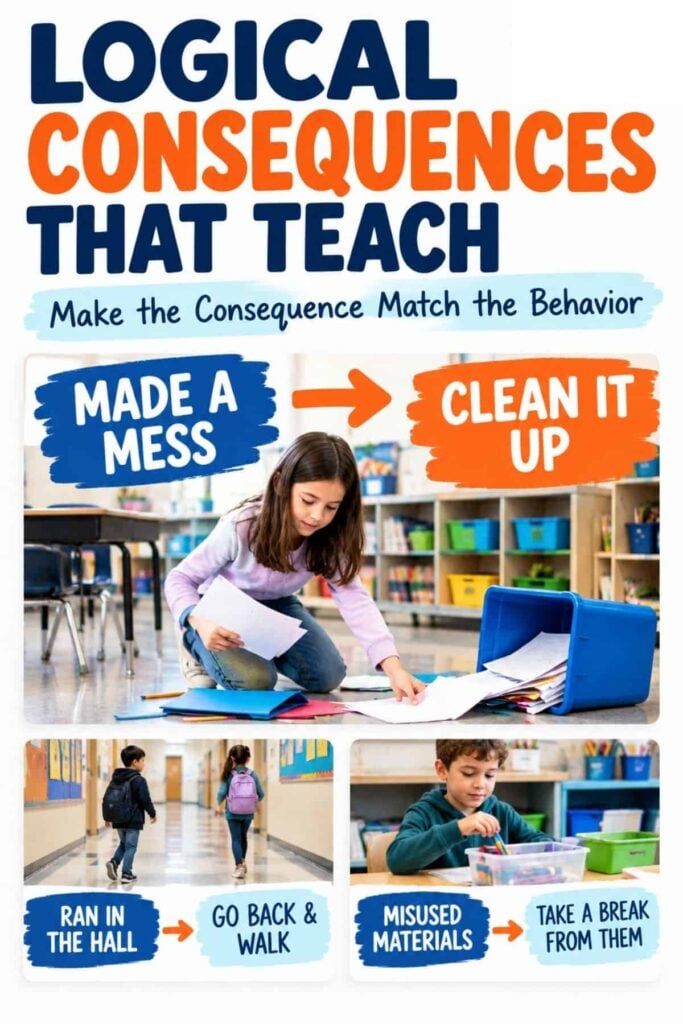
This post explains what classroom consequences are, the difference between logical and natural consequences, a list of examples you can use tomorrow, and how to make consequences actually change behavior in a K-5 classroom.
What Are Classroom Consequences?
A classroom consequence is what follows a student’s choice, and it can be positive or negative. Positive consequences follow good choices, like earned privileges or recognition. Negative consequences follow a broken rule or expectation, and a good one aims to guide the student back to the right behavior, not punish them.
This is where consequences and punishment part ways. A punishment is meant to make a student suffer for a mistake, often with something unrelated, like writing sentences for talking. A consequence is meant to teach, and it stays connected to what happened. The strongest classroom consequences are logical ones, and the framework comes from Responsive Classroom, which describes them as related, respectful, and reasonable.
Logical vs Natural Consequences
These two kinds of consequences do the teaching for you:
- Natural consequences happen on their own, with no action from you. A student who rushes through work makes mistakes and has to redo it. A student who forgets a coat feels cold at recess. You simply let the natural result teach the lesson, as long as it is safe.
- Logical consequences are ones you set up, and they are connected to the behavior on purpose. A student who makes a mess cleans it up. A student who misuses a marker loses the marker for a while. The consequence fits the action, so the student sees the link.
Most of the time in a classroom, you are using logical consequences, because natural ones are either too slow, too unsafe, or would not happen on their own. The key is that the consequence still feels connected to the behavior, which is what makes it teach instead of just punish.
Examples of Positive Consequences
Consequences are not only what happens after a rule is broken. Positive consequences follow good choices, and they are just as important, because students repeat the behavior that gets noticed. A few that work well in an elementary classroom:
- Specific praise that names the behavior, like “you cleaned up without being asked.”
- Earned privileges such as choosing a seat, being line leader, or picking the read-aloud.
- Extra choice time or a few minutes of a preferred activity for finishing work responsibly.
- A positive note or message home when a student makes a great choice.
- A class-wide reward when the whole group meets a shared goal, which builds community around good behavior.
Positive consequences carry more weight than negative ones over a year, so lean on them. My post on classroom rewards that actually motivate students has a long list of low-cost options.
Examples of Logical Classroom Consequences
Here is a list of logical consequences for common misbehavior, each tied to the action so the student can see why it fits:
- Makes a mess during an activity, so the student cleans it up before moving on.
- Misuses materials like markers or scissors, so the student loses them for a short time and practices using them correctly.
- Runs in the hallway, so the student walks back to the start and tries the right way again.
- Wastes time fooling around, so the student finishes the unfinished work during free choice or a preferred activity.
- Disrupts a group, so the student takes a short break and rejoins when they are ready to participate.
- Is too loud during quiet work, so the student moves to a quieter spot to reset.
- Uses unkind words, so the student repairs the relationship with an apology of action, something kind that helps make it right.
- Breaks something on purpose or through carelessness, so the student helps fix or replace it.
- Blurts out repeatedly, so the student practices the raise-your-hand routine before rejoining the discussion.
- Misuses a privilege like line leader or a classroom job, so the student loses it briefly and earns it back.
Notice that many of these are a version of “take a break and try again” or “make it right.” Those two moves cover a large share of elementary misbehavior, and both keep the focus on returning to expected behavior.
How to Make Classroom Consequences Work
A consequence only teaches if you deliver it well. A few principles keep them effective:
- Keep it related. The consequence should connect to the behavior, so the student sees the logic instead of feeling singled out.
- Keep it respectful. Deliver it calmly and privately when you can. The goal is to correct the behavior, not to shame the student in front of the class.
- Keep it reasonable. The consequence should match the behavior. Small slip, small consequence.
- Be consistent. Students learn the most when the same behavior brings the same response every time, from every adult in the room.
- Teach the expectation first. A consequence works only if students know the expectation. Clear routines and procedures prevent most misbehavior before it starts.
The last point is the big one. The best behavior management is preventive, so consequences are a small part of a system built on clear expectations and strong relationships. My post on how to teach responsibility in the elementary classroom is the foundation this sits on, because a student who owns their choices needs fewer consequences in the first place. It also pairs with clear classroom procedures and the positive side of the system: classroom rewards that actually motivate students.
Consequences vs Punishment
It is worth being clear with yourself about the difference, because it changes how students respond. Here is the contrast at a glance:
| Punishment | Logical Consequence | |
|---|---|---|
| Purpose | Make the student pay for the mistake | Help the student learn and make it right |
| Connection to the behavior | Often unrelated | Directly related |
| Tone | Blame or shame | Calm and respectful |
| What it teaches | Avoid getting caught | A better choice next time |
| Effect on the relationship | Builds resentment | Keeps trust intact |
Punishment often works in the short term through fear, but it does not teach a replacement behavior, and it can damage the relationship you rely on all year. Consequences that teach keep the student’s dignity intact and keep the door open to better choices. For a fuller picture of where consequences fit into the system, see my classroom management strategies guide.
What to Do When Behavior Escalates
Not every behavior stops at the first response, so it helps to have a calm progression in mind rather than jumping straight to the biggest consequence. A reasonable ladder for most classrooms:
- Remind. A quick, quiet reminder of the expectation, often a look, a gesture, or a few words.
- Reset. A chance to take a break and come back ready, before any consequence.
- Apply a logical consequence. If the behavior continues, use one connected to the action, like moving seats or making it right.
- Involve the family. For repeated or bigger issues, a calm message home brings a partner into the plan.
- Loop in support. For safety concerns or patterns you cannot shift, bring in an administrator or counselor.
Two cautions keep this fair. Avoid whole-class consequences for one student’s behavior, since punishing everyone for one child’s choice breeds resentment and rarely changes the behavior. And when you can, involve the student in deciding how to make it right, because a student who helps choose the repair is far more invested in it. That ownership is the whole point, and it ties back to teaching responsibility in the first place.
Frequently Asked Questions
Bringing It All Together
Classroom consequences work best when they teach rather than punish. Keep them logical and connected to the behavior, deliver them calmly, and stay consistent, and students learn to own their choices and make things right. Build them on a foundation of clear expectations and strong relationships, and you will find you need them less and less as the year goes on.
Jessica BOschen
Jessica is a teacher, homeschool parent, and entrepreneur. She shares her passion for teaching and education on What I Have Learned. Jessica has 16 years of experience teaching elementary school and currently homeschools her two middle and high school boys. She enjoys scaffolding learning for students, focusing on helping our most challenging learners achieve success in all academic areas.