
Mathematical Practice Discussion Cards Get Students Talking about Math
One of the most challenging things in my elementary classroom is to move students away from getting an answer in math to talking about and discussing strategies. When students learn mathematical strategies in depth and apply these strategies to unique situations, they have learned how to transfer the strategy between problems. These Mathematical Practice Discussion Cards will help them do just that!
I love watching light bulbs go off in students’ minds as they realize that they can just [insert a strategy] to solve a problem. It moves them toward efficiency, which is a major goal in math.
*** This post contains affiliate links. What this means is that by clicking on the link and purchasing products from that website, I receive a small commission from that website. Receiving this commission in no way influences my thoughts on the value of the product. Read my Disclosure Policy for more information.***
Allow Students to Talk During Math Time
One of the key ways students learn mathematical strategies is by talking about them. I love doing number talks and problem-solving in my classroom, but it is so difficult to get students to express their thinking about the problems. Most of my students are English learners who don’t have many of the words and sentence structures they need to talk about the math going on in the problems.
I’ve written a couple of blog posts about giving students sentence frames and vocabulary cards to talk about specific mathematical concepts. These posts were geared toward skills and concepts in one area in math, for instance, fractions.
Mathematical Practice Discussion Cards that Promote Collaboration
Today, I want to share with you another resource that bridges all mathematical problems because it focused on Mathematical Practice Standards. I developed these Mathematical Practice Discussion Cards several years ago as we were getting started with the new Common Core Math Standards.
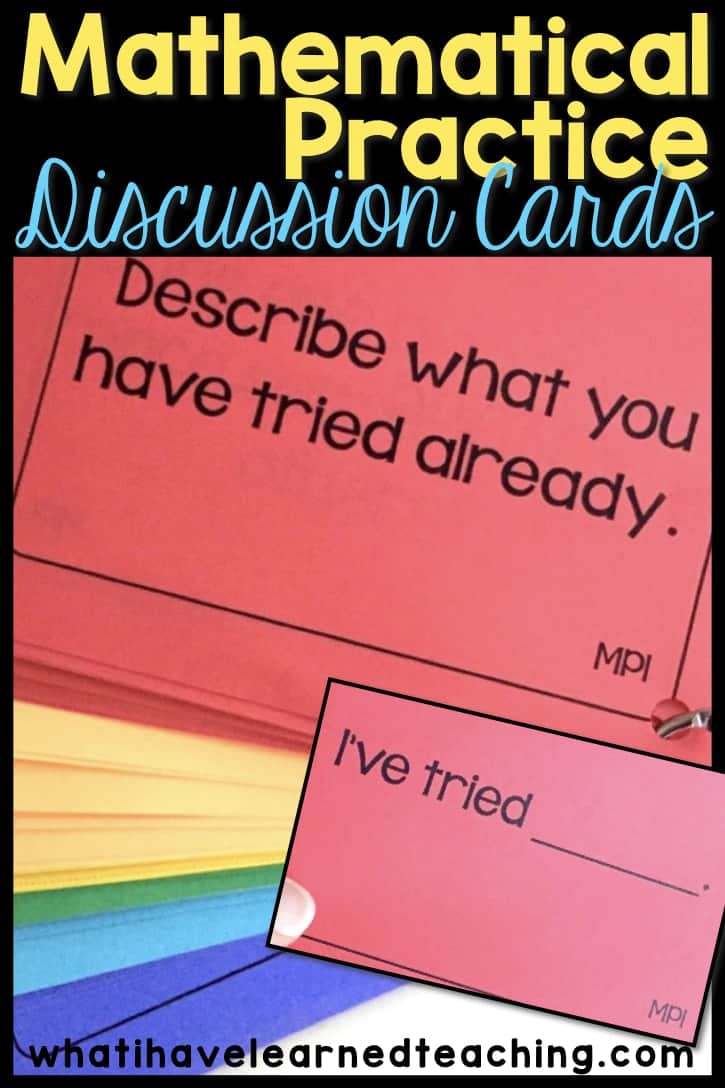
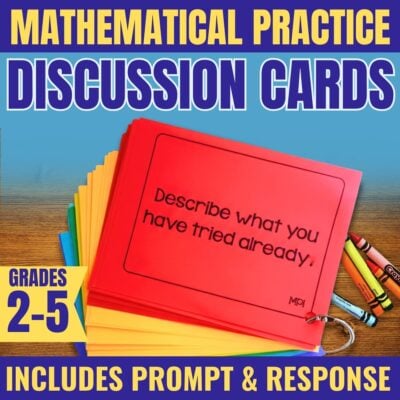
These mathematical practice discussion cards are designed to be used in partner or small group discussions about math problems. The cards are formatted so that when printed back to back, the question or prompt is on one side and the other side has a sentence frame that goes with the question.


Not only do you have a variety of questions that students can ask each other related to each Mathematical Practice Standard, you also focus students on answering questions in complete sentences.
With my second graders, we start out with only a couple of the cards at the beginning of the year and use them repeatedly for a couple of weeks before adding a few more cards to the ring. I’m very explicit about how students hold the cards so that one student reads the question and the other student responds to the question. I want to be sure that both students are participating equally. We generally start with MP 1 & 6 toward the beginning of the year.
By the end of the year, we have quite a few cards on our ring. I simply tell students that they need to discuss a question from a certain color, which corresponds to a Mathematical Practice standard. Students choose the question that best fits their problem and discusses it, using the sentence frames on the back as a guide, if needed.
These cards have been perfect for my English learners who often don’t know where to start when I’ve said, “Turn to your partner and tell them xyz.” These cards give students a starting place and add a little bit more specificity to the task.
How to Print the Mathematical Discussion Cards
When printing them, I print them back to pack on colored paper. I started with MP1 and printed all the question / prompt cards on red paper. Then, I reinserted the paper back into the printer to print on the opposite side and print all the response/sentence frame cards.
You may need to play around with your printer to figure out how to print back to back unless you have a setting for it. It is well worth the effort to have a set of these to use with students every year.
One more hint, if you hole punch it in the bottom right, students can hold up one card easily without the whole ring falling in front of the one that needs to be seen.
How to Purchase the Mathematical Discussion Cards
Are you interested in these cards for your own classroom? They’re available on my website and in my TpT store.

Great article!
You must be an amazing teacher if you can think of this. All I have done with my kids, to help them with math is introduce them to Mr. Nussbaum and
Math Blaster so they can learn math via games. You actually make them think about math – hats off to you.
I’m a big fan of the Mathematical Practices. Thanks for creating such a simple yet powerful tool for students to develop the type of thinking that will also help in solving real world problems.
This is awesome! We have been pushing the SMPs starting last year, and this year I’ve been trying to figure out how to make them meaningful in the classroom! 🙂 Keep up the good work and thanks for inspiring others to bring their A game when teaching our little ones!
Thanks so much for publishing these discussion cards! What a great way to get students holding authentic academic conversation in math!
Jessica,
So glad I received the link to this post in your email this morning! I LOVE all of your posts/resources about problem solving. They are filled with so much great, useful information. My school is currently focusing on using Eureka’s RDW (Read Draw Write) process to solve word problems and your resources about how to teach the different problem types have been so helpful! I teach third grade, but many of my kiddos struggle with the different addition/subtraction problem types. You are definitely one of my go-to teacher blogs. Thanks!!!
So you have those discussion cards for middle school age students?
I do not. The questions and sentence frames should be similar, though. They are based on the Mathematical Practice Standards, which apply to all grades.