
Balance Equations – Hands-On Equalities Sorting Activity with Snowflakes and Hearts
Understanding the meaning of the equal sign can be challenging for most first-grade students. They often think it simply signifies the answer, with the left side presenting an expression and the right side featuring a whole number.
How can teachers effectively convey to students that the equals sign denotes equivalence rather than the solution? Below are some ideas and activities to teach students about the equal sign in math.

Why should first-grade students explore the concepts of equality?
Students often misinterpret the meaning of the equal sign in math. They have difficulty understanding how to solve equations with an expression on the right side of the equal sign or equations that don’t look like X+Y=Z.
Exploring the concepts of equality and learning to balance equations in first grade lays the groundwork for future math learning. Equality is a key principle in mathematics that helps young students understand how things can be equal even if they don’t look alike.
It’s also important for understanding basic algebraic operations, like addition and multiplication. Knowing how to balance equations early will give students the skills needed to solve more complex problems later in their mathematical education.
Hands-on Activities & Tips to Teach Balancing Equations to Students
Teaching first and second-graders to balance equations can be fun and engaging, especially with hands-on activities. The key is simplifying the concept and making it as interactive as possible. Here are some tips and activity ideas:
- Use Concrete Objects: Start with physical objects like blocks, counters, or small toys. These tangible items help young students visualize the concept of balancing.
- Balancing Scale Activity: Use a simple balance scale. Place an equal number of objects (like blocks or marbles) on both sides and show how the scale balances. Then, change the number on one side and discuss what needs to be done to make it balance again.
- Equation with Objects: Write a simple equation on the board (like 3 + _ = 5). Use objects to represent the numbers and have the students physically move the objects to solve for the missing number.
- Drawing It Out: Have students draw pictures to represent equations. For example, if the equation is 4 + 2 = 6, they might draw four apples and two more, showing they all make six.
- Story Problems: Create simple story problems that involve balancing concepts. For instance, “Sarah has 3 apples and needs 5 in total. How many more does she need?” Use objects to act out the story.
- Interactive Games: Use board games or card games where children have to add or subtract to move pieces. This can be a fun way to introduce basic algebraic thinking.
- Group Activities: Have children work in pairs or small groups. Give each group a set of objects and simple equations to solve using those objects. Collaboration often enhances understanding.
- Use Visual Aids: Visual aids like number lines or bar models can help students understand the concept of equality in equations.
- Hands-on Manipulatives: Use manipulatives like Unifix cubes, counters, or magnetic numbers. These can be moved around easily and help visualize the balance in equations.
- Real-Life Scenarios: Connect the concept to real-life situations. For example, “If you have 4 candies and you need 6 in total for your friends, how many more candies do you need?”
Remember to keep the language simple and the activities varied to maintain interest.
What is included in the Cut and Paste Equal Snowflakes Math Activity
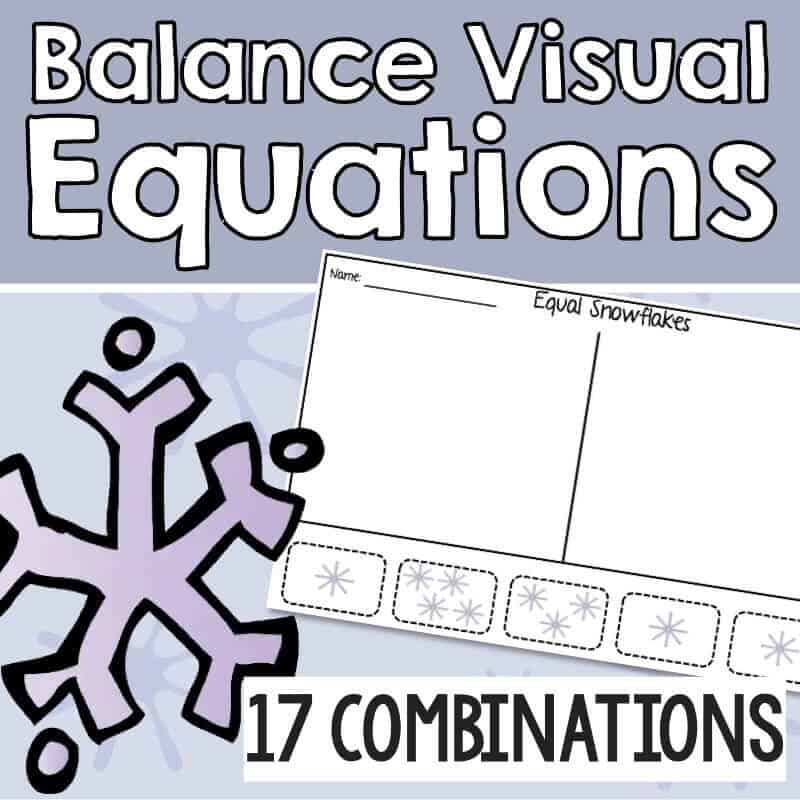
In first grade, the concept of balancing equations can be done with hands-on activities like this cut-and-paste Equal Snowflakes activity.
Equal Snowflakes is an activity about equality. It explores equality with sums of 10 (5 + 5) and 12 (6 + 6).
Students cut out the groups of snowflakes and place them on each side of the line so that there’s an equal amount on each side. After solving the equation, students write each expression. The middle line represents the equal sign.

Students can then write the addition expression on each side that matches the pictures. For instance, the top one would be 4 + 1 = 3 + 1 + 1. Students can write several addition equations on a recording form.
Equal Snowflakes – Exploring Equality and Balancing Visual Equations
Equal snowflakes help students experience equality with a hands-on sorting activity. Students cut out and rearrange groups of snowflakes to make the two side of the line equal.
What is Included in the Equal Hearts Math Activity
Equal hearts helps students experience equality with a hands-on sorting activity. Students rearrange groups of hearts to make the two sides of the line equal. Equal Hearts focuses on numbers 16 (8 on each side) and 20 (10 on each side).
Students can write the equation below the groups of hearts and on the included recording sheet. For instance, the top one above would be 5 + 3 = 6 + 2 and the bottom would be 6 + 2 = 4 + 4. The papers are half page each, for easy copying.

How to Purchase the Equal Snowflakes Activity
It’s a great first-grade activity or a second-grade review. Equal Snowflakes is available on my website or in my TpT store.
Jessica BOschen
Jessica is a teacher, homeschool parent, and entrepreneur. She shares her passion for teaching and education on What I Have Learned. Jessica has 16 years of experience teaching elementary school and currently homeschools her two middle and high school boys. She enjoys scaffolding learning for students, focusing on helping our most challenging learners achieve success in all academic areas.