
Conservation of Matter: Experiments for 5th Grade
When a candle burns down, or a tablet fizzes in water, students assume the matter has disappeared. Teaching the conservation of matter is how you replace that idea with the truth: matter is never created or destroyed, even when it changes form. It only rearranges. This is a core fifth-grade standard, and it lands best through hands-on experiments where students weigh matter before and after a change and see for themselves that the amount stays the same.
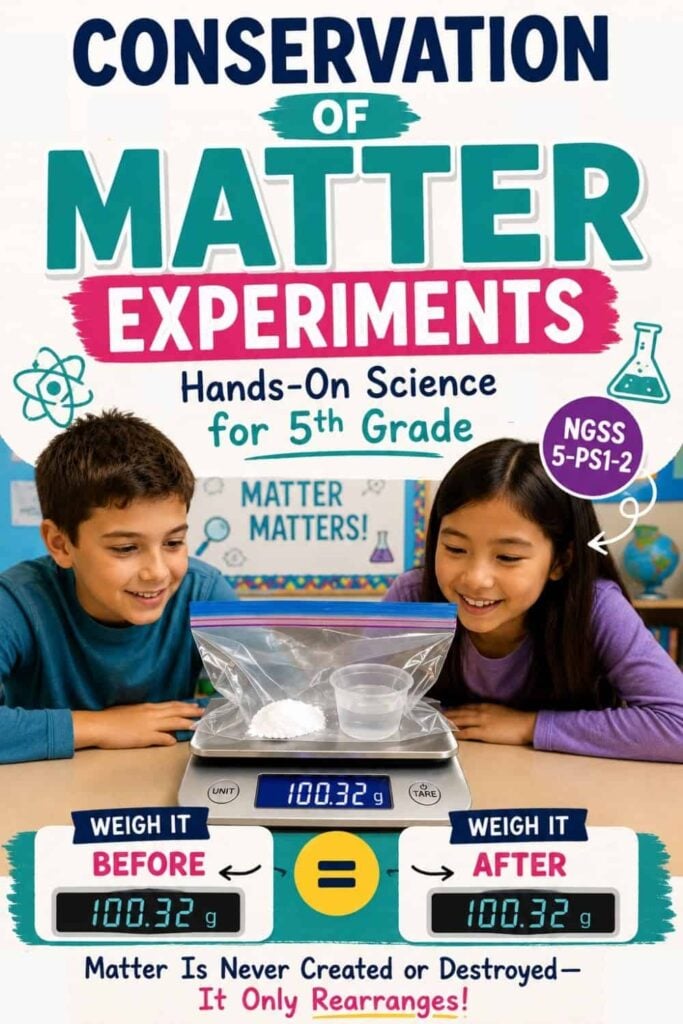
This post explains the law in kid-friendly terms, sorts out the matter-versus-mass question, and walks through experiments that make it stick.
Looking for a full resource guide for teaching physical science in elementary grades? I’ve put one together that spans all grades K-5.
What Is the Conservation of Matter?
The conservation of matter is the idea that matter cannot be created or destroyed during a physical or chemical change. When you mix, heat, cool, dissolve, or react substances, the atoms rearrange into something new, but every atom is still there. Nothing is added, and nothing is lost. That is why the total weight before a change equals the total weight after, as long as nothing escapes.
This is exactly what fifth graders investigate in NGSS 5-PS1-2, where students measure and graph quantities to show that the weight of matter is conserved during changes. You can read the standard at the Next Generation Science Standards site.
Conservation of Matter vs. Conservation of Mass
Students and teachers see both terms, and at the elementary level, they describe the same idea. The law of conservation of mass says the total mass in a closed system stays the same during a change. The conservation of matter says the same thing in terms of the matter itself.
For fifth graders, you can treat them as one concept: the stuff doesn’t disappear, and the weight stays the same. The distinction between mass and weight matters more in middle school, so at this stage, I keep it simple and let students focus on the big idea.
Examples of Conservation of Matter
The easiest way to make this real is with examples students can watch and weigh. In every one of these, the total amount of matter stays the same, even when it looks like something was lost:
- Dissolving drink mix in water. Stir a powdered drink mix into a bottle of water. The powder seems to vanish, but weigh the capped bottle before and after, and the mass is the same.
- Melting ice. A sealed bag of ice weighs the same after it melts into water. Changing state does not change the amount of matter.
- Baking soda and vinegar in a sealed bag. The bag puffs up with gas, but the mass stays the same because the gas is trapped inside.
- A glow stick. Snap and shake a glow stick and weigh it before and after. The chemical change gives off light, but no matter is gained or lost.
- A banana decomposing in a bag. Seal a sliced banana in a bag for a week. As long as the bag stays sealed, the mass stays the same even as the banana breaks down.
- Mixing coins. Weigh a handful of coins separately, then weigh them together. The total is the same, a simple, no-mess way to introduce the idea before a reaction.
Everyday changes work too, once students understand the rule: a melting popsicle, a puddle drying up, and even a burning candle all conserve matter, though the ones that release a gas need a closed system to prove it. That is where the concept gets tricky.
Why Conservation of Matter Is Tricky for Students
This concept fights against what students think they see. The trouble almost always comes from gas, because students can’t see it. When a gas forms or escapes, it looks like matter vanished:
- A fizzing tablet seems to shrink to nothing, but it releases carbon dioxide gas into the air.
- A burning candle looks like it just gets smaller, but it releases gases that rise.
- Sugar dissolving in water seems to disappear, but it is still there, dispersed throughout the water.
The fix is a closed system. When you trap everything, including any gas, and weigh it before and after, students see the number hold steady. That single observation does more than any definition.
Conservation of Matter Experiments and Activities
The whole point of this standard is measuring, so these activities put a scale in students’ hands. Each one gives them before-and-after data to reason from.
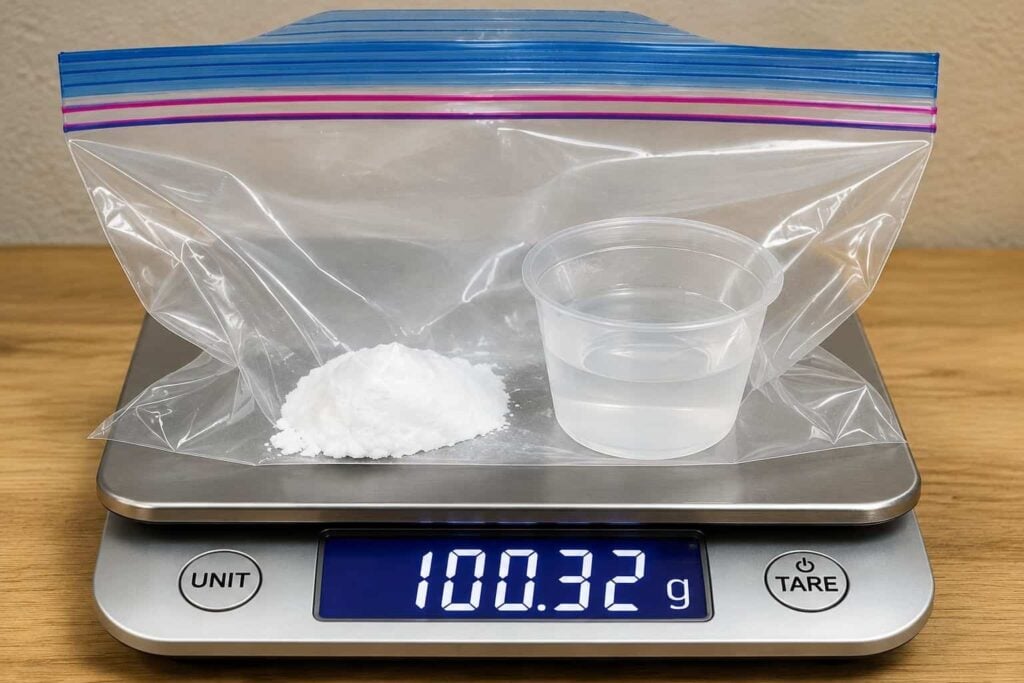
Sealed Bag Reaction
Put a few spoonfuls of baking soda and a small open cup of vinegar in a zip-top bag, then seal it. Weigh the whole bag, tip the cup to mix the two, and weigh again once it stops fizzing.
The bag puffs up with carbon dioxide, but the mass is the same because the gas is trapped. For a powerful follow-up, open the bag, release the gas, and weigh again. The drop in mass shows students exactly where the “missing” matter went.
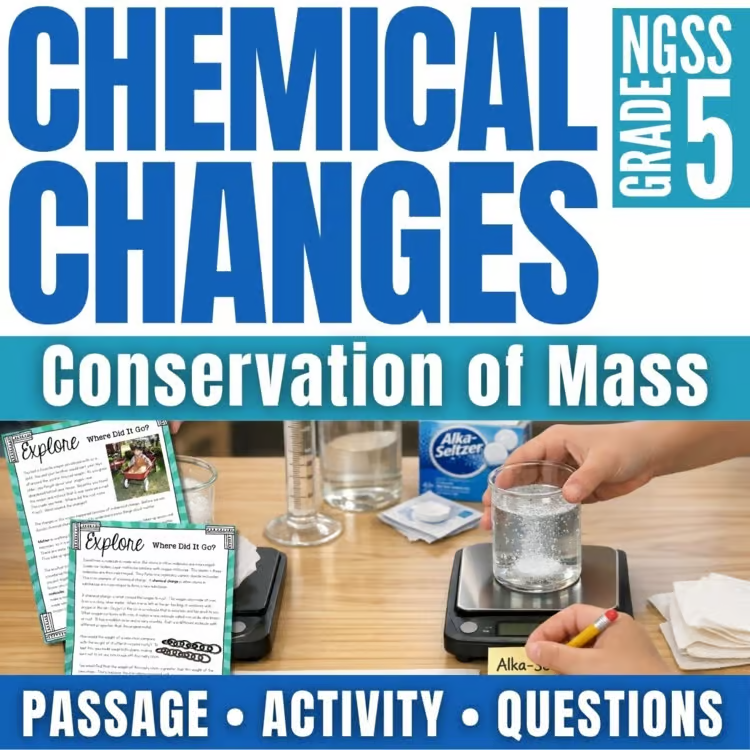
This 5th-grade science station aligns with NGSS 5-PS1-2 and allows students to investigate how mass is conserved during reactions such as the baking soda and vinegar, Alka-Seltzer, and Mentos experiments.
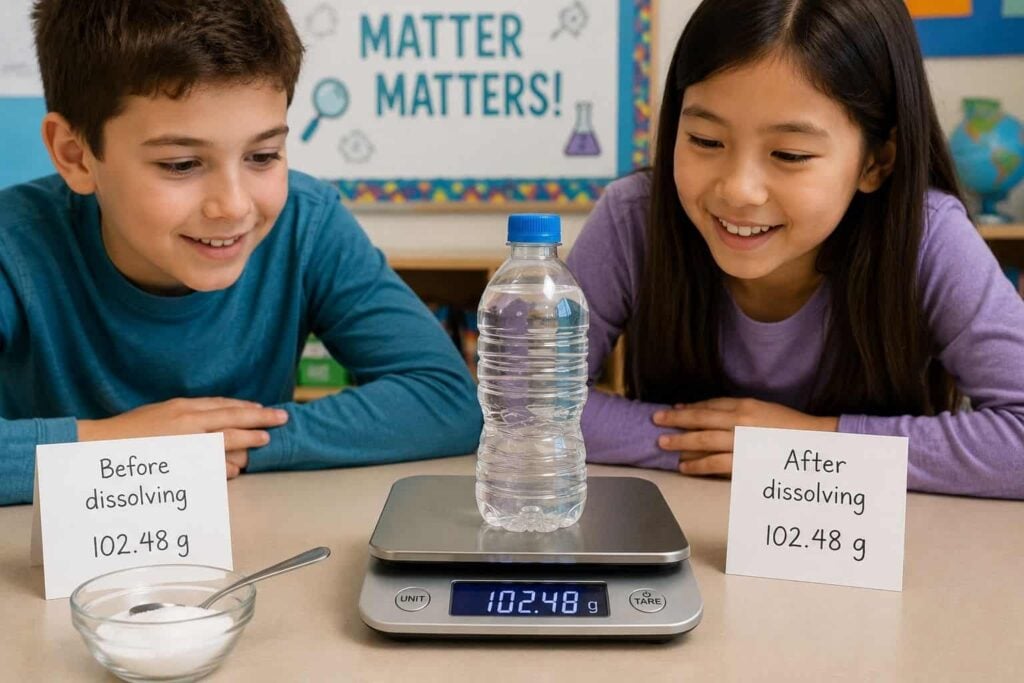
Dissolving in a Closed Container
Weigh a capped bottle of water with a spoonful of sugar or salt next to it, then add the solid, cap it, and dissolve it completely. Weigh again. The mass is unchanged because dissolving is a physical change and no matter is left in the bottle. This is a clean way to show conservation without a reaction.
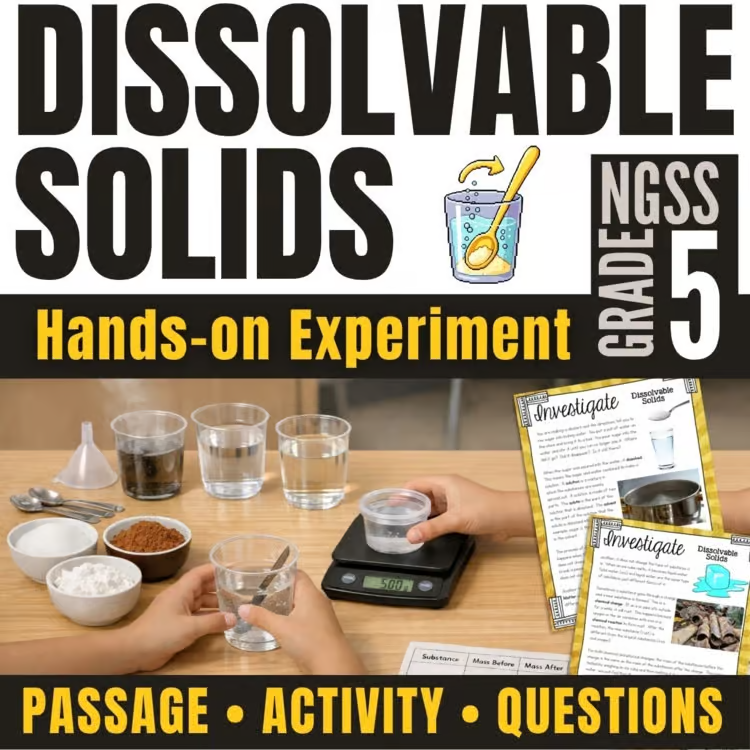
This 5th grade science station allows students to investigate how mass is conserved through interactive experiments, reading comprehension, and data analysis—perfect for reinforcing key science concepts in a meaningful way.
Melting and Freezing
Seal an ice cube in a small bag, weigh it, let it melt, and weigh the water. Same mass. A change in state is a physical change, so matter is conserved. Pair this with the dissolving activity to show that conservation holds for physical changes, not just reactions.
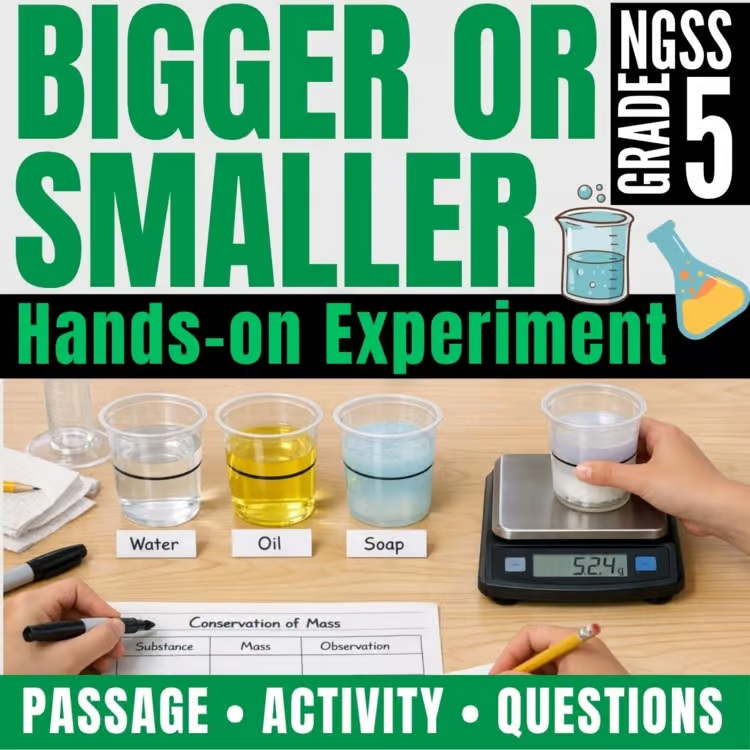
This hands-on states of matter activity helps students explore how mass remains constant during changes in matter through interactive investigation, diagramming, and critical thinking.
Model It With Atoms
Give students colored candy or pompoms and have them build the reactants in a simple reaction, then take the atoms apart and rebuild them as the products. Counting the atoms before and after shows the same number every time. This connects the weight data to its reason: the atoms only rearrange.
Connecting Conservation of Matter to Chemical and Physical Changes
Conservation of matter makes the most sense as part of a larger unit on how matter changes. It explains what happens to the “stuff” during the physical and chemical changes students are already studying. I teach the two together, and my science stations for physical and chemical changes activities sets up the reactions that these conservation experiments measure.
Writing It Up With Claim, Evidence, Reasoning
These experiments are designed to support claim, evidence, and reasoning, because students leave with real numbers. After the sealed bag activity, have them answer whether matter was conserved. The claim is yes; the evidence is the matching before-and-after weights; and the reasoning is that the atoms rearranged, but none were created or destroyed.
My post on claim, evidence, and reasoning in elementary science has sentence stems that help students write it up, and science experiment recording sheets provide a place to record their measurements.
Frequently Asked Questions
Final Thoughts
Conservation of matter is one of those ideas that students have to measure to believe. Give them a scale, a closed system, and a chance to observe, and the concept moves from “the matter disappeared” to “the matter is still here, just rearranged.” Build it into your unit on how matter changes, and let the data do the convincing.
Looking for a ready-made set? My Conservation of Mass 5th Grade Science Stations give students hands-on labs, reading passages, and recording sheets to investigate that matter is conserved, all aligned to NGSS 5-PS1-2.
Conservation of Mass Science Station BUNDLE
These Conservation of Mass Next Generation Science Stations include eight different science stations where students deepen their understanding of conservation of mass, including the structure and properties of matter and chemical reactions. The focus is on 5-PS1-2.
Jessica BOschen
Jessica is a teacher, homeschool parent, and entrepreneur. She shares her passion for teaching and education on What I Have Learned. Jessica has 16 years of experience teaching elementary school and currently homeschools her two middle and high school boys. She enjoys scaffolding learning for students, focusing on helping our most challenging learners achieve success in all academic areas.