
Claim, Evidence, Reasoning (CER) in Elementary Science
Ask a third grader to explain a science answer, and you’ll often get “because I just know” or a single guess with nothing behind it. Teaching claim, evidence, and reasoning helps move students from guessing to thinking like scientists. CER gives students a clear structure for making a claim, supporting it with evidence, and explaining the reasoning that connects the two.
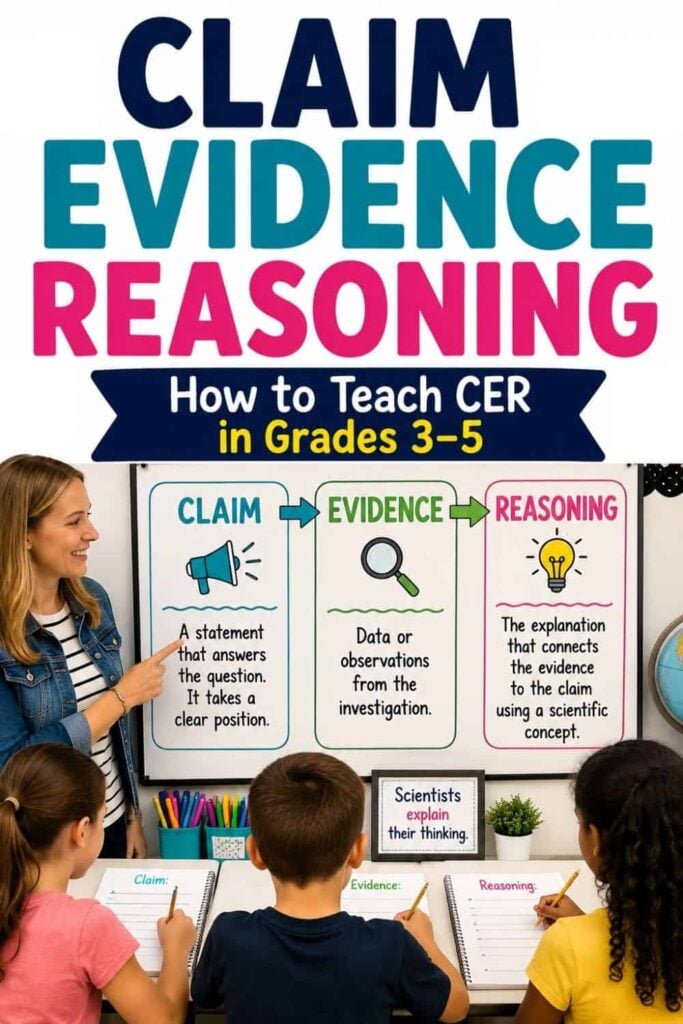
This post breaks down what CER is, why it belongs in your science block, and exactly how to teach it in grades 3 through 5, including sentence stems, a scaffolding sequence, examples, and how to assess it.
What Is Claim, Evidence, Reasoning (CER)?
Claim, evidence, reasoning is a framework that helps students write and talk about science the way scientists do: by supporting their ideas with proof. It has three parts:
- Claim. A statement that answers the question. It’s short, usually one sentence, and it takes a clear position.
- Evidence. The data or observations that support the claim. This is what the student saw, measured, or read, not what they already believed.
- Reasoning. The explanation that connects the evidence to the claim is usually based on a scientific concept. This is the part students skip, and it’s the most important.
The reasoning is where the real thinking lives. A student can make a correct claim and list accurate evidence and still not understand why they connect. CER forces that connection out into the open where you can see it.
Why Use Claim, Evidence, Reasoning in Elementary Science?
CER does more than tidy up student writing. It changes how students approach science. Instead of hunting for the answer the teacher wants, they learn to build an argument from what they actually observed. A few reasons it’s worth the time:
- It builds scientific thinking. CER lines up with the science and engineering practices of constructing explanations and arguing from evidence, so students are doing real science, not just recalling facts.
- It makes thinking visible. You can see exactly where understanding breaks down, whether a student can’t find evidence or can’t connect it.
- It crosses subjects. The same structure strengthens writing and supports the kind of evidence-based responses students need in reading, too.
If you want the research and standards background, the National Science Teaching Association has helpful material on building argumentation into elementary science.
How to Teach Claim, Evidence, Reasoning Step by Step
CER is a skill that must be taught and practiced, not just assigned. This sequence works well across a unit or even a whole year.
1. Start With a Non-Science Example
Before you bring in science content, introduce the structure with something familiar. “Our class should get five more minutes of recess” is a claim. The evidence is that students focus better after a break, and the reasoning explains why a break helps the brain. When the content is easy, students can focus on learning the framework.
2. Model It With Your Own Thinking
Work through a full CER response in front of students, saying your thinking out loud. Show how you choose a claim, pull evidence from an investigation, and write the reasoning. Students need to hear the messy middle, not just see a finished example.
3. Write It Together, Then in Groups
Move to shared writing where the class builds a response together, then let small groups try one. This gradual release lets students lean on each other before they write alone. Reasoning is usually the part that needs the most group practice.
4. Release to Independent Writing
Once students are comfortable, they write their own CER responses after an investigation. Keep the anchor chart and sentence stems available all year, because students will need them well past the first unit.
CER Sentence Stems and Anchor Charts
Sentence stems are the single most useful support for CER, especially for younger writers and multilingual learners. They give students a way into each part without handing them the answer. A starter set:
- Claim: “I claim that…” or “My investigation shows that…”
- Evidence: “My evidence is…” or “During the investigation, I observed…”
- Reasoning: “This evidence supports my claim because…” or “This happens because…”
Put these on a class anchor chart and a small desk copy so students can reach for them during writing. If you already use sentence stems in other subjects, this fits right in. My post on sentence stems, sentence frames, and signal words has more on how to build academic language this way.
Claim, Evidence, Reasoning Examples for Grades 3-5
Seeing CER in real science contexts helps it click. Here is what a solid response looks like at each grade.
Third Grade: Fossils
After studying fossils, students might answer the question of whether an animal lived in water. Claim: This animal lived in water. Evidence: its fossil has fins and was found in rock that formed at the bottom of a lake. Reasoning: Animals with fins are adapted for moving through water, so this animal most likely lived there. This pairs naturally with my fossils in the 3rd-grade lesson, where students read fossil evidence.
Fourth Grade: Erosion
After testing how water moves through soil, students might claim that faster water causes more erosion. Evidence: more soil washed away in the tray where the water ran faster. Reasoning: faster-moving water carries more energy, so it can move more soil. Investigation-based questions like this give students real data to reason from, which is easier to record with science experiment recording sheets.
Fifth Grade: Chemical Change
After mixing two substances, students might claim that a chemical change happened. Evidence: a gas formed, and the temperature dropped on its own. Reasoning: a new substance with new properties formed, and forming a new substance is a sign of a chemical change. Fifth graders can handle reasoning that names the science concept directly.
How to Assess CER
A simple rubric keeps assessment focused and fair. Score the three parts separately: Is the claim clear, and does it answer the question? Is the evidence accurate and relevant? Does the reasoning connect the evidence to the claim using a scientific idea? Sharing the rubric with students ahead of time tells them that a complete, well-reasoned response matters more than a long one. Early in the year, I give the most feedback on reasoning, since that’s the part students are still learning to write.
Frequently Asked Questions
Final Thoughts
Claim, evidence, and reasoning take time to teach, but they pay off across science, writing, and reading all year. Start with one non-science example, model your own thinking, and keep an anchor chart and sentence stems within reach. Focus your feedback on reasoning, and your students will move from “because I just know” to explanations they can actually defend.
Jessica BOschen
Jessica is a teacher, homeschool parent, and entrepreneur. She shares her passion for teaching and education on What I Have Learned. Jessica has 16 years of experience teaching elementary school and currently homeschools her two middle and high school boys. She enjoys scaffolding learning for students, focusing on helping our most challenging learners achieve success in all academic areas.