
Warm-Blooded vs. Cold-Blooded Animals: A Sorting Activity for 3rd Grade
When 3rd graders are learning about warm-blooded and cold-blooded animals, the concept clicks fastest when they can see it in action. Sorting real animals into categories — rabbit here, snake there — gives students a hands-on way to connect the inherited trait to the actual animals they already know.

This post explains what warm-blooded and cold-blooded mean at a 3rd grade level, how this topic connects to NGSS standards, and what’s included in the sorting activity I use in my classroom.
What Are Warm-Blooded and Cold-Blooded Animals?
Whether an animal is warm-blooded or cold-blooded is an inherited trait — every animal in a species shares the same characteristic because it was passed down from parent to offspring. That connection to inheritance is exactly why this topic fits into 3rd grade science.
Warm-Blooded Animals
Warm-blooded animals regulate their own body temperature from the inside. No matter how cold or hot the environment gets, their bodies work to maintain a stable internal temperature. Birds and mammals are warm-blooded. That includes familiar animals like dogs, cats, rabbits, deer, eagles, and penguins — yes, even penguins, who stay warm in Antarctic temperatures because their bodies generate heat internally.
Cold-Blooded Animals
Cold-blooded animals depend on their environment to regulate body temperature. When it’s warm outside, their bodies warm up. When it’s cold, they slow down. Fish, reptiles, and amphibians are all cold-blooded. Snakes basking on a rock in the sun, frogs going dormant in winter, and alligators lying still on a warm bank — all of these behaviors are the animal managing its temperature from the outside.
A helpful way to frame this for 3rd graders: warm-blooded animals make their own heat, cold-blooded animals borrow heat from their surroundings.
How Warm-Blooded vs. Cold-Blooded Animals Connect to 3rd Grade NGSS
This topic falls under NGSS standard 3-LS3: Heredity — Inheritance and Variation of Traits. Students at this level are learning that many characteristics of organisms are inherited from their parents and that some traits are shared across an entire group. Whether an animal is warm-blooded or cold-blooded is a trait inherited from parent to offspring, which makes it a clear, concrete example of the broader concept of inherited characteristics.
Sorting activities work well here because they ask students to examine the evidence — the animal’s vertebrate group — and draw a conclusion rather than simply memorizing a list. That kind of categorization thinking is exactly what the standard asks students to practice. I use this activity as part of my science stations rotation, where students work through the sort independently or in small groups.

About the Warm-Blooded and Cold-Blooded Animals Sorting Activity
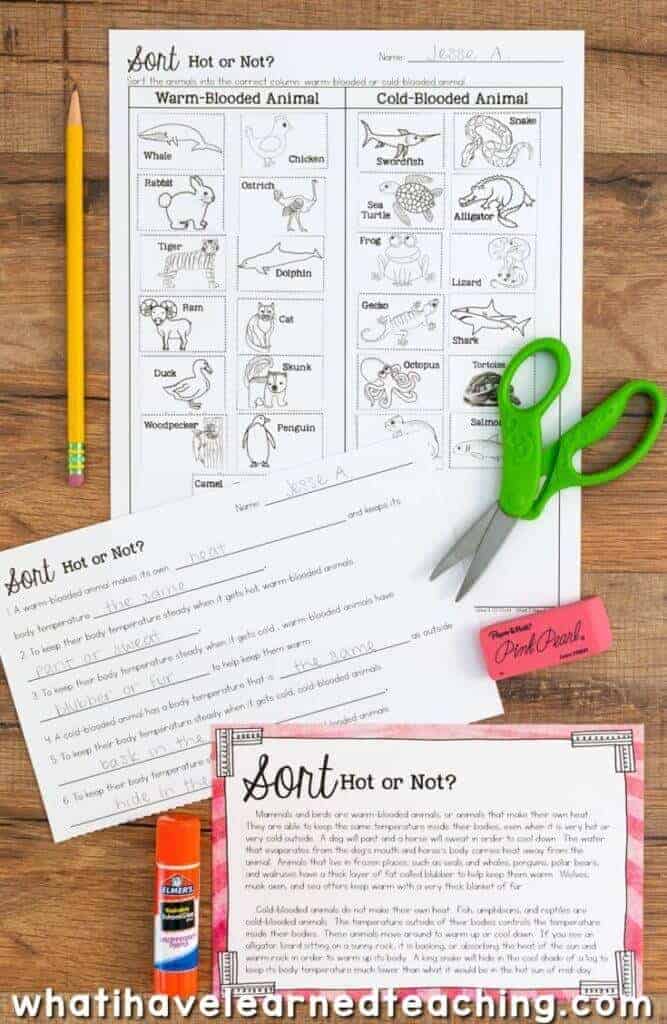
The Warm-Blooded vs. Cold-Blooded Sort Science Station includes a short reading passage that introduces the attributes of warm-blooded and cold-blooded vertebrates, including how animals in each group retain, acquire, or release heat. Students first read the passage to build background knowledge, then apply it to the sort.
Table Group Sort
The table group option uses larger color sorting cards. Students look at each animal image — rabbits, cats, snakes, alligators, and many more familiar animals — and sort them into warm-blooded or cold-blooded vertebrates. All cards are labeled with the animal name and include a color picture. Students work together to categorize each animal and discuss their reasoning.

Cut and Paste Sort Option
The cut-and-paste option is in black and white and in worksheet format. Students look at each animal image and sort it into the correct category on their own page. You can use both options together — whole group sort with the cards, followed by individual practice with the worksheet — or choose one based on what works best for your class.

Differentiated Response Options
Like all my science stations, this one includes differentiated responses so students can demonstrate their understanding at the appropriate level. Options include short answer, fill-in-the-blank, and multiple-choice formats. Both worksheet and task card versions are included for each option, so you can choose the format that fits your station setup.
What Is Included in the Science Station
- Short reading passage with background knowledge on warm-blooded and cold-blooded vertebrates
- Larger color sorting cards for table groups
- Cut and paste the black-and-white sort for individual students
- Differentiated responses: short answer, fill-in-the-blank, and multiple-choice formats
- Answer key
This station is sold individually on TPT and is also part of the full Inheritance and Variation Traits Science Stations bundle. The Third Grade NGSS Science Station Bundle is also available if you’re looking for a full year of stations. If you want to go deeper into the standard, there is also a 5E Unit on Inheritance and Variation of Traits that covers the concept in greater detail.
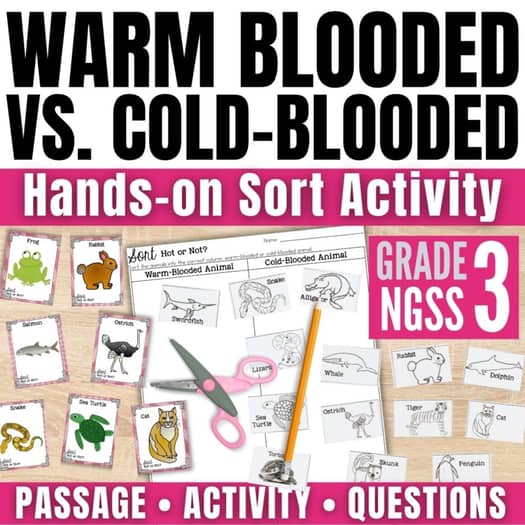
Sort animals according to whether they are warm-blooded or cold-blooded vertebrates. Included are teacher notes and student text to build background knowledge about warm-blooded and cold-blooded animals.
Would you like a Free Science Station?
Sign up below to get a free third grade science activity delivered to your inbox!

Jessica BOschen
Jessica is a teacher, homeschool parent, and entrepreneur. She shares her passion for teaching and education on What I Have Learned. Jessica has 16 years of experience teaching elementary school and currently homeschools her two middle and high school boys. She enjoys scaffolding learning for students, focusing on helping our most challenging learners achieve success in all academic areas.