
 Two-Digit Addition No-Prep Practice with Addition Strategies
 Two-Digit Addition Strategies and Activities for 2nd Grade
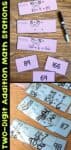
Teaching two-digit addition strategies well means giving students more than an algorithm. Students who only learn to line up numbers and add down the column often hit a wall when regrouping is introduced or when they need to estimate. Students who work through multiple models first — number lines, base-10 blocks, breaking apart addends — build the place value understanding that makes regrouping make sense.

This post walks through the strategies in the Two-Digit Addition Math Stations resource, which was designed to give students structured, self-checking practice with each strategy before moving to the next level of complexity.
The stations are designed for 2nd grade but work well for 1st graders who are ready for two-digit work and for 3rd graders who need reinforcement of place value strategies before moving to three-digit addition.
What is included in the Addition Math Stations
In this set of math stations students focus on a variety of addition strategies including using an open number line, using base-10 blocks, breaking apart or ungrouping the addends, and adding tens to tens and ones to ones. Many of the strategies focus on place-value and help students understand how to use place-value strategies when adding two-digit numbers.
The math stations are self-checking. Answers are included so students can match the answer with the problem and check their own work.
There are four levels of two-digit addition problems. The activities are leveled by the complexity of addition problems:
- Level One: Add Tens (30 + 40)
- Level Two: Add Tens & 1 One (30 + 44)
- Level Three: No Regrouping
- Level Four: Regrouping
Activities are similar throughout the packet so that students use the same models and strategies with increasingly more difficult problems.

Two-Digit Addition Task Cards, Assessments, Activities, and Games
Two-Digit Addition Task Cards, Assessments, Activities & Games includes practice activities to help your students solidify their understanding of how to add two-digit numbers using multiple strategies. Do your students struggle with two-digit addition? Are they struggling with the concept of adding larger numbers? These games and activities will help.
How to Use the Two-Digit Math Stations
All of these actives in black and white so that they can be printed on colored paper (I use regular paper, not card stock) and laminated. Print the full page, laminate the full page, and cut apart. Using regular paper, not card stock, means the layers of paper don’t peel apart and the cards last for years.
Students can then use their whiteboard markers to work out the problem and find the matching answer or equation. Students do the work on the cards and then erase it for the next pair of students. Recording sheets are included for teachers who want more accountability with student work.
Color Code the Problems to Scaffold Two-Digit Addition

By providing four levels, teachers can differentiate the problems for students who need more or less scaffolding. Print the sets of problems on different colored paper and have certain students work through a specific color of problems when they visit that math center.
What Addition Strategies and Models are included?
Students work with four main place value strategies to complete the two-digit addition problems.
- Use an Open Number Line
- Use Base-10 Blocks
- Break Apart (Ungroup) the Addends
- Add Tens to Tens and Ones to Ones (Using Vs)
I have included a fun Spin the Addends game at two of the levels, as well as some quick formative assessments that follow the above levels of problems. Also included are a few extra worksheets that help students make jumps of 10 on a number line and other worksheets where students find patterns when adding one-digit and two-digit numbers.
Read more about a variety of models and strategies to use when solving two-digit addition and subtraction problems.

Use an Open Number Line
The number line stations walk students through the process step by step: what number to start on, how many jumps to make, and how to identify the landing number. There are two versions with the same problems — one where students add the tens first, and one where they start with the largest whole number. Having both versions lets students try each approach and decide which feels more natural.

After completing the number line, students find the matching equation and answer card. The self-checking format means students get immediate feedback without needing a teacher at the center.

Use Base-10 Blocks
The base-10 blocks stations come in two versions. One version has students use 10s sticks only while the other version has students regroup the 10s sticks into a hundreds square. The problems are the same in both sets.

Using the base-10 blocks pictured on each card, students count by tens and then ones to add the numbers together. Students then record the equation and draw the base-10 blocks in the space provided using squares, sticks and dots.
Break Apart or Ungroup the Addends
In this section, students expand each addend into tens and ones. After expanding, students add tens to tens and ones to ones, then group the tens and ones back together into the final sum.
This section is great for students who are moving from drawing symbols to using numbers, but who might still have some difficulty keeping track of it mentally.

Add Tens to Tens and Ones to Ones (or using Vs)
Students can do the activities in this section in one of two ways, with numbers or with base-10 block drawings. More proficient students will feel comfortable using numbers and being able to cross over 10 and 100. Less proficient students may need to continue to draw the sticks and dots.
In this math center, students mentally add the tens to the tens and write the total on the left. They then add the ones to the ones and write down the total. Finally, students add together the tens and ones to find the sum of the original two-digit addition equation.

This section is great for students who are learning to group tens together and ones together without having to draw each addend separately.
Here are a few more ways I teach students to compose and decompose numbers for two-digit addition and subtraction.
Two-Digit Addition Task Cards, Assessments, Activities, and Games
Two-Digit Addition Task Cards, Assessments, Activities & Games includes practice activities to help your students solidify their understanding of how to add two-digit numbers using multiple strategies. Do your students struggle with two-digit addition? Are they struggling with the concept of adding larger numbers? These games and activities will help.
Related Resources
If you want to use the Two-Digit Addition Math Stations with your students, they are available on my website and in my TpT Store.
Other resources that complement the Two-Digit Addition Math Stations include:
You might like a few pages from some of my two-digit addition and subtraction products if you teach second grade. I’ve compiled a PDF of resources as a sampler from several different products that emphasize all the work we do in our classroom to develop these strategies in depth.

Jessica BOschen
Jessica is a teacher, homeschool parent, and entrepreneur. She shares her passion for teaching and education on What I Have Learned. Jessica has 16 years of experience teaching elementary school and currently homeschools her two middle and high school boys. She enjoys scaffolding learning for students, focusing on helping our most challenging learners achieve success in all academic areas.