
Slow and Fast Changes: Examples and 2nd Grade Science Sort
When teaching earth science, one of the most useful distinctions to help students understand is the difference between slow changes examples and fast changes examples in the real world. Slow changes like erosion and mountain building happen over thousands or millions of years.
Fast changes like earthquakes and volcanic eruptions can reshape the land in minutes. This post covers examples of both types of changes and introduces a sorting activity designed for second grade that makes the difference concrete and hands-on.

Find more earth science resources organized by NGSS standard in the complete elementary earth science guide.
What Is the Difference Between Slow and Fast Changes?
Slow changes shape Earth’s surface gradually over thousands or millions of years. Processes like erosion, weathering, and tectonic plate movement are slow changes.
Fast changes happen in seconds, hours, or days. Earthquakes, volcanic eruptions, landslides, and floods are fast changes. The key distinction is speed: slow changes are too gradual to observe directly, whereas fast changes are rapid and often visible.
Examples of Slow Changes
Slow changes are often caused by water, wind, ice, and tectonic plate movement. Here are common examples of slow changes to Earth’s surface:
- Erosion — wind, water, and ice gradually wear away rock and soil over time
- Weathering — rain, freezing temperatures, and chemicals slowly break down rocks
- Sediment deposition — rivers carry sediment downstream and build up landforms like deltas
- Mountain building — tectonic plates push together and raise mountains over millions of years
- Canyon formation — rivers cut through rock layers over thousands of years to form canyons
- Glacial carving — glaciers move slowly and carve valleys as they go
- Sand dune formation — wind gradually moves sand particles to build and shift dunes
- Soil formation — organic material and weathered rock break down over centuries to form new soil
Examples of Fast Changes
Fast changes often happen suddenly and with little warning. Here are common examples of fast changes to Earth’s surface:
- Earthquakes — sudden movement along tectonic plates causes the ground to shake and crack
- Volcanic eruptions — lava, ash, and rock reshape the landscape within hours or days
- Landslides — heavy rain or earthquakes cause rock and soil to slide downhill rapidly
- Floods — rivers overflow their banks, depositing sediment and eroding land quickly
- Tsunamis — massive ocean waves reshape coastlines within minutes
- Avalanches — snow or rock slides down a slope in seconds
If you are teaching this as part of your second grade earth science unit, this sorting activity is a good hands-on companion to these concepts.
What is Included in the Slow and Fast Sort Station
Included in the Sort about Slow and Fast Changes are:
- Reading Passage about erosion, plate tectonics, earthquakes, and volcanoes
- Larger table-group color sorting cards that include a picture and description of the landform
- Smaller cut and paste sort for individual students that include a black-and-white picture
- Differentiated questions in short answer, fill-in-the-blank, and multiple-choice formats. Worksheet and task cards are included for some options.
- Answer key
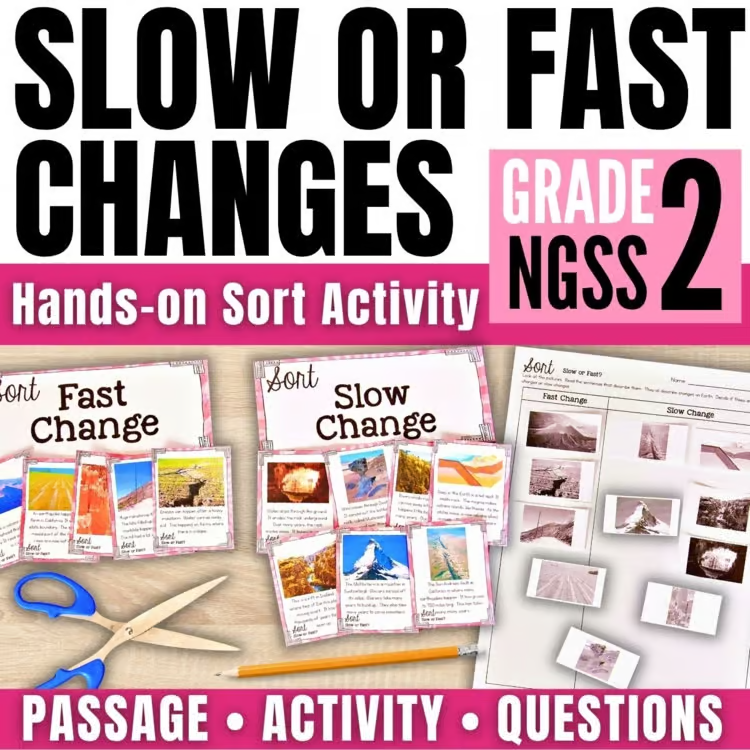
Help your students understand how landforms change over time with this interactive SORT Science Station, part of the History of the Earth unit for 2nd grade.
Slow and Fast Changes Sort for Table Groups
There are two ways to do this sort. One way is in table groups where students look at the images on the cards, read the short description, and determine which type of change the landforms underwent: fast or slow change.
Most of the landforms are an actual place in the world. Here are a few examples of the descriptions:
- The Matterhorn is a mountain in Switzerland. Glaciers carved off its sides. Glaciers take many years to build up. They also take many years to carve mountains.
- This is a rift in Iceland. It is where two of Earth’s plates are moving apart. It has taken thousands of years for this to open up.
- Erosion can happen after a heavy rainstorm. Water carries away soil. This happens on farms where there is a slope.

There are different types of changes that students will learn about in this sort: the slow and fast changes that landforms undergo. Students will decide whether each particular landform forms from a slow or fast change by looking at the images and reading the information.
Slow and Flash Change Cut and Paste Sort
The second way to do the sort is a cut-and-paste option. Students can do both options: sort color option as a whole group and the cut and paste option individually. Or you can choose to have students do only one option.
The cut-and-paste option is all in black and white and a worksheet format. After reading the informational passage, students look at the images and then sort the cards depending on if each landform undergoes a slow or fast change. Have a copy of the color sort available for students to reference since the worksheet sort does not have descriptions of the landforms.

Reading Passage & Differentiated Responses
This science activity comes with a detailed reading passage and differentiated responses for students to demonstrate their understanding.
This reading passage goes in-depth about erosion, plate tectonics, earthquakes, and volcanoes. Included is an MP3 version of the text read aloud for students who struggle with the amount or complexity of the text. The audio text can be accessed via the QR code or link.
Below is an example of the Short Answer worksheet and the Fill-in-the-blank worksheet. Multiple-choice and short-answer task cards are also available for students to use with their science journals.

Help your students understand how landforms change over time with this interactive SORT Science Station, part of the History of the Earth unit for 2nd grade.
How to Purchase the Slow and Fast Changes Science Station
This Slow and Fast Changes Sort Science Station can be purchased on Teachers Pay Teachers. It is sold individually and part of a whole Sorts for Second Grade Science Stations. Also available is a Second Grade NGSS Science Station BUNDLE for History of the Earth.

History of the Earth: Slow and Fast Changes Second Grade Science Stations
In this set of science stations, students learn about how plate tectonics, earthquakes and volcanoes and how they affect the shape of the land around us. It includes 8 different science stations where students deepen their understanding of plate tectonics. All stations in this set meet the DCI 2-ESS1-1 and incorporate ETS1.A.
Would you like a Free Science Station?
Fill in your email below and be send a free second grade science station.

Jessica BOschen
Jessica is a teacher, homeschool parent, and entrepreneur. She shares her passion for teaching and education on What I Have Learned. Jessica has 16 years of experience teaching elementary school and currently homeschools her two middle and high school boys. She enjoys scaffolding learning for students, focusing on helping our most challenging learners achieve success in all academic areas.