
How Plants Prevent Erosion: 4th Grade Science Experiment
Finding a way to make erosion feel concrete, not just a textbook definition, is one of the trickier parts of a weathering and erosion unit. This plants prevent erosion experiment for 4th grade solves that problem by putting two pans side by side: one with bare soil, one with plants, and a pitcher of water. Students see the difference immediately and have the data to explain why.
It’s one of twelve stations in the Weathering and Erosion Science Stations unit, aligned with NGSS 4-ESS2-2 and the Disciplinary Core Ideas 4-ESS2.A and 4-ESS2.E, and it connects directly to real events that students can understand.
What Students Learn in this 4th Grade Soil Erosion Lab
Students read a nonfiction passage about how vegetation affects erosion before running the experiment. The reading opens with a real-world example: a wildfire in Sand Canyon in July 2016 left bare mountain slopes, causing significant mudslides during the winter of 2016–2017 because the plants that held the soil in place were gone. From there, the passage covers:
- What erosion is and how water energy loosens and moves sediments
- How rain separates soil particles, which are then carried away by streams
- The two ways plants protect soil: by covering the surface and by anchoring it with root systems
- How deforestation leaves slopes without root systems, making them vulnerable to erosion
- How over-farming loosens soil and increases erosion risk
- Solutions people use to fight erosion: cover crops, preserves, and tree planting programs
By the time students start the experiment, they already have a framework for what they’re about to see.
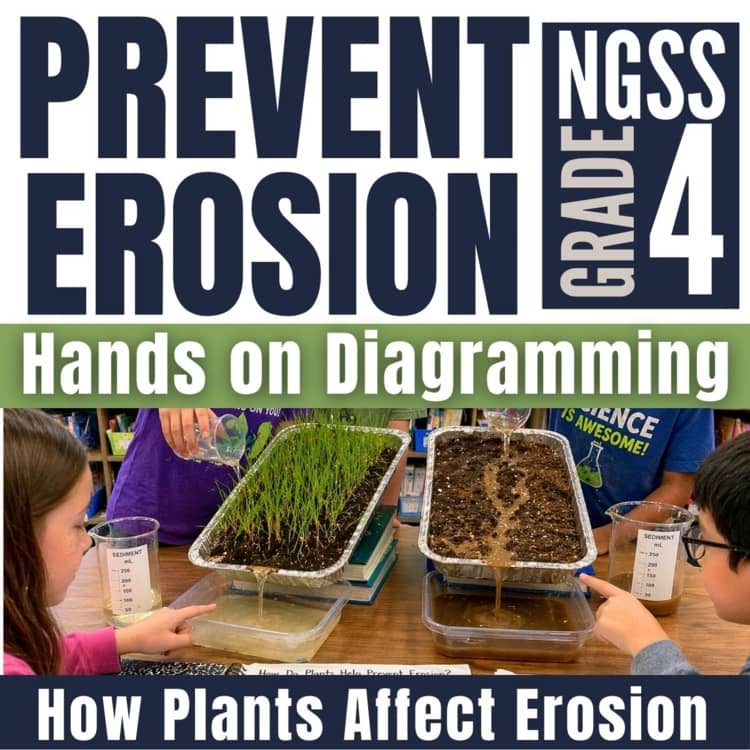
This hands-on 4th grade NGSS science lab allows students to explore soil erosion, weathering, and the role of vegetation through an interactive experiment and diagram activity.
Plants Prevent Erosion Experiment Overview
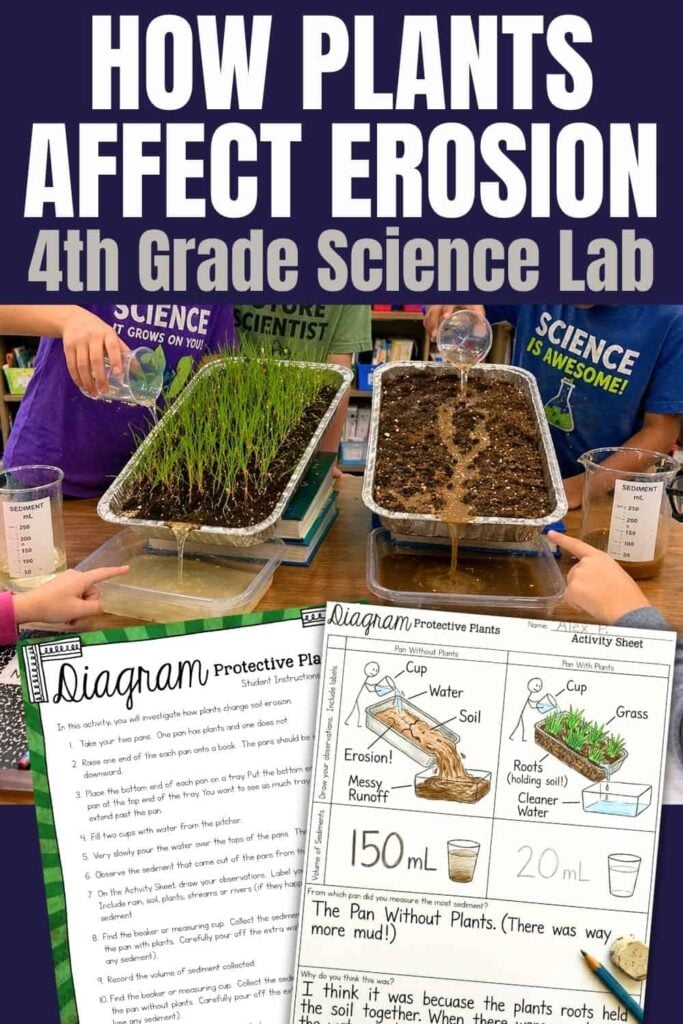
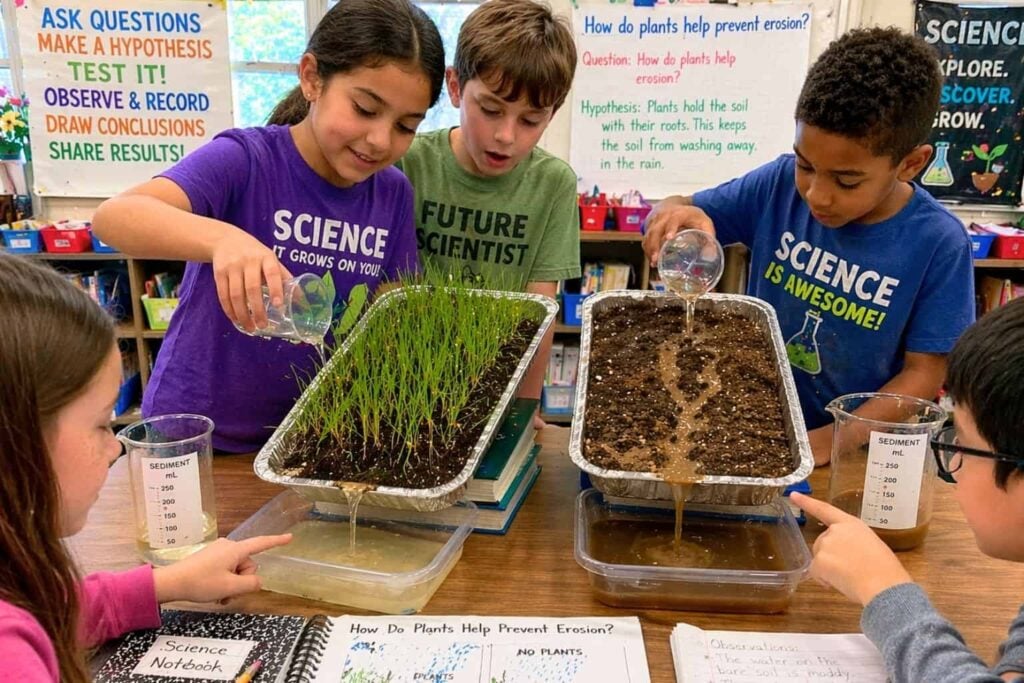
Students set up two identical cake pans on equal stacks of books, pour the same amount of water over each, and compare the results. One pan holds bare soil; the other holds soil with sod or ground cover planted in it. Students measure the sediment in each runoff cup, record their results, draw and label a diagram, and answer comprehension questions.
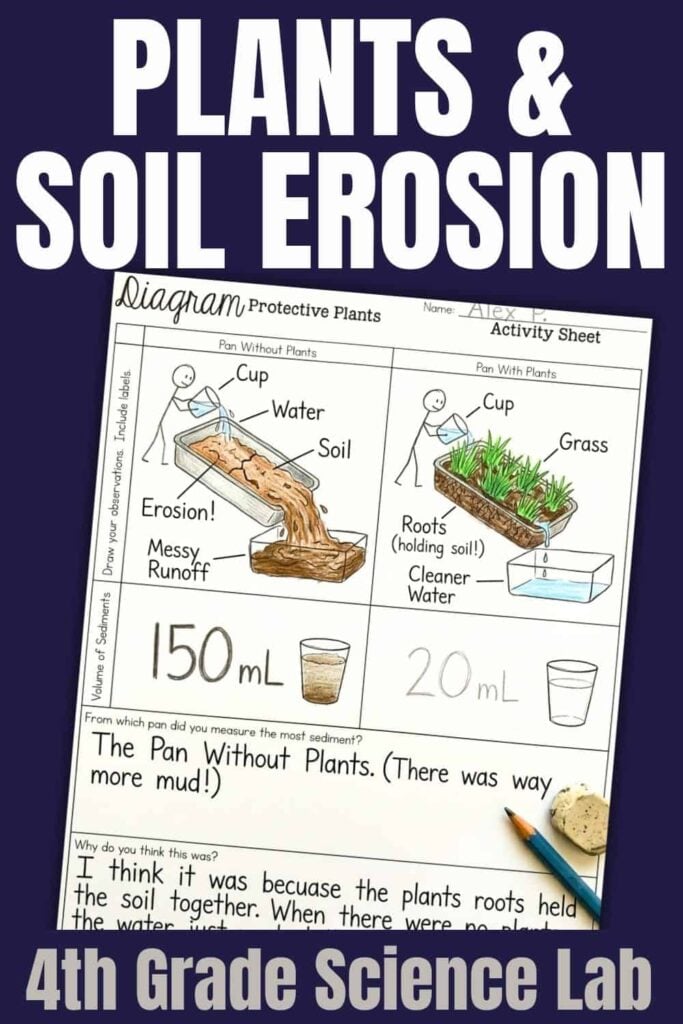
The measurement piece adds a math connection: students use the beaker to measure the volume of sediment in mL, giving them real data to compare. That data becomes the evidence behind their diagram labels and written responses. Students aren’t guessing, they’re reporting what they measured.
Student Sheets and Questions
Four differentiated versions are included, each covering the same 7 comprehension questions.
The short-answer worksheet asks students to explain what erosion is, how water causes it, how plants protect soil in two ways, what happens to erosion when plants are removed, and what solutions exist. It also includes the measurement recording section and a diagram-drawing prompt.
The fill-in-the-blank without a word bank covers the same questions in sentence-completion format. Students need to recall terms like erosion, sediments, deforestation, preserve, and cover crop from memory; this is a good option for students who are near grade level but benefit from sentence-level scaffolding.
The fill-in-the-blank with a word bank provides all key vocabulary for students who understand the concepts but need support with retrieval or written production.
The multiple-choice task cards include all questions, each on a separate card, with four answer options. They work well at a station, for partner quizzing, or as a quick check before moving on.
What This Looks Like in the Classroom
- Science station: Set both pans up at the station before class. The experiment runs quickly once materials are in place, and cleanup is manageable with trays under each pan.
- Whole class experiment: Run the water pour as a class demonstration, then have students complete the diagram and questions independently while the results are fresh.
- Partner investigation: Pairs share one set of materials, take turns pouring the water and reading the beaker measurement, then each completes their own student sheet.
Why This Activity Works So Well
1. The Experiment Makes the Concept Undeniable
Students can read that plants slow erosion, but when they hold two cups of runoff, one cloudy with sediment, one relatively clear, there’s no argument. The experiment produces a result students can observe, measure, and point to. That data makes the comprehension questions feel less like a quiz and more like an explanation of something they actually witnessed.
2. It Builds Scientific Diagram Skills
Drawing and labeling a scientific diagram is a skill students need to practice explicitly. This activity structures it naturally: students aren’t drawing from imagination, they’re recording what they observed. The diagram section guides them to label the pan, slope, soil, plants, water flow, and runoff, giving them practice with visual scientific documentation in a context that makes sense.
3. Cross-Curricular Connections
The reading passage addresses ELA standards 4.RI.1, 4.RI.3, 4.RI.4, and 4.RI.7, so students will cite text evidence, explain how concepts connect, determine the meaning of domain-specific vocabulary, and interpret text features. The measurement portion connects to Math 4.MD.A.1. Students are doing real math and real reading while learning science. Those aren’t separate events.
4. NGSS Alignment
The activity addresses 4-ESS2.A (how water changes Earth’s surface) and 4-ESS2.E (how living things affect Earth’s surface). The experiment provides students with direct evidence of the standards. They’re not asked to take the textbook’s word for it. They generate the evidence themselves.
Easy Differentiation Ideas
For additional support:
- Use the fill-in-the-blank with the word bank student sheet
- Allow students to refer to the reading passage while answering questions
- Pre-label parts of the diagram so students only need to complete selected labels
For extension:
- Have students design a third pan setup, such as soil with rocks instead of plants, and predict what the results would show, then explain their reasoning
- Ask students to research one real-world erosion prevention program and present what methods are used and why they work
- Challenge students to calculate the ratio of sediment collected in each pan and explain what the numbers mean in terms of the experiment
Bringing It All Together
By the end of this activity, students can explain how plants protect soil from erosion in two distinct ways, describe what happens when that protection is removed, and support their explanations with data from their own experiment. The combination of reading, hands-on investigation, measurement, and diagram work means students have engaged with the concept multiple times and in multiple ways, and they have the evidence to back up what they learned.
This activity is part of the Weathering and Erosion Science Stations for 4th Grade, available in the What I Have Learned store on TPT.
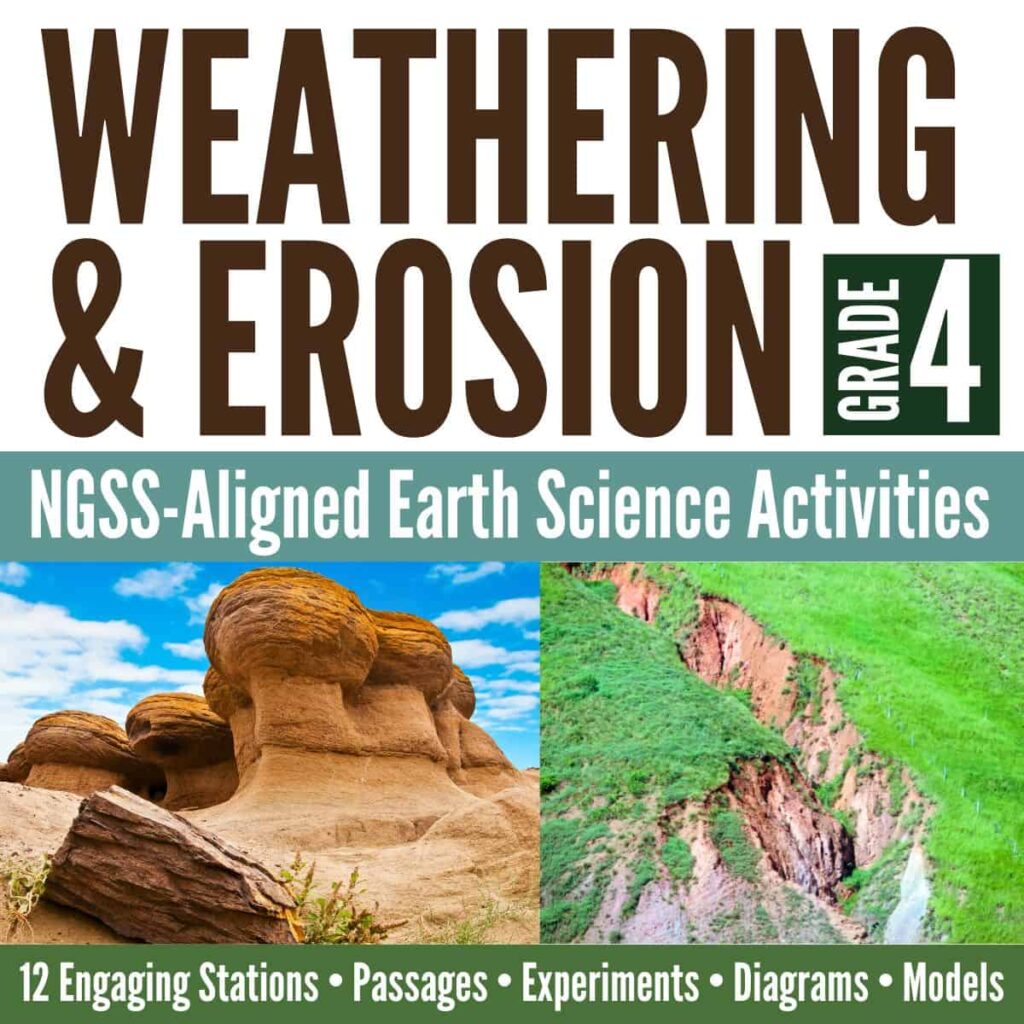
Weathering & Erosion – Earth Materials & Systems, Biogeology BUNDLE
Weathering & Earth Materials & Systems, Biogeology Fourth Grade Next Generation Science Standards include 12 different science stations where students deepen their understanding of how weathering and erosion change the Earth’s surface.
Jessica BOschen
Jessica is a teacher, homeschool parent, and entrepreneur. She shares her passion for teaching and education on What I Have Learned. Jessica has 16 years of experience teaching elementary school and currently homeschools her two middle and high school boys. She enjoys scaffolding learning for students, focusing on helping our most challenging learners achieve success in all academic areas.