
Set Specific Learning Goals with Students
How do you set specific learning goals with students? How do you help them choose the best goal for themselves, make it specific and measurable, grade-level appropriate, and more? How do you do goal setting in an elementary classroom?
Here is one example of how I have done goal setting in my elementary classroom.

A previous blog post on Goal Setting in the Elementary Classroom focuses on how to start goal setting and working with behavior goals at the beginning of the year. I talk about goal setting weekly with the students. In the beginning, we set a lot of behavior goals and then move on to academic goals.
Use a Pre-Assessment to help Students Set Specific Learning Goals
Goal setting works really well if you have some sort of pre-assessment for students to review and then set a goal. Without data, students don’t know where to start or where to go. Students need to know where they are at in order to move forward.
The preassessment doesn’t need to be elaborate or too detailed, but it does need to give you and your students enough information to create an action plan.
Set Learning Goals with Younger Students
Setting learning goals can be complicated for younger students. You have to find something that is relevant to them where they can take ownership and feel like they have a way to “get better”.
I decided to focus on math facts.
We’ve been practicing our math facts for the past several weeks, and thanks to my Automaticity Assessments by Strategy, I know what each student needs to work on (and so do they)!

We started with the above anchor chart, which mimics our goal-setting pages with arrows. On this anchor chart, I explained that we were going to set some goals with math facts and that each student was working on a different math fact.
I put a sticky note at the top after “my” and put, “+2, doubles, doubles +1” on the sticky note, emphasizing that each student was at a different place, but that we can do similar actions or steps to get to our goals.
Brainstorm the Action Steps to Set Specific Learning Goals
We brainstormed all the things we can do to learn our math facts. I elicited ideas from students but tried to be as specific as possible. Here was our final chart after our brainstorming:
We discussed how the things on the outside are activities that don’t help us learn our math facts. Even reading!
We talked about how reading is a good thing, but for this goal, it doesn’t help us learn our facts. That’s a hard concept to grasp, so my basic motto is during math time you have to do math, and during reading time you have to do reading.
Choose ONE on Which to Focus
After we brainstormed all the things that students could do to practice their facts, we discussed choosing one thing that they will work on over the next week to learn their ____ facts.
Students created their own arrow sheet. They wrote down several activities that they like doing to practice their math facts and then {were supposed to} choose one activity to focus on during this next week.

This student needs to work on choosing one (maybe two) thing to do to practice her facts.
We’ll work on that part of goal setting!
Here are a few more examples:
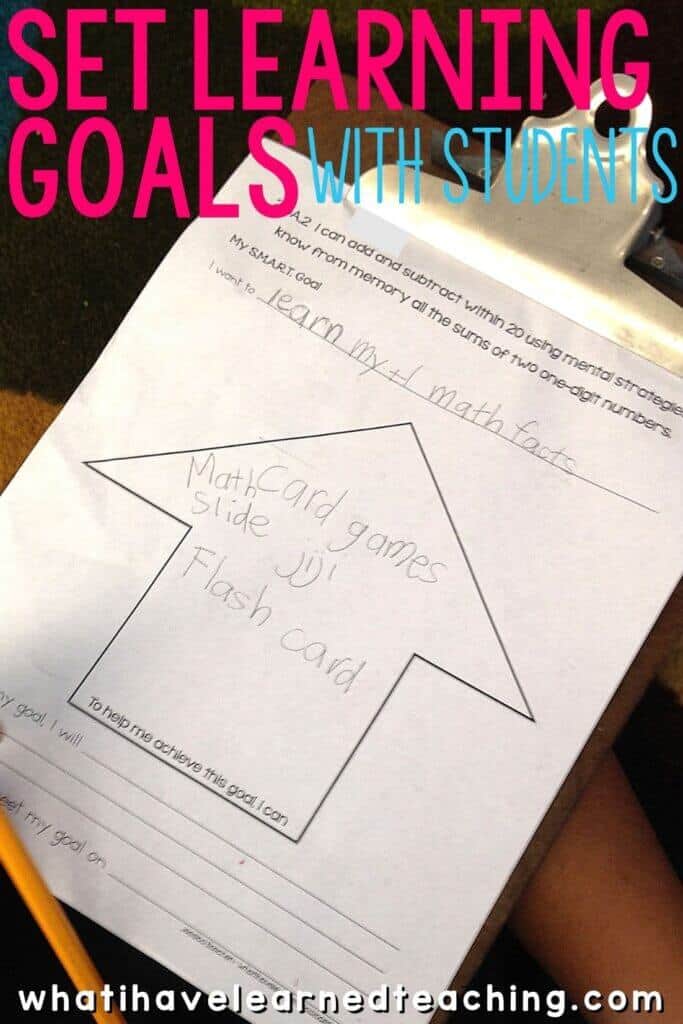
This little one struggled for two weeks to learn her +1 facts and finally passed them on Friday after we did the goal-setting!

Overall, I think they did a wonderful job for their first time setting individual academic goals. We’ll continue with setting goals for math facts over the next couple of weeks and add in a few other goals for reading, too. Those are even more differentiated! I may take that type of goal setting into our small/guided reading groups.

I love this idea! Thank you so much for sharing! It’s a great way to help the kiddos visualize what they can do to help reach their goals!
Hilary
Second Grade is Out of This World!
Could you give us a link for the arrow goal setting sheets? These would be great to work on with my kindergarteners.
The Arrow goal sheet is located within the Goal Setting Lessons PDF.
Hi,
I love the way you implement goal setting I’m trying it out in my class this year. Any advice for how to write a smart goal for gaining confidence? I have a kiddo who acknowledged that it was something she could work on but I am having a hard time writing the so I will….. part of her goal. How do I make it measurable?
Great question! Could you quantify it and do something like, “I will choose to be confident X times in the next week”? Her action steps would need to define what the choice to be confident will look like. Maybe, raise my hand during class, talk with someone I don’t normally talk with, etc. Or you could have a discussion about what it means to be confident then quantify that with doing that action X times over a period of time.