
R Blends Worksheets, Activities, and Word Lists for First Grade (Free PDF)
If you’re looking for r blends worksheets, this is the place for you! R blends can be tricky for early readers because students need to say both sounds together without sneaking in an extra vowel.
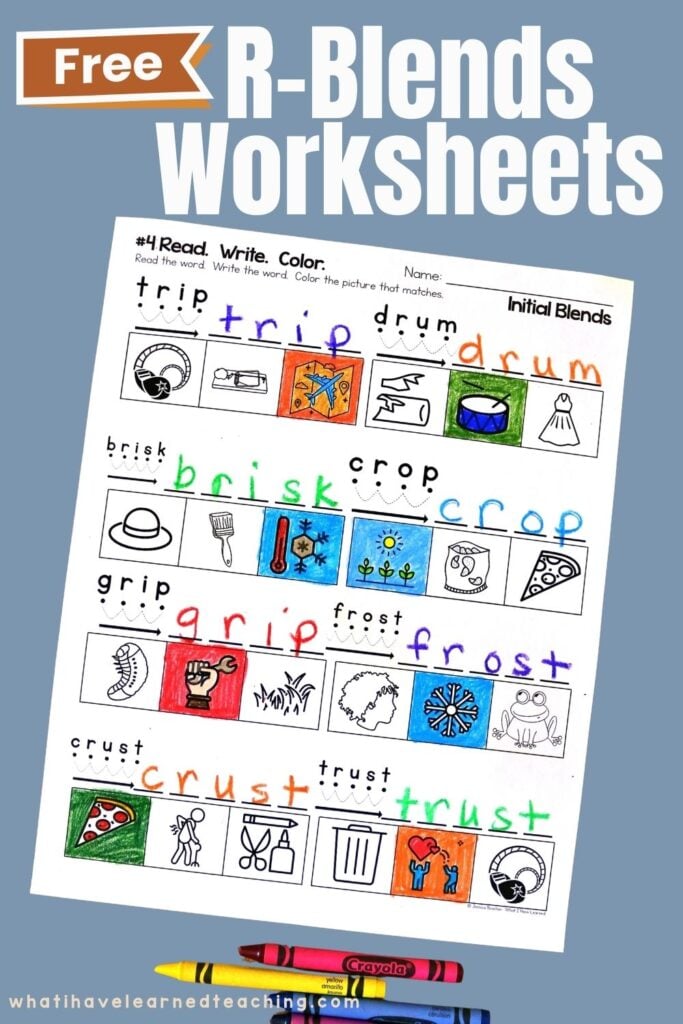
Simple, consistent practice makes all the difference. When students see, say, read, and write r blend words in different ways, the skill starts to click—and suddenly frog sounds like frog (cue teacher celebration 🎉).
In this post, you’ll find r blends worksheets, r blend activities, and r blend words for first grade, plus a free PDF you can use right away with your students.
What Are R Blends?
R blends are two consonants at the beginning of a word where the second letter is r, and both sounds are heard.
Common r blends include:
- br (brag, brush)
- cr (crab, crop)
- dr (drag, drip)
- fr (frog, frost)
- gr (grab, grass)
- pr (press, print)
- tr (trap, trim)
Students don’t blend these sounds into one (like a digraph). Instead, they say both sounds quickly: b-r, c-r, d-r.
Free R Blends Worksheets PDF
Need something you can print and use tomorrow? I’ve got you covered.
These r blends worksheets give students structured practice with reading, writing, and recognizing r blend words.
👉 Grab the free R blends worksheets here:

What’s Included in the Free Worksheets
The free sample includes a variety of activities that build skills step by step:
- Segmenting and blending practice
- Read, trace, and write pages
- Match words to pictures
- Sentence reading with comprehension checks
- Simple writing activities
For example:
- On one page, students segment and blend words like “brag,” “crab,” and “drag” and match them to pictures (page 6).
- Another page has students read, trace, and write words like “fresh,” “trap,” and “grab” (page 7).
- There are even sentence-based activities, such as “Dump the junk in the trash,” that help connect decoding to meaning (page 10).
This mix helps students move from decoding single words to reading full sentences with confidence.
R Blends Worksheets for First Grade
If you’re teaching r blends worksheets first grade, the key is keeping routines predictable and simple.
Here’s what works well:
Use a Consistent Routine
Students should know what to expect:
- Say the sounds
- Blend the word
- Read it
- Write it
When the structure stays the same, students can focus on the phonics skill instead of figuring out directions.
Start with Oral Practice
Before worksheets, try:
- Saying b-r…br together
- Stretching sounds slowly
- Practicing with hand motions
Then move to paper.
Keep It Short and Focused
A single page a day is plenty. (Your future self will thank you.)
R Blend Words for First Grade
Here are some common r blend words first grade students should practice:
BR Words
brag, bran, brush, brim, brisk
CR Words
crab, crash, crop, crust, crunch
DR Words
drag, dress, drip, drum, drop
FR Words
frog, frost, fresh, frizz
GR Words
grab, grass, grill, grin, grip
TR Words
trap, trim, trip, trot, trust
Many of these words are included in the worksheets, along with simple sight words in sentences to support comprehension .
Easy R Blend Activities for the Classroom
Worksheets are helpful—but adding a few quick activities can make learning stick even more.
1. Blend It Like a Robot
Students say sounds in a robot voice:
- “b…r…a…g”
Then speed it up: - “brag!”
Bonus: Kids love anything that sounds like a robot.
2. Picture Match
Show a picture (like a crab) and give students 2–3 word choices:
- crab
- grab
- trap
Students choose the correct r blend word.
3. Write the Room
Post r blend words around the classroom. Students walk around and:
- Find the word
- Write it
- Read it to a partner
Movement + phonics = a win.
4. Sentence Scramble
Give students mixed-up words:
- the / trap / catch / will / rat
Students build:
- “The trap will catch the rat.”
(Yes, it may take longer than expected. Yes, it’s still worth it.)
Why R Blends Practice Matters
R blends show up everywhere in early reading. When students struggle with them, reading becomes slow and choppy.
When they understand them:
- Decoding improves
- Fluency increases
- Writing becomes clearer
And suddenly, those “mystery words” aren’t so mysterious anymore.
Want More Than Just R Blend Worksheets?
If your students are doing well with these, the next step is expanding to:
- Other beginning blends (bl, cl, fl)
- Ending blends (nk, ng, st)
- Mixed review across patterns
That’s where a full phonics set can save you a lot of planning time.
Bringing It All Together
R blends are one of those small skills that make a big difference. With the right mix of practice, repetition, and simple routines, students can master them faster than you might expect.
Start with the free worksheets, keep the practice consistent, and give students plenty of chances to read and write r blend words in context.
And when a student finally reads “frog” without hesitation? That’s the kind of moment that makes phonics teaching totally worth it.
Jessica BOschen
Jessica is a teacher, homeschool parent, and entrepreneur. She shares her passion for teaching and education on What I Have Learned. Jessica has 16 years of experience teaching elementary school and currently homeschools her two middle and high school boys. She enjoys scaffolding learning for students, focusing on helping our most challenging learners achieve success in all academic areas.