
Stir salt into a glass of water, and it seems to disappear. Stir sand into water, and it just sits there. Both are mixtures, but only one is a solution, and that difference is the heart of one of the trickiest topics in elementary science. Mixtures and solutions trip students up because the words sound interchangeable and the science feels invisible.
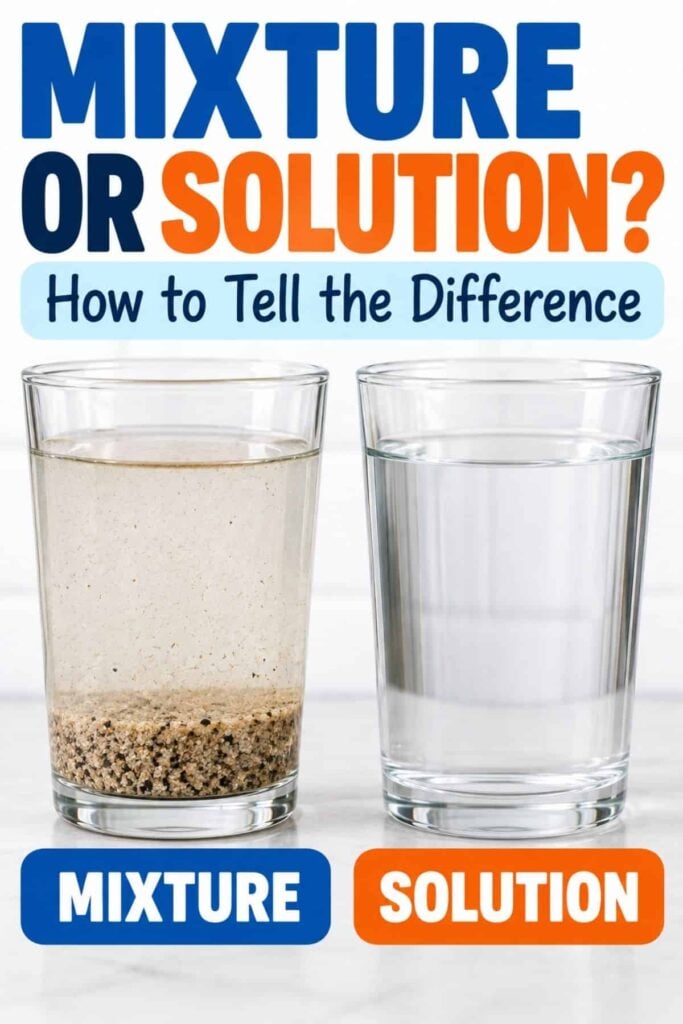
This post explains what a mixture is, what a solution is, how they are different, and how to tell whether a given mixture counts as a solution, along with examples and activities you can use in 5th grade.
What Is a Mixture in Science?
A mixture is two or more substances combined together without becoming a new substance. Each part keeps its own properties, and because nothing new is made, you can usually separate a mixture back into its parts. Trail mix is a mixture: the raisins, nuts, and chocolate are stirred together, but each stays itself, and you could pick them apart again.
The key idea for students is that mixing is a physical change, not a chemical one. No new substance forms.
M post on physical and chemical changes is a helpful companion to this topic.
What Is a Solution in Science?
A solution is a special kind of mixture where one substance dissolves completely and evenly into another. When salt dissolves in water, it spreads out so evenly that you cannot see it or filter it out, and every sip tastes equally salty. That even, dissolved mixing is what makes a solution a solution.
Here is the part students need to hear clearly: every solution is a mixture, but not every mixture is a solution. A solution is just a mixture that has dissolved evenly. Salt water is a solution. Sand in water is a mixture but not a solution, because the sand does not dissolve and settles to the bottom.
The Difference Between Mixtures and Solutions
The difference comes down to whether the parts dissolve evenly. Here it is at a glance:
| Mixture (not a solution) | Solution | |
|---|---|---|
| Do the parts dissolve? | No, or only partly | Yes, completely |
| Can you see the parts? | Usually yes | No, it looks like one substance |
| Is it evenly mixed? | Often uneven; parts can settle | Evenly mixed all the way through |
| Can you filter the parts out? | Often yes | No, filtering will not separate it |
| Examples | Sand and water, trail mix, salad, cereal in milk | Salt water, sugar water, lemonade, brewed tea |
A good rule for students: a solution is always a mixture, but a mixture is only a solution if everything dissolves evenly.
Examples of Mixtures and Solutions
Sorting real examples is the fastest way to make this stick. These are all mixtures, but only some are solutions.
- Solutions: salt water, sugar water, lemonade, brewed tea or coffee, and clear soda. In each, one substance dissolves evenly into another.
- Mixtures that are not solutions: sand and water, trail mix, a garden salad, cereal in milk, and oil and water. You can see the separate parts, and they do not dissolve evenly.
This is exactly the thinking behind test questions that ask which of the following mixtures are solutions. The answer is always the ones where the parts dissolve completely and evenly, like salt water, and not the ones where you can still see or settle out the pieces, like sand in water.
How to Tell if a Mixture Is a Solution
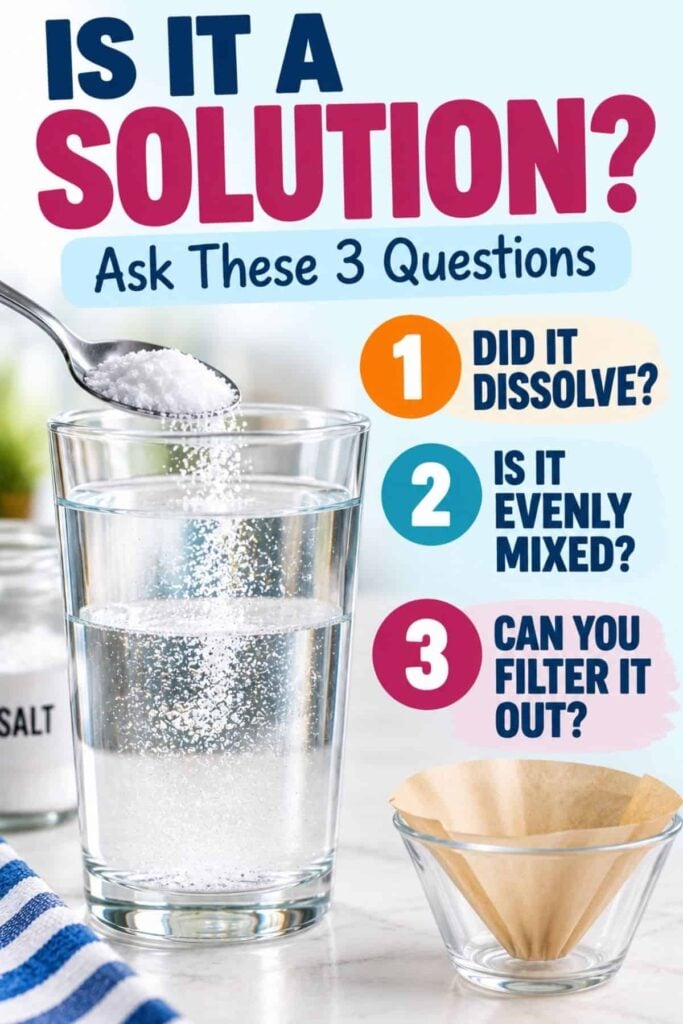
Give students three questions to ask about any mixture. If the answer to all three is yes, it is a solution:
- Did it dissolve completely? The added substance disappears into the other one.
- Does it look the same throughout? No visible pieces, no layers, no settling.
- Can you filter the parts out? A coffee filter or strainer will not separate a true solution.
Sand in water fails the first question, so it is a mixture but not a solution. Salt water passes all three, so it is a solution. That three-question check turns a confusing idea into something students can apply on their own.
Activities for Teaching Mixtures and Solutions
This topic is made for hands-on exploration, since students can mix and separate right at their desks:
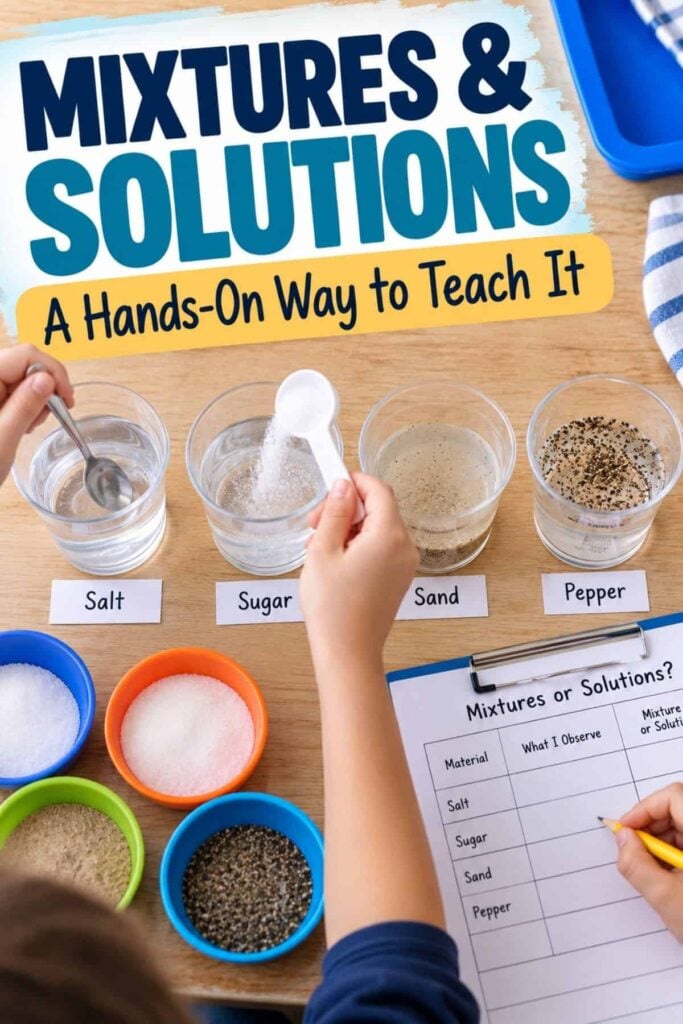
- Make and sort. Give students cups to mix salt, sand, sugar, and pepper into water, then sort each one as a solution or a mixture that is not a solution.
- Separate a mixture. Challenge students to get the parts back out using a filter, a magnet, or evaporation. Evaporating salt water to recover the salt is a favorite, and it shows the salt never really left.
- Solution or not sort. Use picture cards of everyday mixtures and have students sort them, defending each choice with the three-question check.
- Connect it to conservation of matter. Weigh a solution before and after dissolving to show the matter is still all there, which ties into the conservation of matter standard.
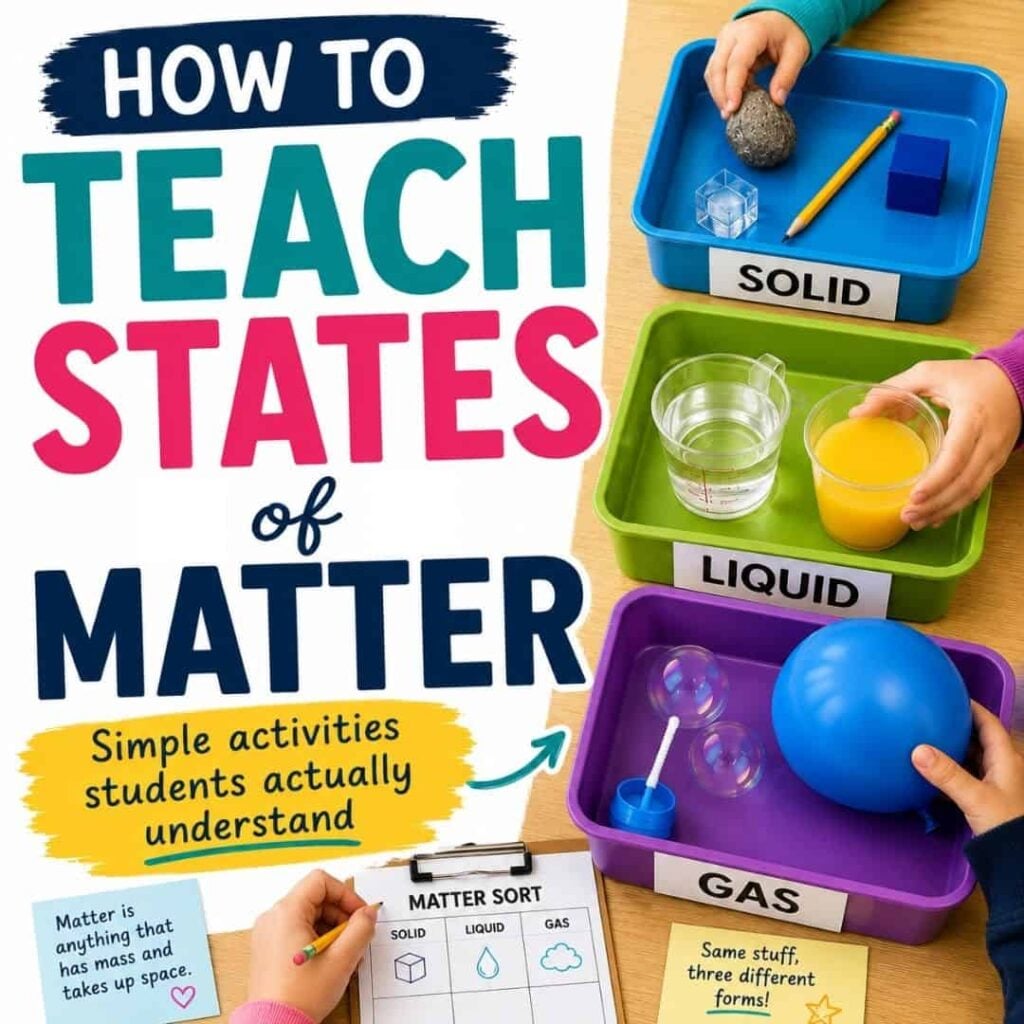
Mixtures and solutions fit naturally into a larger unit on matter. If you teach states and properties of matter first, my states of matter post sets up the vocabulary students bring into this topic.
Frequently Asked Questions
Bringing It All Together
Mixtures and solutions click for students once they have a simple test: did it dissolve evenly, does it look the same throughout, and can you filter it out? Give students real mixtures to make, sort, and separate, and the difference between a mixture and a solution stops being a definition to memorize and becomes something they can see. Build it into your matter unit, and it reinforces everything students are learning about how matter behaves.
Want it ready to teach? My 5th grade properties of matter science stations give students hands-on practice classifying and investigating matter, and pair well with a mixtures and solutions unit aligned to NGSS.
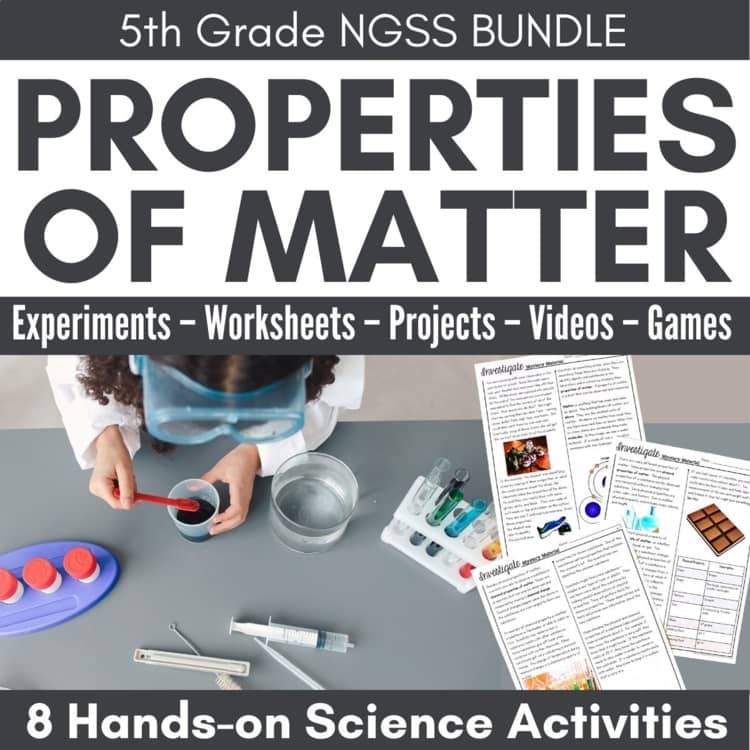
5th Grade Properties of Matter Science Stations | NGSS 5-PS1-3
Engage your students with these 5th Grade Properties of Matter Science Stations aligned to NGSS 5-PS1-3. This hands-on resource includes 8 interactive stations, reading passages, investigations, games, graphic organizers, and digital Google Classroom™ activities that help students identify materials based on their physical and chemical properties.
Jessica BOschen
Jessica is a teacher, homeschool parent, and entrepreneur. She shares her passion for teaching and education on What I Have Learned. Jessica has 16 years of experience teaching elementary school and currently homeschools her two middle and high school boys. She enjoys scaffolding learning for students, focusing on helping our most challenging learners achieve success in all academic areas.