
Geosphere Activities: Hands-On Earth Science
Teaching Earth’s spheres can feel abstract, especially when students are trying to picture how rocks form, how landscapes shift, and how living things interact with the ground beneath them. The geosphere is a great place to start because it’s tangible.
Students can hold rocks, dig in soil, and watch erosion happen in real time. This roundup of geosphere activities pulls together hands-on lessons that get students exploring the land sphere and seeing how it connects to the hydrosphere, atmosphere, and biosphere.

Want to see how this fits into your full science year? The Earth Science for Elementary Students guide maps out every standard from 2nd through 5th grade, with activities and resources for each.
What Students Learn About the Geosphere
The geosphere is the solid Earth: rocks, minerals, soil, mountains, and the layers beneath our feet. When students study it, they start to see that the ground isn’t static. It’s constantly being shaped, broken down, and rebuilt. Across these activities, students explore:
- How soil supports plant life and connects the geosphere to the biosphere
- How rocks form, change, and break down through the rock cycle
- How weathering and erosion reshape the land over time
- How fossils preserve clues about Earth’s past
- How landforms shape weather and where organisms can live
Earth’s Geosphere Science Activities
In the science activities below, students will explore rock classification, how rocks form and break down over time through erosion, and how the other spheres affect the geosphere.
Rock Classification Activities
Rocks are the easiest entry point into the geosphere. Bring in a collection of samples and have students sort them by color, texture, hardness, and composition. Once they get the hang of looking closely, they start noticing patterns that naturally lead to discussions about how different rocks form.
Two of my favorite geosphere activity sets focus on rocks. In the Fossils in Rock Layers Diagram activity, students read about how fossils end up preserved in sedimentary rock, then complete a diagram showing fossils across rock layers. It’s a great way to reinforce the connection between time, sediment, and the fossil record.
For the rock cycle itself, the Chocolate Rock Cycle activity is a student favorite. After reading a passage about how rocks form and change, students use chocolate shavings to model sedimentary, metamorphic, and igneous rocks. The chocolate is memorable for obvious reasons, but it also makes the abstract idea of heat and pressure feel real.

Students complete a diagram of fossils in rock layers and answer questions in order to reinforce what they have learned about fossils and rock layers.

In this science activity, students will have the chance to create an assortment of “rocks” using delicious chocolate shavings.
Erosion Simulation: Geosphere Meets Hydrosphere
A simple stream table shows students how water shapes the land. Set up a tray with soil and small rocks, then let water flow through it. They’ll see channels form, sediment move, and tiny canyons appear. It’s one of the clearest ways to demonstrate how the hydrosphere acts on the geosphere.
The River Erosion and Deposition science station takes this further. Students read background passages, then run controlled experiments testing factors that affect erosion and deposition. It pairs well with a stream table demonstration as a follow-up investigation.

Designed for 4th-grade classrooms, this engaging station encourages students to observe, test, and analyze how water and slope affect the movement of soil.
For 5th grade, the Ocean Erosion and Deposition reading passage and investigation takes the concept to the coast. Students read about how waves, wind, and living things work together to shape coastal landforms, then investigate solutions people use to prevent coastal erosion and deposition. It’s a great way to extend erosion learning beyond rivers and into a real-world problem students hear about in the news. Like the other 5th-grade stations, it ties to NGSS 5-ESS2-1.

Perfect for teaching Earth’s spheres and systems, this hands-on activity combines reading comprehension, critical thinking, and engineering design as students explore real-world coastal problems and propose solutions.
Mountains and Rainfall: How Landforms Shape Weather
Mountains are one of the clearest examples of the geosphere influencing the hydrosphere. As prevailing winds push clouds toward a mountain range, the air rises, cools, and drops its moisture on one side. The other side stays dry. Students often haven’t connected the dots between the land they see and the rainfall patterns above it, and this is a powerful “aha” moment.
The Mountain Rainfall reading passage and graphing activity is a great fit for 5th grade. Students read about how prevailing winds and elevation affect precipitation, then graph real precipitation data from towns near a mountain range. By the end, they can clearly see how a geospheric feature creates a measurable pattern in the hydrosphere. This one ties directly to NGSS 5-ESS2-1.

This hands-on science station combines informational text with data analysis and critical thinking to help students understand how the geosphere impacts the hydrosphere through mountains, precipitation, and rain shadows.
Landforms and the Biosphere
The shape of the land determines what can live there. A mountain supports different plants and animals than a plain or a plateau, and changes to the geosphere ripple outward into the biosphere almost immediately. This is another sphere interaction students can grasp quickly with the right activity.
The Landforms and the Biosphere modeling activity gives 5th-grade students a structured way to investigate this. Each student is assigned a landform (mountain, plateau, hill, or plain) and reads about the organisms that live there. Then they analyze a scenario where the geosphere changes and predict how the biosphere responds. The final piece is a three-dimensional model showing the landform after the change. It’s hands-on, it’s specific, and it gets students thinking about cause and effect across spheres.

Students explore how mountains, plateaus, hills, and plains are formed, how they affect the climate, and how organisms adapt to different environments through a combination of reading, research, and hands-on modeling.
Weathering Caused by Animals: Geosphere Meets Biosphere
Animals are surprisingly powerful weathering agents. From burrowing rodents to tree roots pushing through cracks, living things constantly break rocks apart and move soil. This is a fun angle because students don’t usually think of animals as part of geology.
In this animal weathering activity, students read about creatures that break apart rock and then build a model animal burrow to see how the process works. It’s a clear bridge between the biosphere and geosphere that often surprises students.

Students explore the fascinating world of animals that break apart rocks. Through reading about these creatures and creating an animal burrow, students investigate the concept of weathering that is caused by animals.
Soil Composition Analysis
Soil is the geosphere doing one of its most important jobs: supporting life. Have students collect samples from a few different spots around school, then use sieves and magnifying glasses to separate sand, silt, clay, and organic matter. Comparing samples leads to great conversations about what makes soil good for growing things.
The Soil and Plant Growth model is a strong fit here for 5th grade. Students explore how soil composition affects which plants can grow, thereby tying the geosphere directly to ecosystems and the biosphere.

This station encourages students to think like scientists as they analyze soil conditions, observe patterns, and record their findings while reinforcing key life science concepts.
Why These Geosphere Activities Work
Each of these activities does something a textbook page can’t. Students hold the rocks. They watch the water carve a channel. That tactile experience is what turns vocabulary into understanding.
These geosphere activities also make the connections between Earth’s spheres visible. Erosion isn’t just a geosphere topic; it’s the hydrosphere doing work on the land. Soil isn’t just dirt; it’s where the geosphere meets the biosphere. Fossils aren’t just old bones; they’re a record of how all the spheres have interacted across deep time.
Bringing It All Together
Start with rock classification to ground students in what the geosphere is, then move on to processes such as weathering, erosion, and fossilization. Layer in sphere interactions with mountains and rainfall, landforms and ecosystems, and soil and plant growth. By the end, students will see the ground beneath them as something dynamic, connected, and worth paying attention to.
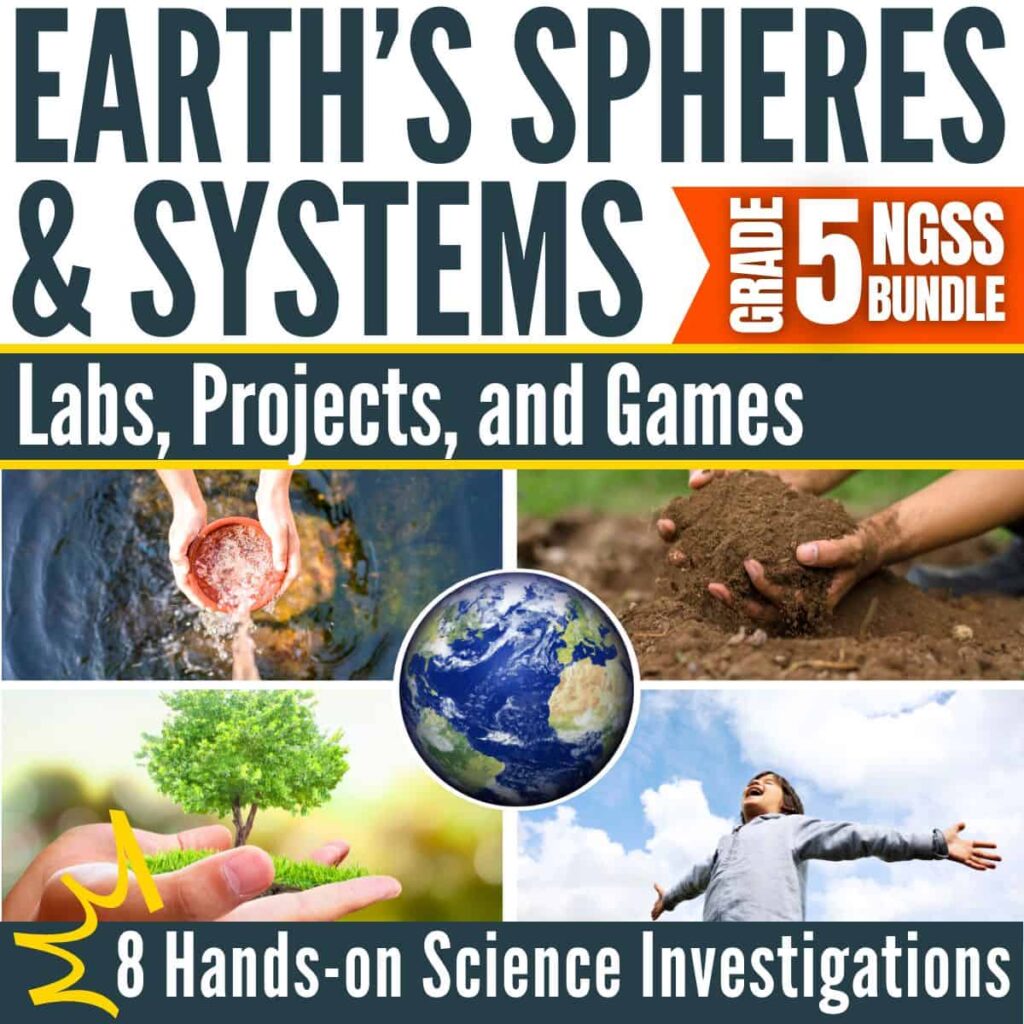
Earth’s Spheres and Systems Science Station UNIT BUNDLE
These Earth’s Spheres and Systems Next Generation Science Stations include eight different science stations where students deepen their understanding of the Earth’s Spheres, the five layers of the atmosphere, the kingdoms in the biosphere, and the systems in the geosphere. The focus is on 5-ESS2-1.
Jessica BOschen
Jessica is a teacher, homeschool parent, and entrepreneur. She shares her passion for teaching and education on What I Have Learned. Jessica has 16 years of experience teaching elementary school and currently homeschools her two middle and high school boys. She enjoys scaffolding learning for students, focusing on helping our most challenging learners achieve success in all academic areas.