
Climate Zone Sorting Activity Third Grade Science Station
If you’re looking for a hands-on way to teach climate zones, this climate zone sorting activity for third grade makes the concept clear and engaging for students.

Instead of memorizing definitions, students read real-world descriptions, think critically, and sort each example into the correct climate zone. It turns what could be a dry topic into an interactive science station your students will actually remember.
This resource is aligned to NGSS and works well for centers, small groups, or whole-class exploration.
What Is the Climate Zone Sort Activity?
This climate zones sorting activity helps students understand how different regions of the world have different climates based on temperature and precipitation patterns.
Students:
- Read short descriptions of places around the world
- Identify key climate clues (temperature, rainfall, seasons)
- Sort each description into the correct climate zone
It’s a simple structure, but it encourages students to think rather than guess.
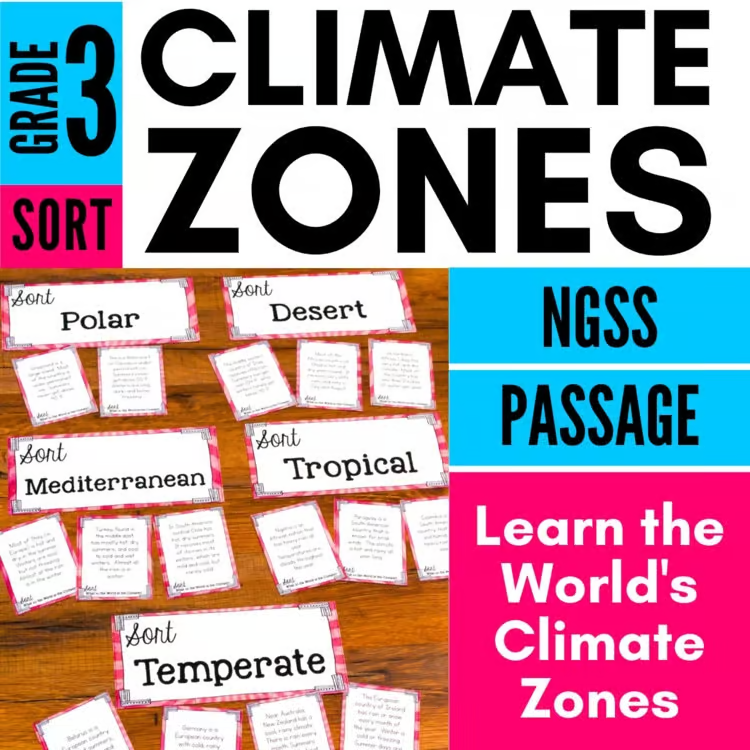
This NGSS-aligned Earth Science Station invites students to explore our planet’s diverse climates, from the polar zones’ icy reaches to the lush greenery of the tropics.
What’s Included in the Climate Zone Sorting Activity
This science station includes multiple options so you can easily differentiate for your students.
Informational Text
Students begin with a short, student-friendly article that introduces each climate zone:
- Polar
- Temperate
- Mediterranean
- Desert
- Tropical
This gives them the background knowledge they need before sorting.

Differentiated Student Responses
You’ll find multiple formats to meet different student needs:
- Short answer questions
- Fill-in-the-blank responses
- Multiple-choice questions
You can choose what works best for your class (or use all three for differentiation).
Sorting Activity Options
1. Table Group Color Sort
- Encourages students to explain their thinking
- Larger cards for collaborative group work
- Great for discussion and reasoning

2. Cut and Paste Sort (Individual Option)
- Black-and-white version for easy printing
- Perfect for independent practice or assessment
- Simple and focused

3. Geography Connection (Optional but Powerful)
Students can:
- Locate countries on continents
- Color-code them based on climate zones
- Create a visual world map of climates
This adds a strong cross-curricular connection without extra prep.
Answer Key
An answer key is included so you can quickly check student understanding or use it for self-checking.
How the Climate Zone Sort Works
Each card includes a short description of a real place. Students read carefully and determine which climate zone it belongs to.
Here are a couple of examples:
- Belarus is a European country with hot summers, cold winters, and rain all year long.
- The northern part of Canada is under permanent ice. Summers never get above 50°F. Winters are long, dark, and below freezing.
Students use clues such as temperature, seasons, and precipitation to determine where each example belongs.
This builds a deeper understanding than simply labeling a map.
Why This Activity Works for Third Grade
Third graders are ready to move beyond surface-level definitions. This activity helps them:
- Apply science concepts to real-world examples
- Practice reading comprehension in science
- Build reasoning and discussion skills
- Make connections between climate and location
It’s one of those activities where you can actually hear students thinking out loud, which is always a good sign.
Flexible Formats for Any Classroom
This climate zone sorting activity comes in both:
- Full-color (great for centers and reuse)
- Black-and-white (easy to print and assign)
You can use it for:
- Science stations
- Small group instruction
- Whole class modeling
- Independent practice
- Quick assessments
Extend the Learning
If you want to go deeper, this activity pairs well with:
- A full weather and climate science station set
- A 5E climate unit for more structured instruction
- Geography lessons on continents and regions
It works well as either an introduction or a review.
How to Get the Climate Zone Sorting Activity
This Climate Zone Sorting Activity for Third Grade is available on Teachers Pay Teachers. It can be used as:
- A stand-alone science station
- Part of a larger weather and climate unit
- Included in a third-grade science station bundle
This NGSS-aligned Earth Science Station invites students to explore our planet’s diverse climates, from the polar zones’ icy reaches to the lush greenery of the tropics.
Want a Free Science Station?
If you’d like to try a similar activity first, you can grab a set of free science stations for 2nd–4th grade. It’s a great way to see how these sorts work in your classroom before diving into the full set.

Jessica BOschen
Jessica is a teacher, homeschool parent, and entrepreneur. She shares her passion for teaching and education on What I Have Learned. Jessica has 16 years of experience teaching elementary school and currently homeschools her two middle and high school boys. She enjoys scaffolding learning for students, focusing on helping our most challenging learners achieve success in all academic areas.