
Addition and Subtraction Within 20 Strategies: Make 10, Add 10, and Use 10
I am all about teaching students to use strategies when adding and subtracting. Second-grade standards ask students to fluently add and subtract within 20 using strategies, not just memorization. To become fluent, students need to take ownership of the math facts and create their own pathways to find the solution.

What I like to do is present students with a variety of strategies and then see what resonates with each student and helps them become a more efficient math fact solver.
In a previous post, I touched on the importance of developing 10 as a benchmark number. I also gave an example of some math stations that we use when adding +8 and +9 math facts.
I have even more information about using addition strategies for developing +9 facts and a pretty cool “trick” that I taught my son.
In this post, I explain the strategies we use for addition and subtraction within 20 as well as share some worksheets and activities you can use with your students.
Addition and Subtraction Within 20 Strategies
When students learn addition and subtraction within 20, memorizing facts is only part of the process. Strong math instruction helps students develop strategies that make solving problems easier and more efficient.
Three of the most helpful strategies students learn in second grade are:
| Strategy | What Students Do | Example |
|---|---|---|
| Make 10 | Combine numbers to make 10 first | 8 + 2 = 10 |
| Add 10 | Add ten to a number and notice the pattern | 10 + 7 = 17 |
| Use 10 | Break apart numbers to make a ten first | 9 + 6 → (9 + 1) + 5 |
These strategies help students move from counting to flexible thinking about numbers.
The activities below show how students can practice each strategy using visual models, games, and worksheets.
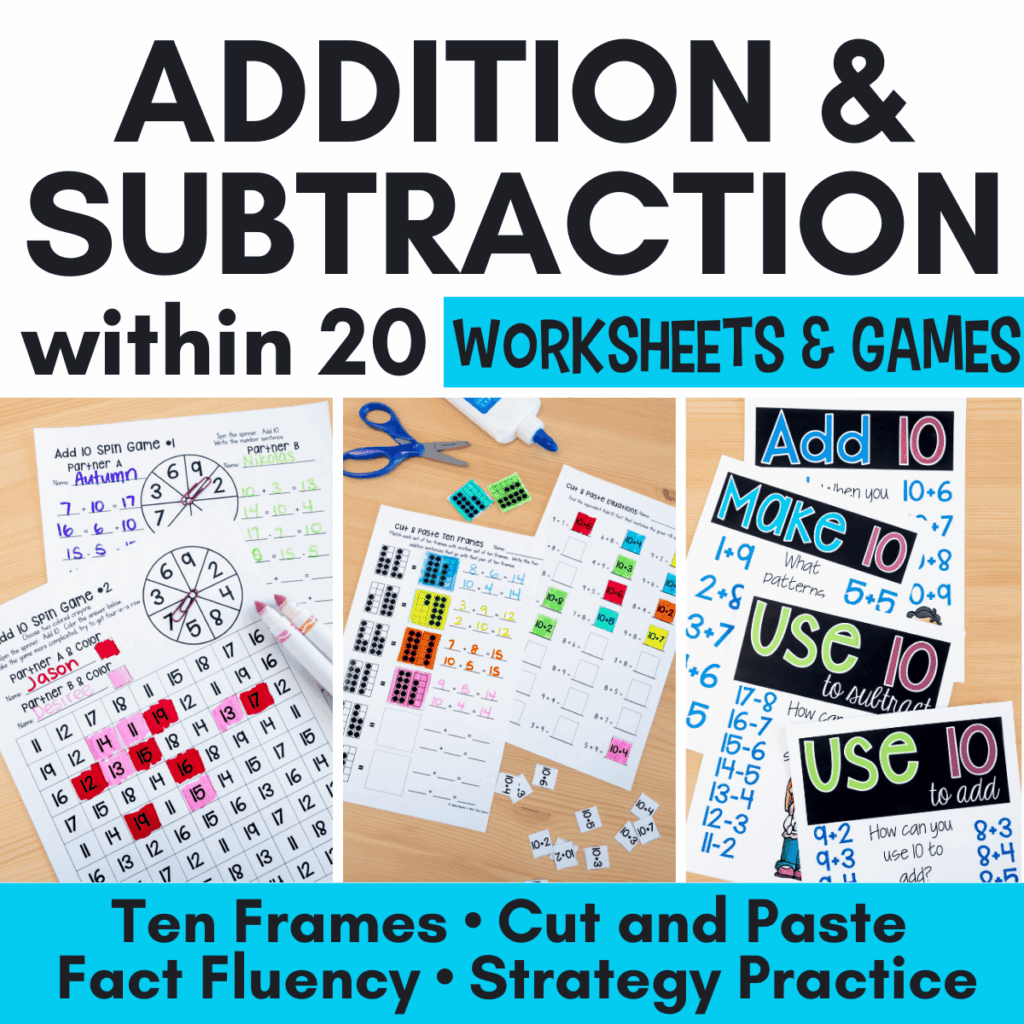
Addition and Subtraction Within 20 Using Ten as a Benchmark
Help second grade students build addition and subtraction fluency within 20 by using 10 as a benchmark number. This math unit includes no-prep worksheets, cut-and-paste activities, partner matching cards, and quick checks focused on making ten, adding ten, using ten to add, and using ten to subtract.
Worksheets for Addition and Subtraction Within 20 Strategies
In this blog post, I’m going in-depth on how to scaffold using 10 to add and subtract by developing some make 10 and add 10 strategies.
The worksheets you see below are from my Addition and Subtraction within 20: Make 10, Add 10, Use 10 to Add, Use 10 to Subtract resource. This resource contains 200 pages of worksheets that approach these concepts in a variety of ways, from number bonds, ten frames, number lines, and fun partner games.
Also available are complimentary games and activities that Use 10 to add +9 and +8 facts. The worksheets provide great instruction and practice, while the games are fun and help students go deeper and develop flexibility in their thinking.
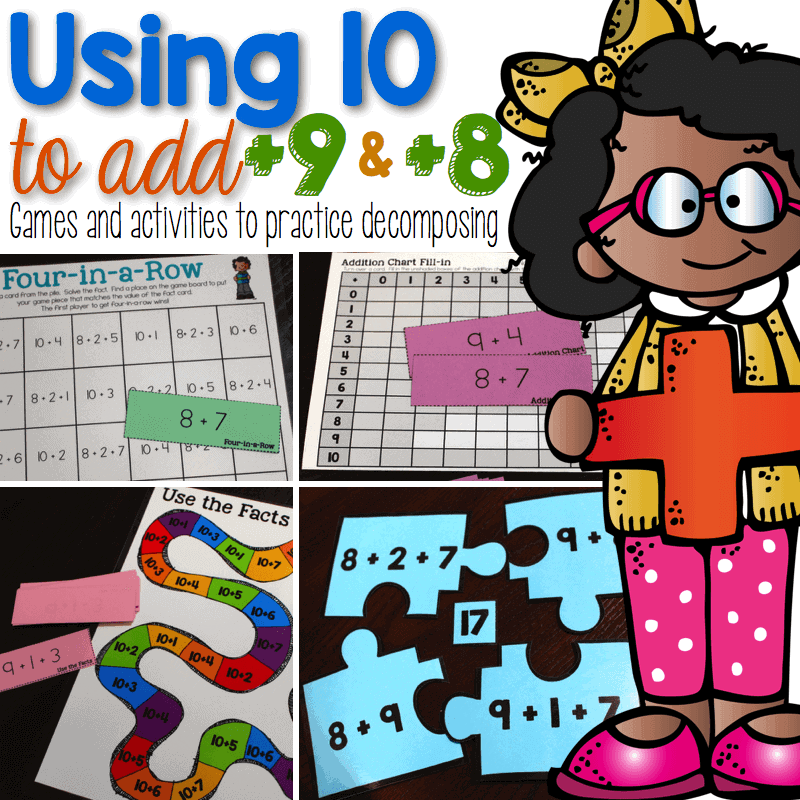
Using 10s to Add (+9 and +8)
Using 10 to Add is full of a variety of games and activities to engage your students in using ten to add +9 and +8 facts. These games and activities specifically focus on establishing 10 as a benchmark number to give students practice in developing automaticity with larger math facts before moving on to multi-digit addition and subtraction.
I differentiate between Make 10, Add 10, and Use 10 in this set of resources
- Make 10 is simply finding two numbers that add up to 10, like 7+3.
- Add 10 is adding 10, like 10 +7.
- Use 10 is finding a make 10 fact that you can use to find the answer. This is generally to a +8 and +9 fact. Although it can be used with other numbers, this set of worksheets concentrates only on +/- 9 and 8.
Most of the worksheets you see below are duplicated for each of the math strategies, with different numbers in place. If you want some additional information on the difference between strategies and models, I go in-depth about that topic in this blog post.
Make 10 Strategy for Addition Within 20
The make 10 strategy helps students solve addition problems by creating a group of ten first. Since students are very familiar with the number 10, this strategy makes larger facts easier to solve.
For example:
8 + 5 can be solved by breaking apart the 5.
8 + 2 = 10
10 + 3 = 13
Students often practice this strategy using:
- ten frames
- number bonds
- counters
- equations
The worksheets below give students multiple ways to see how numbers combine to make ten.
There are a variety of worksheets that use ten frames, number bonds, and equations. This variety not only allows you to differentiate for a variety of students but also develops students’ flexibility in mathematical thinking.

The bottom worksheet helps students see the combination of ten frames and digits. This is a great transition tool to move students from using models to numbers. Below is the same worksheet in its entirety.
One thing I love about my cut-and-paste worksheets is that students have all of the answers right there on the worksheet. Each problem on the worksheet below has four possible “answers”. Students use a visual ten-frame and numbers to help write the equations.


We also work on matching ten strips and matching ten frames. This worksheet Is an easier version of the concept as it just requires matching. Students match the ten strips and write the corresponding equations.
This sheet also develops the understanding that the order of the addends does not matter when adding.
I include both ten frames and ten strips because students will resonate with different models. I want students to be able to think flexibly, no matter the model.
After working with two ten frames, the above worksheet asks students to create one of the ten frames and write the fact family. This sheet helps students to discover a pattern and practice both addition and subtraction when writing the fact family.
Make 10 with Number Bonds
Number bonds are another great tool to use in the classroom. Students generally learn to use a number bond in kindergarten and first grade, so it’s not a new tool. However, I want my second graders to become fluent in using them, no matter the orientation of the number bond.
I’ve created this sheet of number bonds in all different directions so that students have practice orienting themselves. Sometimes students come into class with a fixed mindset in math and need some help developing more flexible thinking strategies.

Make 10 Spinner Games
Also included in each section are spinner games that students can play with a partner. Here is an example of the Make 10 spinner game.

Make 10 Word Problems
One more resource at each level is word problems, where students can practice the mathematical skills within a context. Students are encouraged to draw a picture to illustrate their thinking.

These word problems align with my Word Problems by Problem Type resources. The Word Problems by Problem Type are numberless word problems that encourage students to read for context. The numberless word problems also allow teachers to differentiate the computation. Teachers can easily create problems with Making 10, Adding 10, or Adding or Subtracting +9 or +8 facts.
Developing 10 as a Benchmark Number
One of the most important ideas behind addition and subtraction within 20 is helping students see 10 as a benchmark number. When students understand how numbers combine to make 10, they can use that understanding to solve many different math facts more efficiently.
As students become comfortable with this idea, strategies like Make 10, Add 10, and Use 10 become much easier for them to apply when solving problems within 20.

If you want to see more classroom activities that help students build this understanding, take a look at my post on Strategies that Develop 10 as a Benchmark Number, where I share additional activities and math routines that strengthen students’ understanding of how numbers relate to ten.
Add 10 Strategy
Adding 10 is one of the easiest mental math strategies students learn. When students add ten to a number, the ones digit stays the same while the tens digit increases by one.
For example:
7 + 10 = 17
4 + 10 = 14
Practicing this strategy helps students later when they begin adding and subtracting two-digit numbers.
Add 10 is a pretty easy skill for students to develop, so we don’t spend too long on it. However, it isn’t one to skip.
Why?
When students start using number lines and making jumps of ten when adding and subtracting two-digit numbers, having this skill as a foundation will really help them see the pattern of the ones-digit with the larger numbers.
Below is a number bond sheet. You’ll notice that I continue various orientations. There are several versions of the number bond sheet with a variety of numbers.


Above is a cut-and-paste sheet where students are presented with adding 10 in a variety of formats. This helps promote flexibility in thinking. I love that the cut-and-paste worksheets provide all of the answers.
Fun Partner Games
Here is another fun partner game. Students spin the spinner and add 10 to the digit that was spun. This helps students develop mental math skills while having fun with a classmate.

Students can play an easy version of the game where they simply color squares or play a more challenging version where they have to connect four squares together.
In the picture below are a variety of worksheets from this section of the resource. Students use number bonds, equations that face different directions, and ten frames. All of these models help students develop flexibility in their mathematical thinking.

The bottom worksheet above helps students see the combination of ten frames and digits. Students will develop fluency when they see that the digit in the ones place is the same as that in the ten-frame on the right. This is a great tool to help students move from using models to numbers.
Use 10 Strategy for +9 and +8 Facts
The use 10 strategy is often used when students solve +9 and +8 facts. Students break apart one number to make a ten first, then add the remaining amount.
Example:
9 + 7
Break apart the 7:
9 + 1 = 10
10 + 6 = 16
This is the place where we want students to develop a variety of strategies and ways of breaking apart numbers. Students can practice this strategy with:
- equations
- number lines
- ten frames
- number bonds
In this section are a variety of worksheets for breaking apart one of the addends. In the resource are Add +8, Add +9, Subtract -8 and Subtract -9 as well as a mix of all four strategies. Below are some of the activities.


In the above sheet, students cut out and match ten frames that have the same value as the one provided on the left. If students need to, they can count the dots, but I’m hoping at this point, students can move the dots over to find the equivalent ten-frame set. After matching, students write the equations that go with the ten frames.
The second sheet is another cut-and-paste worksheet that asks students to do the math without ten frames. I generally provide students with ten frames and counters to use, but with the amount of practice that we’ve done, most of my students can do it without the ten frames.
There are many equations on this page, and they are all +8 and +9 facts. I find that most students will use a ten to add when adding +8 and +9 facts, but not with +7 and +6 facts. It’s just a little bit too far of a jump for them.
Above is a worksheet where students practice adding up. Students start with the 8 or 9, add up to 10, then add up to the minuend.
Also above are a few more examples of the worksheets in the Use 10 to Add section. There is a spinner game where students practice breaking apart the subtrahend to add 1 to 9. This is a +9 worksheet.
Also available are number line and ten-frame activities, both of which are +9 and +8 mixed. You can easily differentiate the activities and provide students with just what they need.
Spinner Games for practicing -9 and -8 Subtraction Strategies
Like the other sections, students can practice these new math skills using spinner games. There are a couple of versions of the games that provide flexibility in thinking and different ways to break apart the numbers.
Below are two spinner games. One for -9 and one that is a mix of both -9 and -8.

Use Number Line +8 & +9 Facts
Number lines are one of my favorite math tools for adding two and three-digit numbers. We start our number line work with single-digit addition by breaking apart one of the addends when adding +9 and +8 facts.
This worksheet is pictured above as well. Here is a view of the entire sheet.

The idea is to jump to the ten, then make the remaining jumps to the sum. Included are a couple of varieties of number line worksheets to give students a lot of practice.
Addition Within 20 Strategy Anchor Charts
Teachers often display anchor charts so students can remember when to use each strategy.
A simple chart might include:
| Strategy | When to Use It |
|---|---|
| Make 10 | When numbers combine to make 10 |
| Add 10 | When adding ten to a number |
| Use 10 | When solving +9 or +8 facts |
Students gradually learn which strategy helps them solve a problem most efficiently.
The Add 10, Make 10, Use 10 to add or subtract posters have all of the facts that students use for each strategy, as well as questions that prompt deeper thinking about the strategy.

Number Bond Matching
One more resource is flashcards for number bond matching. The cards are available and include the numbers on the posters above. Cards are available within each section of the resource so teachers can isolate the strategies students can practice.

Addition and Subtraction Within 20 Using Ten as a Benchmark
Help second grade students build addition and subtraction fluency within 20 by using 10 as a benchmark number. This math unit includes no-prep worksheets, cut-and-paste activities, partner matching cards, and quick checks focused on making ten, adding ten, using ten to add, and using ten to subtract.
How to Purchase the Addition and Subtraction within 20 Worksheets
You can purchase these Addition and Subtraction within 20: Make 10, Add 10, Use 10 to Add, Use 10 to Subtract resources on my website or on Teachers Pay Teachers.
In addition to the Addition & Subtraction within 20 printables, I also have a set of math stations and centers which are specifically for Using 10 to Add +9 and +8.
I developed these math stations after I noticed that my students needed a little more practice with using 10 as a benchmark number.
Frequently Asked Questions
Below are a few common questions teachers have when teaching addition and subtraction within 20 strategies.

Where do you get that awesome pencil-top spinner??? I can’t find them anywhere.
You can find the spinner here: http://www.classroomspinner.com/