

Physical Science Station BUNDLE for 5th grade Matter and Its Interactions
Original price was: $92.00.$49.97Current price is: $49.97.
This is BUNDLE of ALL of the 5th grade NGSS science stations for physical science, Matter and Its Interactions. It includes 32 Science Stations that focus on atoms and molecules, the conservation of mass, properties of matter, and chemical reactions.
Included in this bundle are:
- Atoms and Molecules 5-PS1-1
- Conservation of Mass 5-PS1-2
- Properties of Matter 5-PS1-3
- Chemical Reactions 5-PS1-4
These science stations cover these NGSS Standards:
- 5-PS1-1: Develop a model to describe that matter is made of particles too small to be seen.
- 5-PS1-2: Measure and graph quantities to provide evidence that regardless of the type of change that occurs when heating, cooling, or mixing substances, the total weight of matter is conserved.
- 5-PS1-3: Make observations and measurements to identify materials based on their properties.
- 5-PS1-4: Conduct an investigation to determine whether the mixing of two or more substances results in new substances.
Google Classroom™️ Components Include:
► Google Form™️ with Reading Passage & Differentiated Questions (for Watch, Investigate, Diagram, Read, Model, Explore and Sort)
► Google Slides™️ with Activity Directions & Worksheets (for Investigate, Diagram, Model, Explore, Sort)
Each station is designed to last about 15-20 minutes. Students may do one a day for eight days, two a day for four days, or any format that works for your classroom. Because there are additional activities for the Watch and Play stations, you can offer those as a choice within that station or offer them as an early finisher station, as well.
Includes BONUS file of Teacher Notes, Vocabulary, Big Idea Posters and more.
Information about each Science Station Set is below:
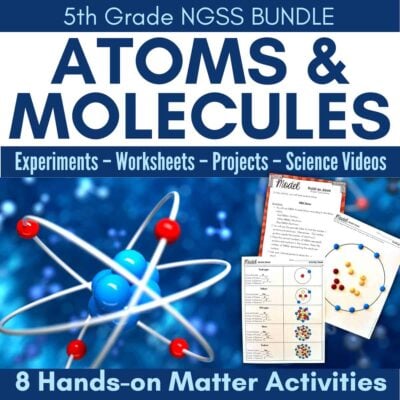
ATOMS & MOLECULES SCIENCE STATIONS
These Atoms & Molecules Next Generation Science Stations include eight different science stations where students deepen their understanding of atoms and molecules, including the structures and properties of matter. The focus is on 5-PS1-1.
Atoms & Molecules Stations Include
► Vocabulary Cards in two formats with and without pictures (only available in the BUNDLE)
► Big Idea Posters to display in your classroom (only available in the BUNDLE)
► Checklists for teachers and students (only available in the BUNDLE)
► Watch a Video – Students watch one of two videos and then answer questions about the videos. Videos are about atoms and molecules. (Google Form™️ available)
► Play a Game – Students play a board game with other students or do a crossword or word search puzzle. The crossword and word search puzzles are available digitally.
► Investigate the Properties of Matter – Students read about matter. They conduct an investigation to determine if air and other things we cannot see are made of matter. (Google From™️ and Google Slides™️ are available)
► Diagram the Periodic Table – Students read about the Periodic Table. They create a periodic table puzzle and practice putting it back together with classmates. (Google From™️ and Google Slides™️ are available)
► Read about Matter Everywhere – Students read about matter, atoms, and molecules. They answer questions in order to reinforce what they have learned. (Google From™️ is available)
► Model an Atom – Students read about atoms. They will build models of different types of atoms found on the periodic table. (Google From™️ and Google Slides™️ are available)
► Explore Solutions – Students read about how we cannot see particles dissolving in a solution. They will create a solution and record observations. (Google From™️ and Google Slides™️ are available)
► Sort Molecule, Element, or Both – Students read about atoms and molecules. They sort materials into three categories. Students then answer questions in order to reinforce what they have learned. (Google From™️ and Google Slides™️ are available)
NGSS Alignment
As a Fifth Grade Performance Expectation, students are expected to “describe that matter is made of particles too small to be seen through the development of a model.” (5-PS1-1). This correlates with the DCI 5-PS1.A, which states, “Matter of any type can be subdivided into particles that are too small to see, but even then the matter still exists and can be detected by other means. A model showing that gases are made from matter particles that are too small to see and are moving freely around in space can explain many observations, including the inflation and shape of a balloon and the effects of air on larger particles or objects.” All stations in this set meet the Performance Expectation and DCI, helping students gain an understanding of how matter is made of tiny particles, including molecules and atoms.
The NGSS are three-dimensional. These stations meet:
- Performance Expectation: 5-PS1-1
- Disciplinary Core Idea: PS1.A: Structure and Properties of Matter
- Science and Engineering Practices: Developing & Using Models: Develop a model to describe phenomena. (5-PS1-1)
- Crossing Cutting Concepts: Scale, Proportion, and Quantity: Natural objects exist from the very small to the immensely large. (5-PS1-1)
___________________________________________________________________________
CONSERVATION OF MASS SCIENCE STATIONS
These Conservation of Mass Next Generation Science Stations include eight different science stations where students deepen their understanding of conservation of mass, including the structure and properties of matter and chemical reactions. The focus is on 5-PS1-2.
Conservation of Mass Stations Include
► Vocabulary Cards in two formats with and without pictures (only available in the BUNDLE)
► Big Idea Posters to display in your classroom (only available in the BUNDLE)
► Checklists for teachers and students (only available in the BUNDLE)
► Watch a Video – Students watch one of two videos and then answer questions about the videos. Videos are about conservation of mass / matter. (Google Form™️ available)
► Play a Game – Students play a board game with other students or do a crossword or word search puzzle. The crossword and word search puzzles are available digitally.
► Investigate Dissolvable Solids – Students read about physical and chemical changes and how these changes relate to the law of conservation of mass. They will conduct an investigation to determine if the masses before and after changes differ. (Google From™️ and Google Slides™️ are available)
► Diagram the Bigger or Smaller – Students read about the law of conservation of mass and how it applies to change in state of matter. They will conduct an investigation to learn more about this and draw diagrams to show what happened to substances as their states changed. (Google From™️ and Google Slides™️ are available)
► Read about Conservation of Mass – Students read about conservation of mass in chemical and physical changes. They answer questions in order to reinforce what they have learned. (Google From™️ is available)
► Model Chemical Changes – Students read about matter and chemical changes. They will learn how the mass of substances before a chemical change needs to equal the mass after the change. They will model this with an activity and then answer questions in order to reinforce what they have learned. (Google From™️ and Google Slides™️ are available)
► Explore Chemical Changes – Students read about chemical changes. They will learn that the mass of substances before and after the change is the same. (Google From™️ and Google Slides™️ are available)
► Sort Physical Change or Chemical Change – Students read about physical and chemical changes with respect to the law of conservation of mass. They will sort materials into two categories. Students then answer questions in order to reinforce what they have learned. (Google From™️ and Google Slides™️ are available)
NGSS Alignment
As a Fifth Grade Performance Expectation, students are expected to “Measure and graph quantities to provide evidence that regardless of the type of change that occurs when heating, cooling or mixing substances, the total weight of matter is conserved.” (5-PS1-2). This correlates with the DCI 5-PS1.A, which states, “The amount (weight) of matter is conserved when it changes form, even in transitions in which it seems to vanish;” and DCI 5-PS1.B, which states, “No matter what reaction or change in properties occurs, the total weight of the substances does not change. (Boundary: Mass and weight are not distinguished at this grade level.) All stations in this set meet the Performance Expectation and DCIs, helping students gain an understanding of how mass is conserved when there are physical and chemical changes.
The NGSS are three-dimensional. These stations meet:
- Performance Expectation: 5-PS1-2
- Disciplinary Core Idea: PS1.A: Structure and Properties of Matter and PS1.B: Chemical Reactions
- Science and Engineering Practices: Using Mathematics and Computational Thinking (5-PS1-2)
- Crossing Cutting Concepts: Scale, Proportion, and Quantity: Natural objects exist from the very small to the immensely large.
___________________________________________________________________________
PROPERTIES OF MATTER SCIENCE STATIONS
These Properties of Matter Next Generation Science Stations include eight different science stations where students deepen their understanding of the properties of matter, including making observations and measurements to identify materials based on properties. The focus is on 5-PS1-3.
Properties of Matter Stations Include
► Vocabulary Cards in two formats with and without pictures (only available in the BUNDLE)
► Big Idea Posters to display in your classroom (only available in the BUNDLE)
► Checklists for teachers and students (only available in the BUNDLE)
► Watch a Video – Students watch one of two videos about properties of matter or wood, water, and properties. They will answer questions in order to reinforce what they have learned. (Google Form™️ available)
► Play a Game – Students play a board game with other students or do a crossword or word search puzzle. The crossword and word search puzzles are available digitally.
► Investigate Mystery Material – Students read about the properties of matter. They conduct an investigation to identify a substance based on the observed properties of matter. They answer questions in order to reinforce what they have learned. (Google From™️ and Google Slides™️ are available)
► Diagram Classifying Properties – Students read about the properties of matter. They create their own diagram of physical properties based on the reading section. Students then answer questions in order to reinforce what they have learned. (Google From™️ and Google Slides™️ are available)
► Read about Properties of Matter – Students read about properties of matter. They answer questions in order to reinforce what they have learned. (Google From™️ is available)
► Model a Table of Properties – Students read about the properties of matter. They create a table of properties of matter and then model how it is used. They answer questions in order to reinforce what they have learned. (Google From™️ and Google Slides™️ are available)
► Explore Magnetic and Electric Properties – Students read about magnetic and electric properties of matter and explore whether objects have those properties. They answer questions in order to reinforce what they have learned. (Google From™️ and Google Slides™️ are available)
► Sort Physical or Chemical Property – Students read about the properties of matter. They will sort materials into two categories. They will then answer questions in order to reinforce what they have learned. (Google From™️ and Google Slides™️ are available)
NGSS Alignment
As a Fifth Grade Performance Expectation, students are expected to “Make observations and measurements to identify materials based on their properties.” (5-PS1-3). This correlates with the DCI 5-PS1.A, which states, “Measurements of a variety of properties can be used to identify materials. (Boundary: At this grade level, mass and weight are not distinguished, and no attempt is made to define the unseen particles or explain the atomic-scale mechanism of evaporation
and condensation.)” All stations in this set meet the Performance Expectation and DCI, helping students gain an understanding of how materials can be identified based on chemical and physical properties of matter.
Special Note: None of these stations give an exhaustive list of all the chemical and/or physical properties of matter. Knowing all of the types of properties is not important, especially at this level. What is important is being able to distinguish between physical properties of matter and chemical properties of matter: Physical properties of matter are those properties that can be observed and measured without changing the substance. Chemical properties of matter, on the other hand, can only be observed and measured by changing the substance.
The NGSS are three-dimensional. These stations meet:
- Performance Expectation: 5-PS1-3
- Disciplinary Core Idea: PS1.A: Structure and Properties of Matter
- Science and Engineering Practices: Planning and Carrying Out Investigations
- Crossing Cutting Concepts: Scale, Proportion, and Quantity: Natural objects exist from the very small to the immensely large.
___________________________________________________________________________
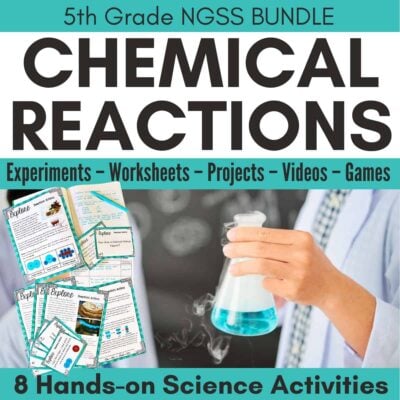
CHEMICAL REACTIONS SCIENCE STATIONS
These Chemical Reactions Next Generation Science Stations include eight different science stations where students deepen their understanding of the chemical reactions, including understanding how to tell if a chemical reaction has taken place. The focus is on 5-PS1-4.
Chemical Reactions Stations Include
► Vocabulary Cards in two formats with and without pictures (only available in the BUNDLE)
► Big Idea Posters to display in your classroom (only available in the BUNDLE)
► Checklists for teachers and students (only available in the BUNDLE)
► Watch a Video – Students watch one of two videos about chemical reactions. They answer questions in order to reinforce what they have learned. (Google Form™️ available)
► Play a Game – Students play a board game with other students or do a crossword or word search puzzle. The crossword and word search puzzles are available digitally.
► Investigate Show Your Stuff – Students read about the chemical reactions. They conduct an investigation to identify a substance based on the observed properties of the chemical reaction. They answer questions in order to reinforce what they have learned. (Google From™️ and Google Slides™️ are available)
► Diagram Showing the Reaction – Students read about the chemical reactions. They will use manipulatives to make diagrams of chemical reactions. Students then answer questions in order to reinforce what they have learned. (Google From™️ and Google Slides™️ are available)
► Read about Chemical Reactions – Students read about chemical reactions. They answer questions in order to reinforce what they have learned. (Google From™️ is available)
► Model a Having a Ball! – Students read about chemical reactions. They will use common chemicals and make an everyday object to model chemical reactions. They answer questions in order to reinforce what they have learned. (Google From™️ and Google Slides™️ are available)
► Explore Reaction Action – Students read about chemical reactions. They will record chemical reactions and determine if a chemical reaction or physical reaction has taken place. They answer questions in order to reinforce what they have learned. (Google From™️ and Google Slides™️ are available)
► Sort Chemical Reaction or Not?– Students read about the chemical reactions. They will sort scenarios into two categories: reaction or not. They will then answer questions in order to reinforce what they have learned. (Google From™️ and Google Slides™️ are available)
NGSS Alignment
As a Fifth Grade Performance Expectation, students are expected to “Conduct an investigation to determine whether the mixing of two or more substances results in new substances. ” (5-PS1-4). This correlates with the DCI 5-PS1.B, which states, “When two or more different substances are mixed, a new substance with different properties may be formed.” All stations in this set meet the Performance Expectation and DCI, helping students gain an understanding of how materials can be identified based on chemical and physical properties of matter.
The NGSS are three-dimensional. These stations meet:
- Performance Expectation: 5-PS1-4
- Disciplinary Core Idea: PS1.B: Chemical Reactions
- Science and Engineering Practices: Planning and Carrying Out Investigations
- Crossing Cutting Concepts: Cause & Effect

Jennifer Morley –
My students loved this resource. It was engaging and really helped them reflect on what they have learned.
Carmichaelfa321 –
This is just what I was looking for! My students and I enjoyed this!
Sheri S. –
Amazing resource! My kids enjoyed it and it really helped with understanding.
Christi G. –
Wow! This is a fantastic resource!!! I have moved grade levels and subjects so this bundle has saved my life finding new resources for learning. Our textbook curriculum is terrible, this bundle is much more engaging and throughout for the students.
Alexandra J. –
Thank you!