
Is Your Class Too Loud? 8 Tips for a Quiet Classroom
Do you find yourself struggling with the noise level in your classroom? Have you received feedback from other teachers or your principal expressing concerns about the noise? Creating a calm, quiet learning environment benefits students’ concentration and fosters an overall sense of tranquility. If you’re looking for effective strategies and tips for a quiet classroom, here are eight valuable ideas that can make a significant difference in your teaching experience.
Whether you’re receiving concerns about noise levels from colleagues or simply seeking to enhance student focus, this blog post is tailored for you. Here, we offer practical, effective techniques for fostering a quiet classroom environment. These strategies are not just about enforcing silence but about creating a balanced and controlled setting that enhances learning.
Before I share tips for a quiet classroom, remember that your classroom doesn’t always need to be quiet. There are times when you will want silence, times you want quiet, and times when students are excited and working.
While your classroom doesn’t always need to be quiet, it does need to be calm, and you do need to be in control. Think of it as controlled chaos vs. a noisy classroom.
Tips for a Quieter Classroom
The tips below for quiet and noisy classrooms are suggestions you can use to keep your classroom calm and manage noise levels.
Try one or try two. Figure out what works for your students and your classroom.
You may find that one suggestion works well for a while, but then stops working. You can have these tools in your classroom management tool belt to calm a noisy classroom throughout the school year.
Play calming music.
Music can be a powerful tool in creating a calm classroom environment. Classical or instrumental music played at a low volume can help students work at a quieter level. Play music during your math rotations or while students write quietly.
Not only can music provide a calming environment, but it can also introduce your students to some great classical composers.
If you have Spotify or Apple Music, you can stream it through one of those apps, but YouTube is also a great resource for FREE calming music.
Use a noise-monitoring app.
The Bouncy Balls app is web-based so that you can play it through your web browser.
One caveat: your students might try to make more noise to see how it affects the meters. If you think your students will do this, consider giving them purposeful time to do it. It’s a fun game, and it could be used as a fun introduction to the apps. Have students make enough noise to hit the top of the meters to demonstrate appropriate behavior.
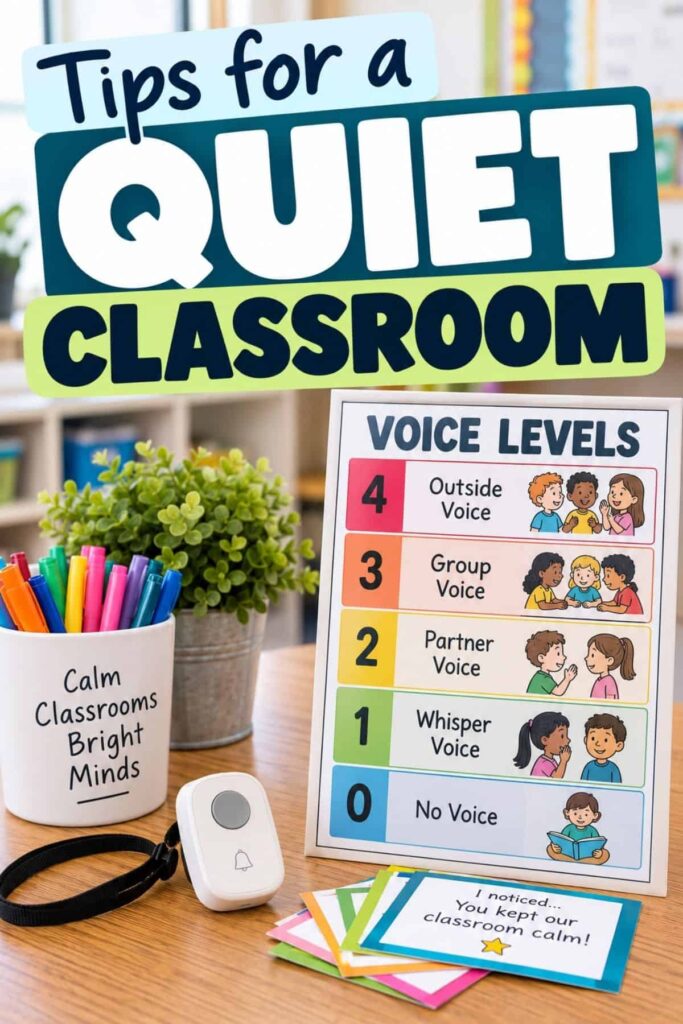
Use a wireless doorbell. Ring it when it gets too loud.
Sometimes, students need a gentle reminder when their noise level gets too loud. If you have a wireless doorbell, you can attach the button to your lanyard and ring it when students’ voices are too loud.
Here are a few options that work well in the elementary classroom:


Reinforce positive behavior. Print tickets and give them to quiet students.
One of the best tips for a quiet classroom is to print a few tickets with encouraging words that praise students for their calm, quiet work behavior. Keep a stash of these tickets and place them on the desks of students who are working well and modeling your high expectations.
Positive reinforcement with a few on-task students will likely encourage other slightly off-task students to change their behavior and quiet down.
Dim the lights.
Like calming music, dimming the lights can also reduce noise levels in your classroom. In fact, consider doing both! Creating a calm environment through light and music will help students relax their bodies and minds, enabling them to focus on their work.
Use a voice-level chart.
As I mentioned at the beginning, you don’t always need your students to be quiet, but you do need them to be calm. Consider using a voice-level chart. Determine the different times of day you have in your classroom. How do you want students to sound during those times? Create 4-5 levels on the chart, with the top level being an outside voice level.

This set includes two different scale formats (0–4 and 1–5), each with simple language and visuals that are easy for young learners to follow. Also includes a version with images only, without numbers.
Practice all the voice levels.
When you introduce the voice level chart to students, be sure to have them practice each level so they understand your expectations.
Break students into smaller groups or partners, or spread kids out around the room.
I use small groups and partner groups several times throughout the day. During the first two hours, students are in small reading groups. After lunch, we do math groups, and at the end of the day, we do science stations. Small groups help me maintain a calm, quiet learning environment. They allow students to interact with various partners throughout the day without getting too excited or overwhelmed by the noise of an entire classroom.
Do you have additional tips for a quiet classroom and for managing a noisy one? These teaching ideas will get you started on training your students to respect one another and the deep learning they do all day long!
Want to Reduce Disruptions So You Can Actually Teach?
Check out this 100% FREE Micro Training
from my friend Linda over at Teach 4 the Heart.
Creating a calm classroom environment can be hard…and you probably didn’t learn everything you needed to about classroom management in college. (I know I didn’t!)
But there is hope and a way to make your teaching experience more fulfilling and less stressful.
Watch this quick 28-minute training to learn how you can minimize disruptions so you can actually teach your content (and get to do the projects & activities that make learning more fun for EVERYONE!
Linda WON’T just tell you to “build relationships” because, frankly, even the best connections can’t eliminate all classroom challenges. Achieving a smooth-running class requires a more nuanced approach.

So join me for this FREE 28-minute training and discover their Calm Classroom Blueprint, used by thousands of teachers to:
- Significantly reduce disruptions during lessons & work times.
- Gain confidence In handling challenging situations (that previously left them dumbfounded).
- Lower daily stress levels and find joy in teaching again!
Jessica BOschen
Jessica is a teacher, homeschool parent, and entrepreneur. She shares her passion for teaching and education on What I Have Learned. Jessica has 16 years of experience teaching elementary school and currently homeschools her two middle and high school boys. She enjoys scaffolding learning for students, focusing on helping our most challenging learners achieve success in all academic areas.