
Preparing your students for a substitute teacher is one of the best investments you can make at the start of the year. Elementary students thrive on consistency, and when the routine breaks, even the most well-behaved class can fall apart for a sub.
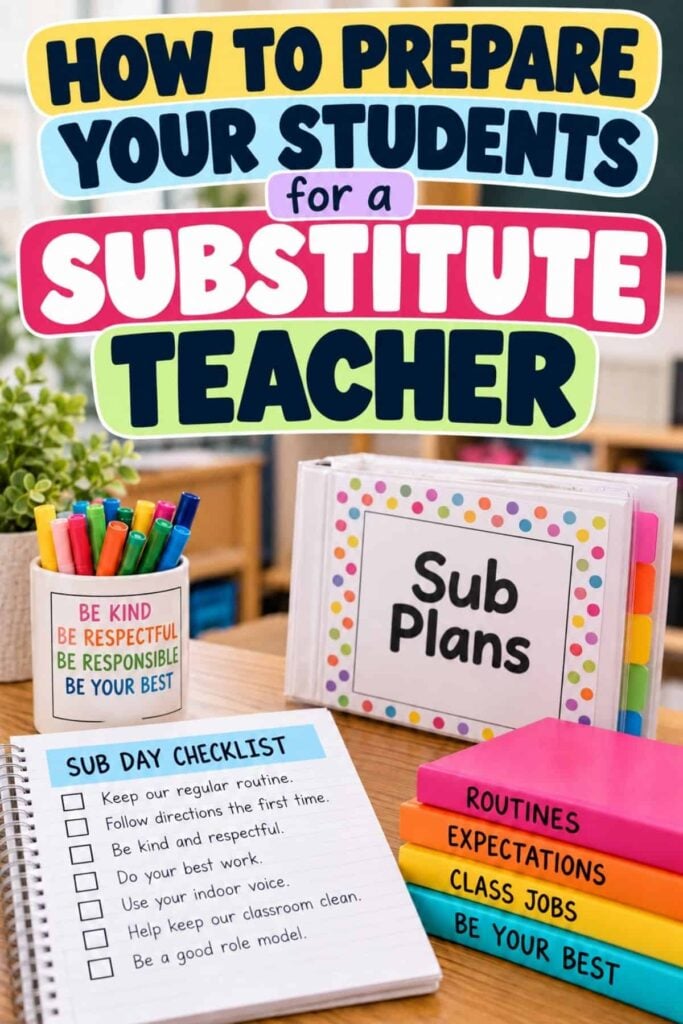
The good news is that you don’t have to wait until you’re already out sick to set your class up for success. A few intentional habits built early in the year make a real difference in your students’ behavior and in how smoothly sub days go.
Set Substitute Teacher Expectations from Day One
The single most important thing you can do is talk to your students about expectations for substitute teachers before you ever have a sub. Elementary students need to hear this directly from you, not figure it out when a stranger walks through the door.
On the first day of school, introduce your core classroom value as respect. That means respecting classmates, respecting the learning space, and respecting any adult who steps into the room in your place. Be specific about what that looks like: following directions the first time, staying in your seat during instruction, using the same procedures you always use.
For kindergarteners and first graders, keep it simple and concrete. “When I’m not here, you still follow our classroom rules. The sub is our guest, and we treat guests with kindness.” For 3rd through 5th graders, you can add more nuance: “A substitute doesn’t know our class yet. How you act today is how you represent our classroom.”
According to Edutopia’s research on classroom management, students are far more likely to maintain expected behavior when expectations are taught explicitly and revisited regularly rather than simply assumed. Build a brief reminder into your class meetings a few times a year to keep it fresh.
Keep Your Elementary Classroom Routine Intact
Elementary students, especially in K–2, are deeply anchored to routine. When the routine changes, anxiety goes up, and behavior often follows. The most effective thing you can build into your sub plans is a day that looks as close to normal as possible.
If you normally have a morning meeting at 8:15, keep it at 8:15. If reading centers are after recess, keep them after recess. A sub doesn’t need to teach new content or run elaborate lessons. They need to hold the structure that your students already know.
When you write your sub plans, note which activities are familiar to students and which would need explanation. Independent reading, partner work on a current project, a math review page, or a writing prompt about something they already know are all activities that can run without the sub having to teach a lesson from scratch. For younger grades, picture-supported directions help too — a short visual schedule posted on the board keeps the class anchored even when the teacher’s face is different.
Avoid leaving anything new. Sub days are not the time to introduce a new math concept or launch a writing unit. Even 4th and 5th-graders who handle change well tend to disengage when a sub tries to teach unfamiliar content. Stick to reviewing, practicing, and applying what they already understand.
Give Students a Role on Sub Days
One of the most effective ways to keep an elementary class on track with a substitute is to give students ownership of the day through classroom jobs. When students have a role, they have a reason to stay engaged, and the sub has natural helpers without having to identify them on the spot.
Before any sub day, note the current job holders in your sub plans so the substitute knows who to call on. Simple jobs work best: a line leader, a paper passer, an attendance helper, a materials manager. For 3rd through 5th grade, you might add a “class helper” whose job is to answer the sub’s questions about where things are or how your procedures work.
There’s a classroom management benefit to keeping job assignments somewhat open as well. Let students know that you may change who has which job on sub days, and that anyone showing great behavior could be chosen. That little possibility keeps the whole class invested rather than just the students who were already going to behave well.
Establish a Go-To Teacher Contact
Every substitute teacher needs a person to call on, and in an elementary school, that connection matters more than it might seem. A sub who doesn’t know who to contact when something goes sideways — a student behavior issue, a question about procedures, a tech problem — is a sub who will either handle it poorly or let it spiral.
Choose a neighbor teacher or grade-level partner who knows your class and has agreed to be your contact. Write their name and room number clearly in your sub folder. Then tell your students, “Ms. Rivera is right next door. She knows I’ll be gone, and she believes in you.” That one sentence does two things — it tells students there’s an adult keeping an eye on things, and it signals that you trust them to do well.
For students who struggle with transitions or behavior, having a named contact and a check-in plan is especially helpful. A quick visit to the neighboring classroom at lunch can reset a hard morning and set the afternoon up for success.
Reinforce Substitute Teacher Expectations Before You Leave
When you know ahead of time that you’ll be out, take five minutes the afternoon before to talk to your class. Keep it brief and positive. You’re not warning them or threatening consequences — you’re reminding them of what you already know they can do.
Something like: “Tomorrow I’ll be out, and you’ll have a substitute. I want you to show them the same respect you show me. Follow our procedures, take care of our classroom, and make me proud.” For 1st and 2nd grade, you might add a brief reminder of the specific procedures the sub will be using — lining up, bathroom passes, and where to put finished work.
Some teachers do a quick role-play with upper elementary students. “What do you do when the sub gives a direction? What if a classmate is being disruptive? What’s your job?” Walking through a few realistic scenarios helps students feel prepared rather than uncertain, and uncertainty is often what drives acting out.
When you return, follow through. Acknowledge students who did well. Address issues calmly and specifically. Students learn quickly whether sub days have real consequences or not — the tone you set when you come back shapes how they behave the next time you’re gone.
Final Thoughts
The most stress-free sub days aren’t accidental. They’re the result of expectations set early, routines students know by heart, and a class that understands what’s asked of them even when you’re not there. Build those habits in September and October, and by the time you need them in February, your students will already know what to do.
If you’re also looking for help on the teacher-logistics side of sub days — what to put in your sub folder, which activities hold up best, and how to keep a sub binder ready year-round — this post on preparing for a substitute teacher covers all of that.
Want to Reduce Disruptions So You Can Actually Teach?
Check out this 100% FREE Micro Training
from my friend Linda over at Teach 4 the Heart.
Creating a calm classroom environment can be hard…and you probably didn’t learn everything you needed to about classroom management in college. (I know I didn’t!)
But there is hope and a way to make your teaching experience more fulfilling and less stressful.
Watch this quick 28-minute training to learn how you can minimize disruptions so you can actually teach your content (and get to do the projects & activities that make learning more fun for EVERYONE!
Linda WON’T just tell you to “build relationships” because, frankly, even the best connections can’t eliminate all classroom challenges. Achieving a smooth-running class requires a more nuanced approach.

So join me for this FREE 28-minute training and discover their Calm Classroom Blueprint, used by thousands of teachers to:
- Significantly reduce disruptions during lessons & work times.
- Gain confidence In handling challenging situations (that previously left them dumbfounded).
- Lower daily stress levels and find joy in teaching again!
Jessica BOschen
Jessica is a teacher, homeschool parent, and entrepreneur. She shares her passion for teaching and education on What I Have Learned. Jessica has 16 years of experience teaching elementary school and currently homeschools her two middle and high school boys. She enjoys scaffolding learning for students, focusing on helping our most challenging learners achieve success in all academic areas.