
How a Letter Is Written: Steps, Parts, and a Sample
Even in a world of texts and emails, students still need to know how to write a letter. It shows up as an elementary writing standard, and it is a real-world skill, whether a student is writing a thank-you note to a grandparent, a message to a pen pal, or a friendly letter for a class assignment. The good news is that once students learn the parts and the steps, writing a letter becomes a quick, repeatable routine.
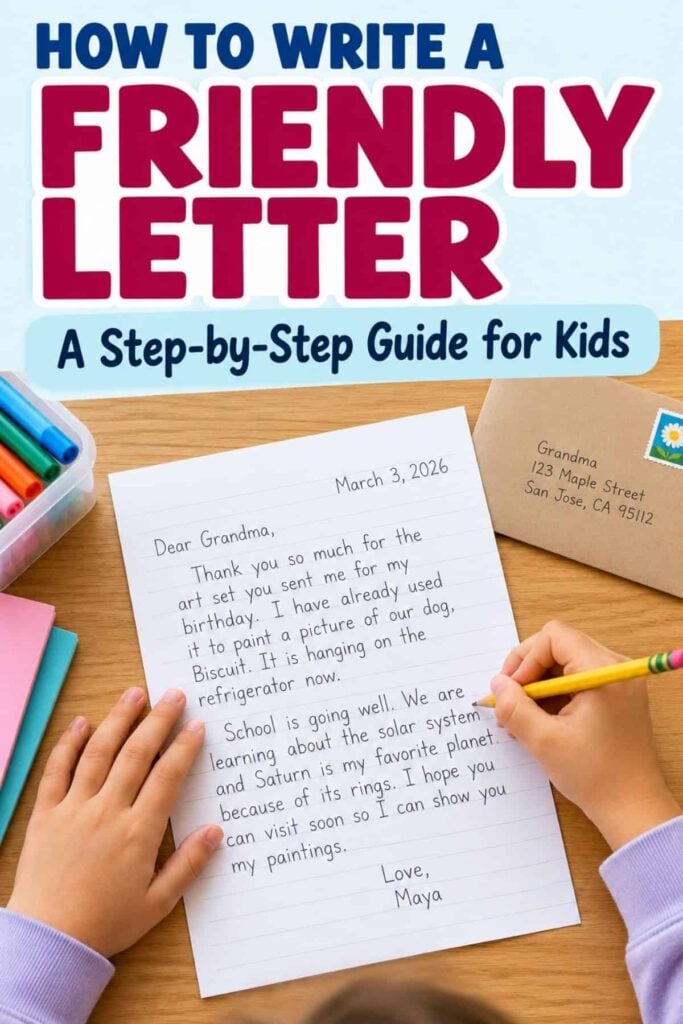
This post walks through exactly how a letter is written, from the date line to the signature, gives you a labeled sample to use as a model, and lays out a simple day-by-day way to teach it.
The 5 Parts of a Letter (and How to Format Them)
Every friendly letter has the same five parts, stacked in the same order from top to bottom. Teaching students to format a letter is mostly teaching them this order, so it helps to name each part clearly.
Heading or Date
The date goes at the top, usually on the right side, and tells the reader when the letter was written. For a friendly letter, the date alone is enough, for example March 3, 2026. A business letter adds the sender’s and recipient’s addresses here, but young writers working on a friendly letter can keep it to the date.
Greeting (Salutation)
The greeting names who the letter is for and always ends with a comma, like Dear Grandma,. This is the line students most often forget the comma on, so it is worth pointing out.
Body
The body is the message itself, usually two or three short paragraphs. Each new paragraph is indented or set off with a space. This is where students say what they actually want to say, so it gets the most planning time.
Closing
The closing is a short sign-off above the signature, followed by a comma, like Sincerely, or Love,. The closing should match the tone of the letter, which is a small but useful lesson in matching formality to audience.
Signature
The signature is the writer’s name, under the closing. In a friendly letter, a first name is usually fine. In a more formal letter, students write their full name.
How a Letter Is Written: The Step-by-Step Process
Knowing the parts is half of it. The other half is putting them together. Here are the five steps students follow to write a letter from start to finish.
Step 1: Decide who you are writing to and why
Every letter starts with an audience and a purpose. Is the student writing to thank a grandparent, catch up with a pen pal, or ask a local business a question? Naming the reader and the reason first shapes everything else, including how formal the letter should be.
Step 2: Plan what you want to say
Before drafting, students jot down two or three things they want to tell the reader. A quick list keeps the body focused and prevents the blank-page freeze. For a thank-you note, that might be what the gift was, how they used it, and a thank-you.
Step 3: Draft using the 5 parts
Now students write, following the five parts in order: date, greeting, body, closing, signature. Encourage them to get the ideas down first and worry about neatness later. The structure does a lot of the work for them.
Step 4: Revise and check the format
Students reread to make sure the message is clear, and all five parts are there, including the comma after the greeting. A simple checklist makes this independent. My post on having students self-check their writing against a checklist shows how to build that habit.
Step 5: Address, fold, and send it
The last step is what makes letter writing feel real: actually sending it. Students address an envelope, fold the letter, and mail or deliver it, or turn it in if it is an assignment. Writing to a real reader who writes back is the single biggest motivator for this skill.
How Do You Start a Letter?
After the greeting, students often stall on the first line of the body. Giving them a few reliable openers reduces hesitation. Here are opening lines students can use right away:
- I hope you are doing well.
- Thank you so much for the birthday gift.
- I am writing to tell you about something exciting.
- How have you been? I have missed you.
- I wanted to share some news.
- I have a question I hope you can help with.
Remember that the greeting always ends with a comma, and the first line of the body starts a new, indented paragraph underneath it.
Friendly Letter vs. Formal Letter
The format shifts a little depending on how formal the letter is, and students should be able to tell the two apart. A friendly letter uses a casual greeting with a first name and a warm closing. A formal or business letter adds the sender’s and recipient’s addresses at the top, uses a title and last name in the greeting, and closes formally.
- Friendly letter: Dear Grandma, … closes with Love, or Your friend,
- Formal letter: Dear Ms. Carter, … closes with Sincerely, or Best,
That is enough for most elementary writers to choose the right tone.
If you want to go further into the different kinds of letters students can write, from invitations to persuasive letters, my post on types of letters kids can write covers them.
Sample Student Letter You Can Use as a Model
Projecting or printing one labeled example does more than any explanation. Here is a short friendly letter with each of the five parts marked, ready to use as an anchor:
[Date] March 3, 2026
[Greeting] Dear Grandma,
[Body] Thank you so much for the art set you sent me for my birthday. I have already used it to paint a picture of our dog, Biscuit. It is hanging on the refrigerator now.
School is going well. We are learning about the solar system, and Saturn is my favorite planet because of its rings. I hope you can visit soon so I can show you my paintings.
[Closing] Love,
[Signature] Maya
Walking through this model and naming each part out loud gives students a clear picture of what their own letter should look like before they start.
A Simple Scaffold for Teaching Letter Writing
Letter writing teaches well as a short, five-day arc: model it, plan it, draft it, check it, and send it. The amount of support shifts with the grade.
Grades K-2: shared writing and fill-in templates
Younger students do best when you write the first letter together as a class. Model each part on chart paper, thinking aloud as you go. Then give students a template with labeled boxes for the greeting, body, and closing so they can fill in their own words without losing the format. A dedicated writing space helps them focus during independent time, and my post on setting up a writing space for independent drafting shows one way to do that.
Grades 3-5: independent drafting with a checklist
Older students can draft on their own after you model once. Give them a graphic organizer to plan, then a five-part checklist to peer-check against before publishing. Once they can draft the body confidently, it is a natural time to work on connecting ideas, which my post on teaching transitions between ideas covers.
Whatever the grade, a real audience raises the quality of the writing. Have students write to a pen pal, a grandparent, a local business, or a community cause. A project with a genuine purpose, like my class’s letters for Oklahoma, pushes students to care about getting it right.

For ready-to-use topics, my friendly letter writing prompts give students something to write about.
Common Mistakes Students Make
A few errors show up again and again, and naming them ahead of time heads most of them off:
- Write vs. right. Students often confuse these homophones. You write a letter with a pen or pencil; right means correct or the opposite of left. Only write has to do with putting words on paper.
- Forgetting the comma after the greeting. Dear Grandma needs that comma. It is the most-missed mark in the whole letter.
- Skipping the date. The date is easy to leave off because it feels optional. Remind students it is one of the five required parts.
- Mismatched formality. Closing a note to a grandparent with Sincerely, or a business letter with Love, signals the closing and greeting do not match. The tone should stay consistent top to bottom.
Frequently Asked Questions
Bringing It All Together
Once students know the five parts and the five steps, writing a letter stops being a mystery and becomes a routine they can repeat for any reader. Teach it once with a strong model and a real audience, and students carry the skill forward to thank-you notes, pen pal letters, and beyond. If you are planning your first letter-writing lesson of the year, my post on writing letters home has more ideas to build on.
Jessica BOschen
Jessica is a teacher, homeschool parent, and entrepreneur. She shares her passion for teaching and education on What I Have Learned. Jessica has 16 years of experience teaching elementary school and currently homeschools her two middle and high school boys. She enjoys scaffolding learning for students, focusing on helping our most challenging learners achieve success in all academic areas.