
Search for fall activities, and you will drown in pumpkin crafts meant for kindergarten. Finding pumpkin activities for upper elementary that actually challenge 3rd, 4th, and 5th graders is much harder. Older students still love a good pumpkin theme in October, but they need content with real academic weight behind it, not another coloring page.
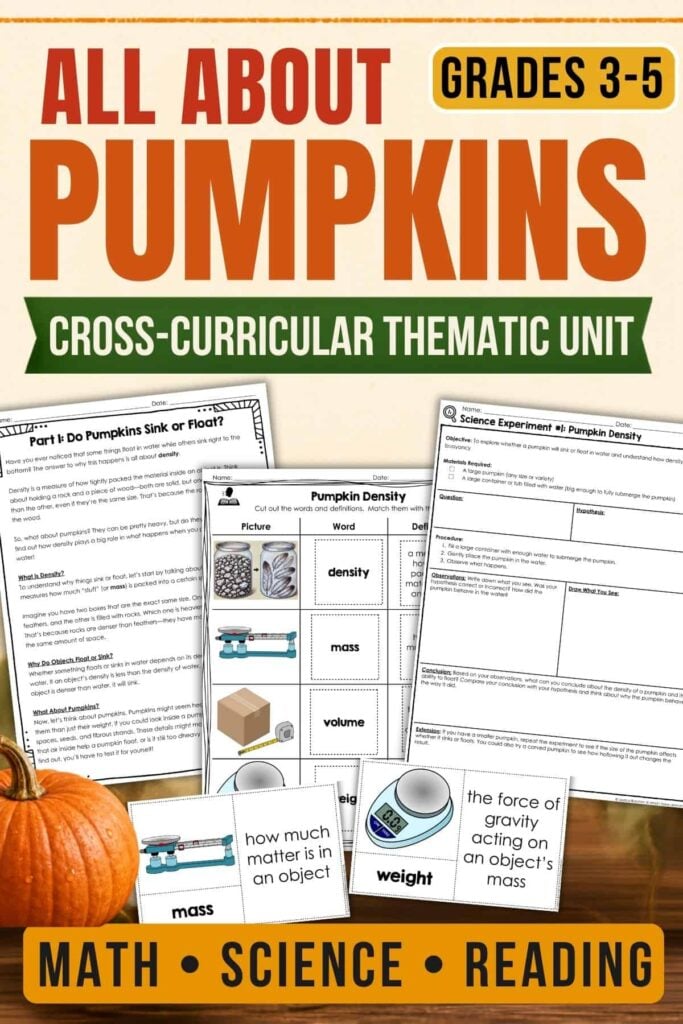
The good news is that a pumpkin makes a surprisingly rich anchor for rigorous, cross-curricular learning: density, life cycles, agricultural history, and measurement all run straight through it.
This post shares how to build a thematic pumpkin unit that keeps the seasonal fun while holding your students to grade-level rigor.
Why a Thematic Pumpkin Unit Works for Upper Elementary
A thematic unit ties several subjects to one shared topic, and that structure does real work for older students. When the same pumpkin shows up in science, reading, and social studies across a week, students make connections across content areas instead of treating each subject as separate. The familiar theme lowers the barrier to entry, so students can spend their energy on the thinking rather than on getting oriented.
It also solves the October engagement problem honestly. You get the seasonal hook that makes the week feel special, without sacrificing the standards you are accountable for. Students investigate, read closely, and build vocabulary, and the pumpkin is simply the thread that connects it all.
What Makes These Pumpkin Activities Rigorous
Rigor is the difference between coloring a pumpkin and explaining why it floats. A few things separate upper elementary pumpkin activities from primary ones:
- Informational text with real comprehension work. Students read content-rich articles and answer questions in several formats- short answer, fill-in-the-blank, and multiple choice- so they are doing more than recall.
- Academic vocabulary is taught for depth. Terms like density, photosynthesis, and civilization are introduced with definitions and a four-square matrix that pushes students to give examples and non-examples, not just copy a meaning.
- Hands-on investigation. A density experiment with predictions, testing, and extensions puts students in the role of scientist, gathering evidence rather than being told the answer.
- Active reading strategies. Students annotate as they read, marking what is interesting, confusing, or important, which keeps them engaged with dense text.
Reading Rockets offers helpful background on why informational text comprehension deserves this kind of deliberate attention in the upper grades.
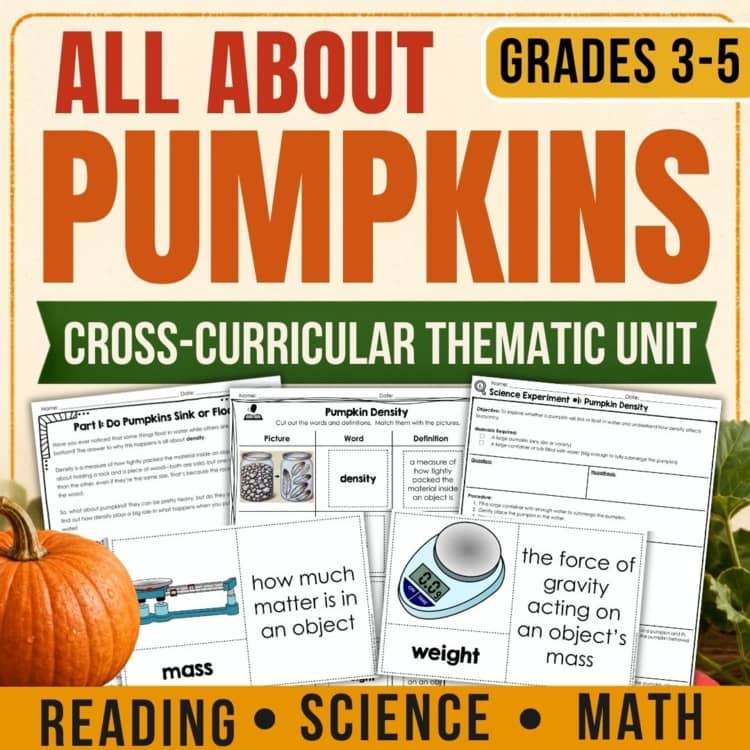
This pumpkin unit for grades 3–5 combines pumpkin life cycle, pumpkin density, and nonfiction reading comprehension with hands-on science, math, social studies, vocabulary, and graphing activities.
Four Cross-Curricular Pumpkin Topics
The strength of a pumpkin theme is how far it reaches across the curriculum. Four topics carry real content in four different areas:
Pumpkin Density (Physical Science)
Students explore why most pumpkins float, building the concepts of density, mass, volume, and weight. A sink-or-float experiment anchors the learning, and extensions push further: testing other objects, comparing pumpkin sizes, hollowing a pumpkin out, and finding how much weight it takes to sink one. This is genuine physical science, not a demonstration.
The Life Cycle of a Pumpkin (Life Science)
Students trace a pumpkin from germination through seedling, pollination, fruiting, and maturation, learning plant-life-cycle vocabulary along the way. It pairs naturally with broader life-cycle study, and my plant life cycle stages guide is a good companion if you are teaching the concept more widely.
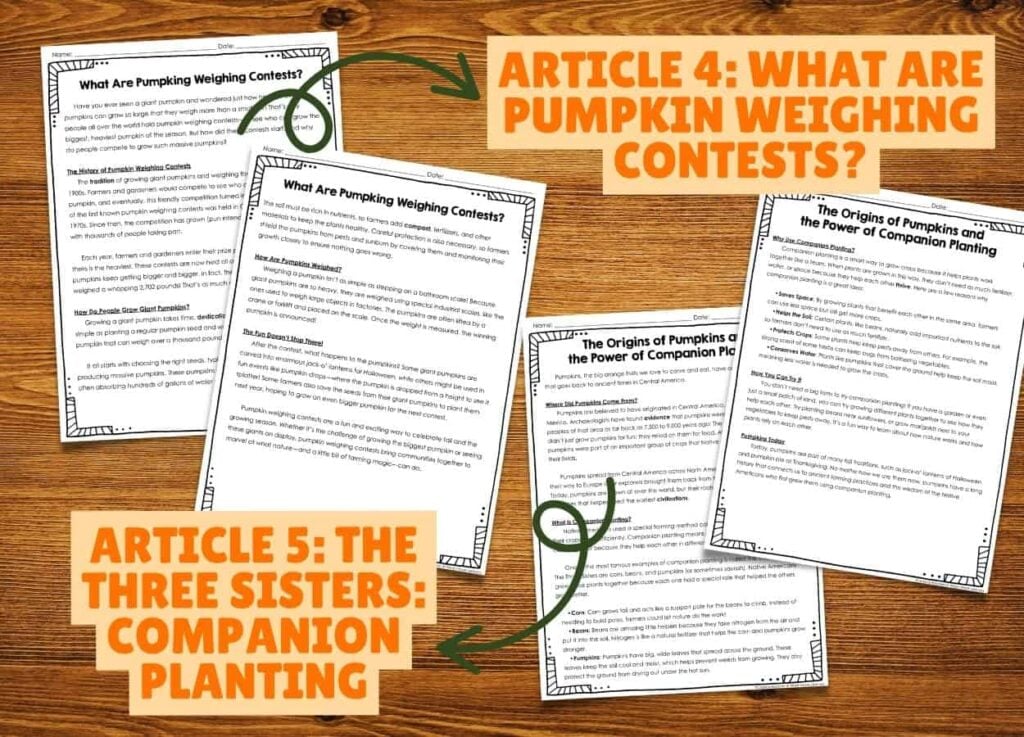
Pumpkin Weighing Contests (Social Studies and Math)
Giant pumpkin contests open a conversation about tradition, dedication, and how growers use compost and care to produce record-breaking fruit. Students also compare and estimate weights, which brings measurement into the theme. For a deeper pumpkin math day, my pumpkin measurement activities extend this strand.
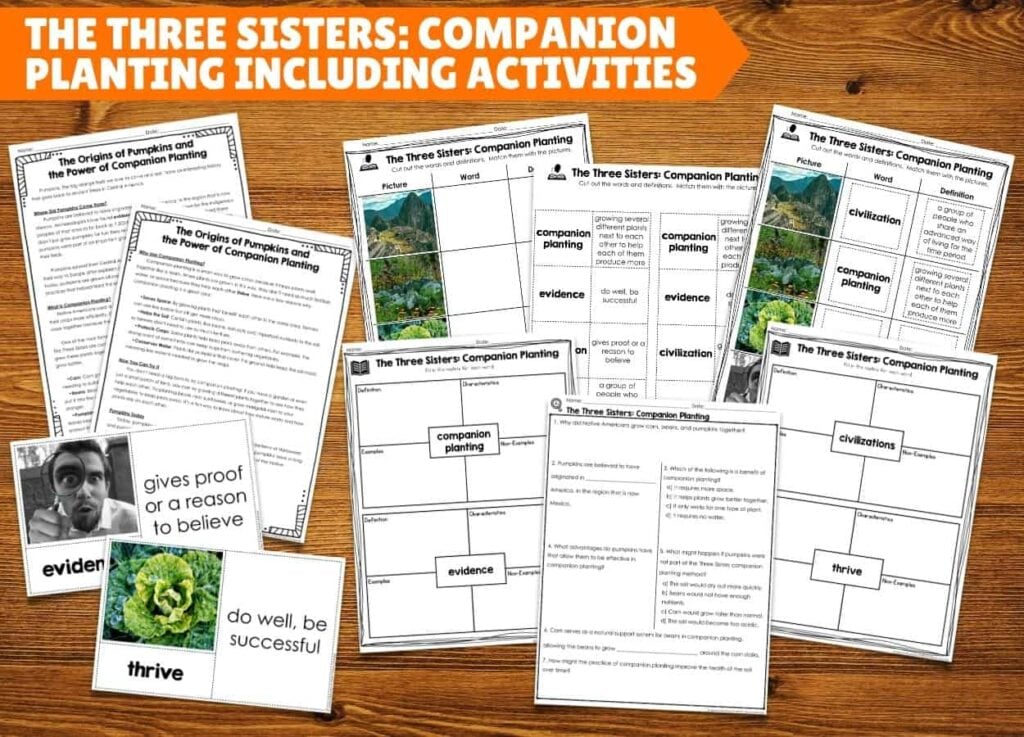
The Three Sisters: Companion Planting (History and Science)
Students learn how Native American civilizations grew corn, beans, and squash together so each plant helped the others thrive, connecting agricultural science to history. They organize the ideas in a web diagram and use evidence from the reading, which builds both content knowledge and reading skills.
How to Use a Pumpkin Unit in Your Classroom
Because the topics stand on their own, the unit flexes to fit your week:
- As a full fall unit. Teach one article and activity a day for a rich, connected week in October.
- In your reading block. Use the informational articles and comprehension questions as close-reading practice with a seasonal hook.
- In science or social studies. Pull the density experiment or the Three Sisters reading to fit the subject you are teaching.
- As sub plans or centers. The self-contained articles and activities are easy to leave for a substitute or set up as a rotation.
Introduce the vocabulary before students read each article, since academic terms make the texts accessible. If you want more seasonal ideas for older students, my fall classroom activities post has more that hold up for upper elementary.
Frequently Asked Questions
Bringing It All Together
A pumpkin does not have to mean a craft. For upper elementary, it can anchor a week of real science, close reading, history, and math that students remember long after the jack-o’-lanterns are gone. Keep the seasonal fun, lead with the informational text and vocabulary, and let the investigations do the heavy lifting. That is how a pumpkin theme earns its place in a 3rd, 4th, or 5th grade classroom.
Want it ready to teach? My All About Pumpkins thematic unit for upper elementary includes four cross-curricular informational articles: density, life cycle, giant pumpkin contests, and the Three Sisters, each with academic vocabulary, a hands-on activity, and comprehension questions in multiple formats, all built for grades 3 through 5.
This pumpkin unit for grades 3–5 combines pumpkin life cycle, pumpkin density, and nonfiction reading comprehension with hands-on science, math, social studies, vocabulary, and graphing activities.
Jessica BOschen
Jessica is a teacher, homeschool parent, and entrepreneur. She shares her passion for teaching and education on What I Have Learned. Jessica has 16 years of experience teaching elementary school and currently homeschools her two middle and high school boys. She enjoys scaffolding learning for students, focusing on helping our most challenging learners achieve success in all academic areas.