
Cut & Paste Math Activities for Second Grade
Most second grade math practice pages ask students to solve a problem and write an answer. That answer is either right or wrong, but without teacher feedback, there is no way for students to know which. Cut and paste math activities for second grade work differently: students receive a set of answer pieces, sort them, and paste them into the correct places on the page. Because each page includes a specific number of pieces — exactly enough for that page and no more — students can check their own work as they go. A leftover piece means something is off, and students can work backward to find the error before the page is ever turned in.

That self-checking element is the feature that makes these activities worth using beyond the usual reasons to add something hands-on to a math lesson. Students who catch their own mistakes have to locate the error, rethink the problem, and fix it. That process reinforces the math more effectively than moving on to the next problem and finding out later from a grade that something went wrong.
Why Cut and Paste Works for Math Practice
Standard practice worksheets are easy to go through on autopilot. A student who knows the general shape of a procedure can fill in answers without fully engaging with the content, especially on a page they’ve seen a similar version of before.
Cut and paste adds a decision step before committing to an answer. Students have to sort pieces, evaluate where each one fits, and check the arrangement against what they know before the glue or tape goes down. That sorting phase serves as a rough draft — students can move pieces around, change their minds, and reconsider before anything is permanent. The physical arrangement also makes errors more visible. If two pieces want to go in the same spot, something is wrong. Students notice this without being told.
The written response component on each page shifts the work into a different kind of thinking. Selecting an answer from a set of choices requires recognition. Writing an explanation requires production — the student has to generate the reasoning rather than just identify it. In second grade, where mathematical vocabulary is still developing, that writing step is also practice in using the language of math to describe what the student is doing and why.
Both components together — cut and paste with self-checking and written response — ask students to do more with each concept than a standard worksheet typically requires, without needing additional materials or preparation time.
What’s Included: Second Grade Math Standards
The activities cover every major second grade Common Core math standard across three domains, with most standards having two pages. The two pages for each standard approach the concept from slightly different angles, so you can use both for additional practice or choose the one that best fits what your students need at that point in the year.
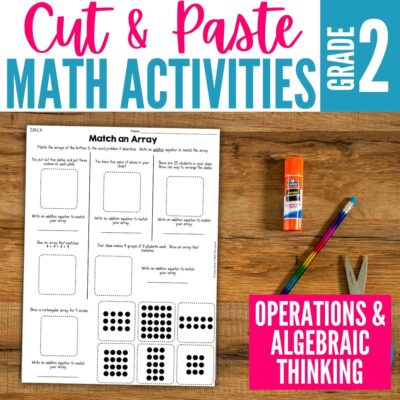
Operations and Algebraic Thinking covers addition and subtraction strategies within 100, working with equal groups as a foundation for multiplication thinking, and applying the properties of operations. The written response pages in this domain ask students to explain the strategy they used, which shows you whether they understand the reasoning behind the procedure.
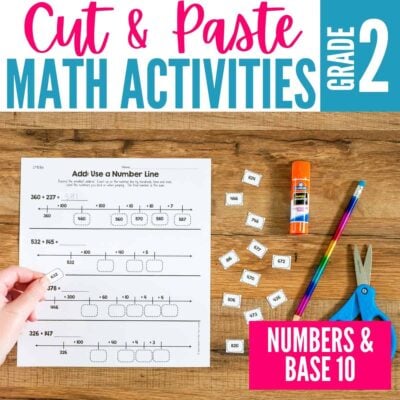
Numbers and Operations in Base Ten addresses the core place value work of second grade: reading and writing numbers to 1,000 in standard form, word form, and expanded form; comparing three-digit numbers using place value strategies; and adding and subtracting within 1,000. Number line work is included here as well, building on the number line strategies that help students develop a mental model for addition and subtraction with larger numbers.
Measurement and Geometry covers measuring lengths with appropriate tools, working with line plots to represent measurement data, telling and writing time, working with money, and identifying, describing, and drawing two-dimensional and three-dimensional shapes.
The full set is available as a bundle covering all three domains, or as individual domain sets:

A Closer Look at Specific Pages
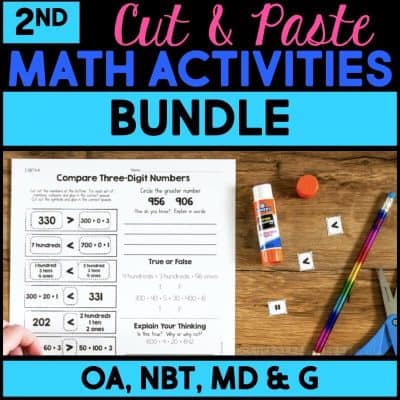
Compare Three-Digit Numbers
Students are given pieces showing numbers in different representations — expanded notation, word form, and standard form — and arrange them into comparisons using greater than and less than symbols. On the right side of the page, students write an explanation of how they determined which number was larger.
This page requires students to use place value reasoning rather than just memorizing the comparison symbols. A student who is comparing 347 and 374 needs to understand why the tens place is the deciding digit when the hundreds digits are the same. The written response makes that reasoning visible.


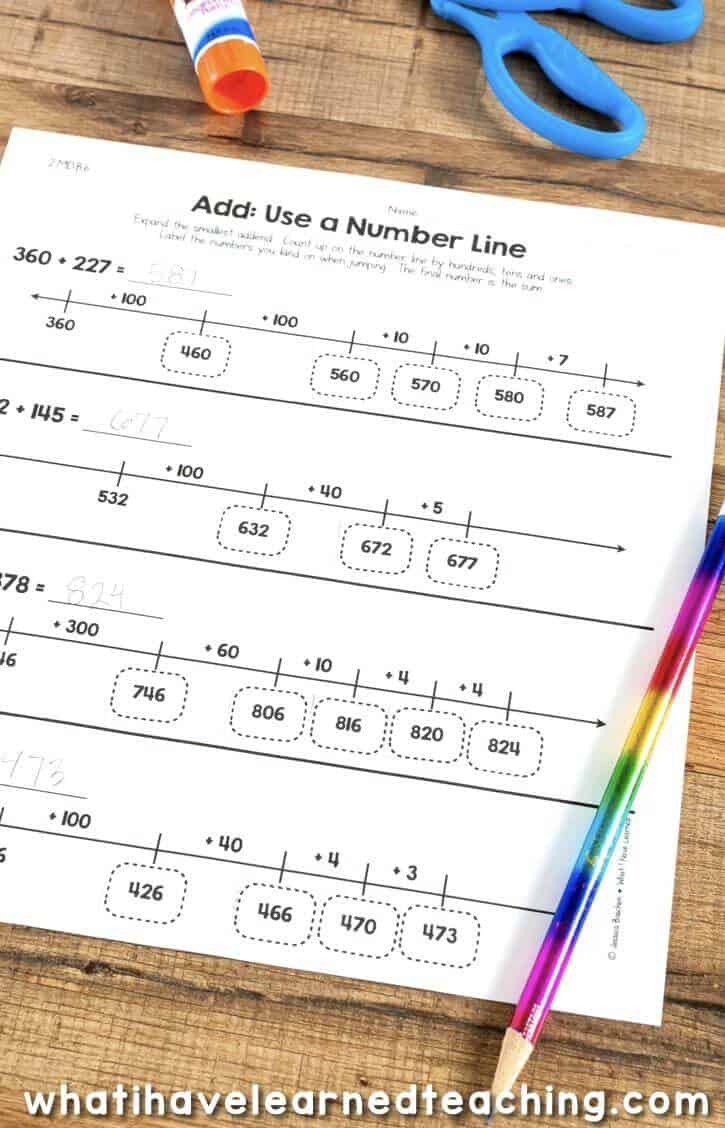
Add Using a Number Line
This page provides the jumps on a number line but asks students to figure out the landing number at each jump. Students who are still developing their number sense use the visual scaffold to work through the addition; students who are more confident can reason through it mentally and use the number line to verify.

Read and Write Numbers
Students draw each number using place value notation — boxes for hundreds, sticks for tens, dots for ones — write it in expanded form, and cut and paste the word form from the piece set. The companion page for this standard gives students different representations in the cut-and-paste component, so the two pages together cover the same standard from different starting points.

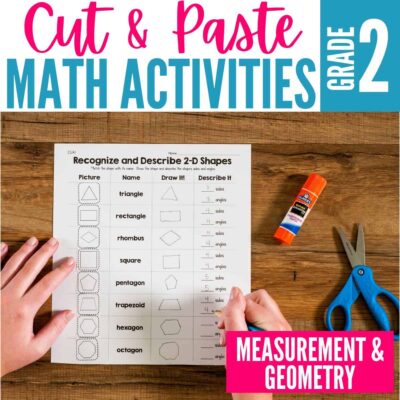
Recognize and Describe 2-D Shapes
Students cut out two-dimensional shapes, match each to its name, draw the shape, and write a description using the number of sides and angles. This page asks students to produce a description rather than select one, which requires them to know the properties well enough to generate them from memory.

When to Use These Activities
Math stations. These pages work well as a station option after a concept has been introduced and students have had time to work with it. The self-checking format means students can work independently without waiting for teacher confirmation at each step. A station with two or three pages from the same domain can run for a full math block.
Substitute teachers. Activities that are self-contained, self-explanatory, and self-checking are exactly what sub days call for. Students know what to do, the sub doesn’t need to understand the specific math concept to keep the work running, and the written response pages give you a useful window into what students actually did when you return.
Fast finishers. These pages can be kept in a folder for students who finish assigned work early. Because no additional setup is needed, they can be pulled without disrupting the lesson.
Concept review and solidification. These activities are designed for after the teaching has happened — not for initial instruction. They work best as a second or third round of practice once students have had multiple exposures to the concept through other formats.
Free Sample
A free sample of four pages with answer keys is available to try in your classroom before purchasing. The sample includes pages from different standards so you can see how the format works across different types of math content.
How to Purchase the Second Grade Cut & Paste Math Activities
The Cut and Paste Math Activities for Second Grade are available on my web site and on Teachers Pay Teachers.
-
 Product on saleCut and Paste Math Activities for Second Grade BUNDLEOriginal price was: $15.39.$9.50Current price is: $9.50.
 -
-
-

This looks really great! I love the way you show the Common Core Standard on each page and in the Table of Contents.
Anita
Looks like a GREAT product! Thanks for stopping by my blog.
Tara
The Math Maniac