
Chemical Reactions Reading Comprehension for 5th Grade
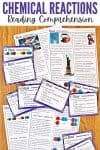
A chemical reactions reading comprehension passage gives 5th graders a way to process what they observe in experiments, moving from hands-on investigation to reading, writing, and critical thinking within the same unit.

This resource pairs a nonfiction reading passage with three formats of comprehension questions, all aligned with NGSS 5-PS1-4 and ELA standards (RI.5.1, RI.5.2, RI.5.4, RI.5.7, RF.5.4, W.5.2, W.5.8). The passage uses real-world examples students recognize: why the Statue of Liberty turned green, how photosynthesis works as a chemical reaction, and what observable signs indicate a reaction has occurred.
These passages support the 5th grade matter standards on chemical reactions and physical vs. chemical changes. My physical science guide for elementary students has hands-on activity resources to pair with this reading practice for the full unit.
What’s Inside This Chemical Reactions Resource?
This engaging reading passage introduces students to chemical reactions through real-world examples, including:
- Why the Statue of Liberty turned green (hello, oxidation!).
- How photosynthesis is a type of chemical reaction.
- The different types of chemical reactions and how substances combine or break apart.
- Identifying signs of a chemical reaction, such as color changes, gas formation, and temperature shifts.
Students will not only read but also apply their learning through comprehension activities that challenge them to think critically and analyze what they’ve learned.
Aligned with NGSS and ELA Standards
This resource isn’t just about science—it’s also an excellent way to integrate literacy skills into your science block. The comprehension questions align with NGSS (5-PS1-4) and ELA standards (RI.5.1, RI.5.2, RI.5.4, RI.5.7, RF.5.4, W.5.2, W.5.8), helping students practice key reading strategies while reinforcing science content.
What Signs of a Chemical Reaction Will Students Learn?
The reading passage focuses on observable signs — the clues scientists (and students) use to determine when a chemical reaction has occurred. Each sign is introduced through a real-world example in the text, giving students a concrete reference point before the comprehension questions ask them to apply what they know.
The five signs the passage covers:
- Color change — The Statue of Liberty is the anchor example. The copper in the statue reacted with oxygen and water over time, producing the green patina visible today.
- Gas formation — Bubbles are a visible sign that a reaction is producing gas. Students connect this to familiar classroom and kitchen examples.
- Temperature change — Some reactions release heat (exothermic); others absorb it (endothermic). The passage introduces both.
- Precipitate formation — A solid forming in a liquid solution indicates that a new substance has been created. This is one sign students often haven’t encountered before the lesson.
- Light or energy production — Photosynthesis is the example here: plants convert light energy into chemical energy, which is itself a chemical reaction.
These five signs are what the comprehension questions test. Students need to identify a sign from a description, explain why it indicates a reaction, and connect it to a new scenario. That’s where the three question formats give you the flexibility to scaffold for different learners.

Looking to teach your students about chemical reactions? This reading passage and comprehension questions resource is perfect for fifth-grade science classrooms teaching NGSS standards.
Differentiated Comprehension Questions to Support All Learners
One of the best features of this resource is its differentiated comprehension questions that meet the needs of diverse learners. Whether you’re working with advanced students who are ready for higher-order thinking or those who need more structured support, these activities help all students engage with the material at their level.
Three Formats for Maximum Flexibility
Short Answer Questions – These open-ended questions encourage students to explain concepts in their own words, helping with scientific reasoning and written communication.
Fill-in-the-Blank – Great for students who need more structured support while still reinforcing key vocabulary and concepts.
Multiple–Choice Questions provide quick, clear checks for understanding, making them perfect for assessments, quizzes, or exit tickets.
How This Helps Your Students:
- Supports different learning styles – Some students thrive with written responses, while others need a more scaffolded approach.
- Builds science and literacy skills simultaneously – Students practice reading comprehension, critical thinking, and vocabulary development while learning science.
- Perfect for differentiation – Use different question types based on student needs or mix and match for variety.

How Can You Use This in Your Classroom?
Teachers can use this Chemical Reactions Reading Passage in different ways, including:
As a Science Station
Set up this resource as a science station during centers to provide independent or small group learning opportunities. Students can read the passage, answer comprehension questions, and engage with the material at their own pace while reinforcing key science concepts.
As an Interactive Lesson
Bring the passage to life by reading it together as a class and discussing the clues that indicate a chemical reaction. This approach encourages student participation, helps them make connections, and supports comprehension through guided discussion.
As an Assessment Tool
The differentiated comprehension questions work well as a formative or summative assessment to check students’ understanding of chemical reactions. Use them before an experiment to assess prior knowledge or afterward to see what students have learned.
As Homework or Independent Practice
For an easy, no-prep way to reinforce learning, assign the passage and comprehension activities as homework or independent work. This gives students extra practice with science reading and supports their ability to explain chemical reactions in their own words.
Why Teachers Love It
- No Prep! Just print and go (or assign the digital Google Form version!).
- Engages students with real-world connections.
- Supports cross-curricular learning by integrating science and literacy.
- Works for independent learning, small groups, or whole class discussions.
The resource is available as a printable PDF and as a Google Form for digital use.
Looking to teach your students about chemical reactions? This reading passage and comprehension questions resource is perfect for fifth-grade science classrooms teaching NGSS standards.
Jessica BOschen
Jessica is a teacher, homeschool parent, and entrepreneur. She shares her passion for teaching and education on What I Have Learned. Jessica has 16 years of experience teaching elementary school and currently homeschools her two middle and high school boys. She enjoys scaffolding learning for students, focusing on helping our most challenging learners achieve success in all academic areas.