
How to Manage a Chatty Class
Some years you get a quiet group. Other years, you get a chatty class. If you find yourself stopping every few minutes to wait for the room to settle, you already know which kind of year this is.
A chatty class is not a bad class. Often, it is a social, engaged group that simply loves to talk, and the goal isn’t to silence them but to teach them when talking helps and when it gets in the way.
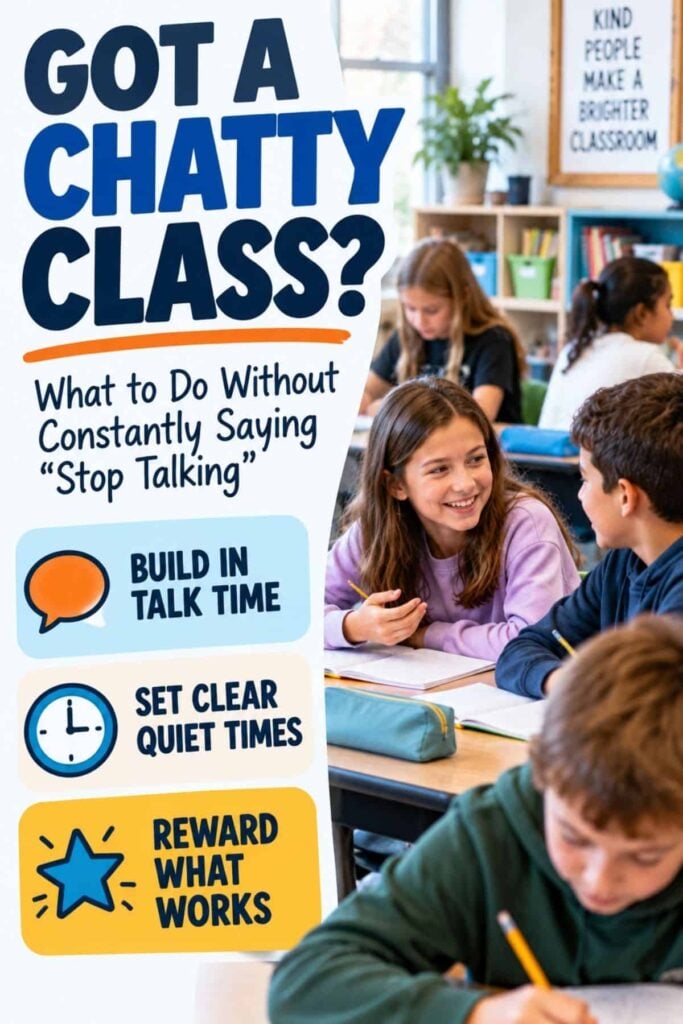
This post walks through how to decide whether the chattiness is actually a problem, how to build in time for the talking your students crave, and what to do about the one or two students who tend to set everyone else off.
Is Your Chatty Class Actually a Problem?
Before you overhaul anything, decide what you are actually dealing with. There is a real difference between chatter that stops learning and chatter that simply grates on you at the end of a long day. Both are worth addressing, but they call for different responses, and naming which one you have keeps you from cracking down harder than the situation needs.
Watch the room for a few days.
Are students missing directions and asking you to repeat everything because they were talking? Is the noise pulling focus during independent work? That is chatter that blocks learning, and it needs structure.
If instead your students are getting their work done and the talking is mostly a background hum that wears on you, you may be able to channel it rather than shut it down. Knowing the difference tells you how firm to be.
Give a Chatty Class Structured Time to Talk
A chatty class talks because talking is how these students think and connect. If the only message they hear all day is “stop talking,” you are fighting their nature, and you will lose.
The more effective move is to build talk into your lessons so students get the interaction they need at the right moments. Give them structured chances to turn and talk, share with a partner, or work through a problem out loud in a small group. When students know a talking moment is coming, they are far more willing to stay quiet during the parts that require listening.
One approach that works well is to trade quiet directly for talk. If students can listen through a focused stretch of a lesson, they earn a short window to talk with a neighbor afterward. The talk becomes something they work toward rather than something they sneak.
Make Class Agreements About When to Listen
Students manage their talking better when they helped set the rule. It creates student buy-in. Rather than handing down a silent-classroom mandate, talk with your students directly about being a chatty group. Name it out loud. Tell them their energy and eagerness to share are strengths, and that there are specific times when they need to listen instead.
Then make an agreement together about what noise level fits which activity. Be explicit: silent during directions and independent reading, quiet partner voices during group work, and a free-talk level during transitions or the last few minutes of a task.
When you write these agreements with students, they own them. From there, your job is mostly to remind them. A quick “remember our agreement for this part” resets the room far faster than raising your voice. If you want a fuller framework for building this kind of buy-in, my post on strategies for classroom management goes deeper.
Reinforce the Behavior You Want to See
It is easy to spend all your energy on the students who are talking and none on the ones who are not. Flip that. When you narrate and reward the behavior you want, students who crave your attention start competing to earn it the right way.
- Praise specifically and often. Instead of a general “good job,” name it: “This table started their work silently the moment I finished directions.” Students repeat what gets noticed.
- Use a quiet reward that spreads. Some teachers walk the room and hand a small token, a point, or a classroom-store coin to students who are on task and quiet. Others settle fast when they see it happening.
- Reward the group, not just individuals. Group points or a class-versus-teacher tally gives a chatty class a shared reason to hold each other accountable, which works better than you policing every voice.
Use Seating and Transitions to Cut the Chatter
Two of the most reliable levers for a chatty class are where students sit and how they move between activities. Both are within your control, and both are worth adjusting more than once across a year.
Seat students strategically
Your chattiest students do not need to sit together. Spread them around the room and place them near calmer students who are less likely to take the bait.
When you do use table groups, mix talk levels within each group rather than clustering the talkers. Do not be afraid to move a student or reshuffle the whole arrangement mid-year. A seating change is one of the lowest-cost fixes you have.
Reteach transitions
Transitions are often where a chatty class gets loudest, because the structure drops for a minute and students fill the gap with talk. If that is your trouble spot, revisit the procedure. Tell students exactly what a transition should look like, then practice it. Practice it wrong on purpose, laugh about it, then practice it right. When students do not meet the expectation, stop and run it again. Most classes tire of the practice quickly and start meeting the bar to avoid repeating it.
When One or Two Students Set Off the Whole Class
Very often a chatty class is not really thirty chatty students. One or two trigger everyone else. If that sounds like your room, shift some of your attention from the group to those individuals, because settling them settles the class.
Individual systems give these students concrete, immediate feedback. A few that teachers use with success:
- A small countdown of tokens. Place three sticky notes or three cubes on the student’s desk. Remove one each time they disrupt the class. Whatever is left at the end of the period earns something, and give them a path to earn tokens back by turning the behavior around.
- A whole-class version of the same idea. Give every student a handful of cubes or beans in the morning. Take one when someone talks out of turn. Whatever remains at the end converts to free time or a class reward, which builds shared accountability.
- An individual behavior chart. For a student who needs more frequent check-ins than the rest of the class, a chart broken into short chunks of the day gives both of you steady feedback. My post on behavior charts covers when and how to use one, and my free Editable Behavior Charts are a ready place to start.
These systems do not work with every student, and that is normal. Expect some trial and error before you find the approach that fits a particular child. Pairing any of them with a conversation about choices and consequences helps students see the connection between what they do and what follows. My post on teaching responsibility covers this in more detail.
When a Chatty Class Just Needs a Break
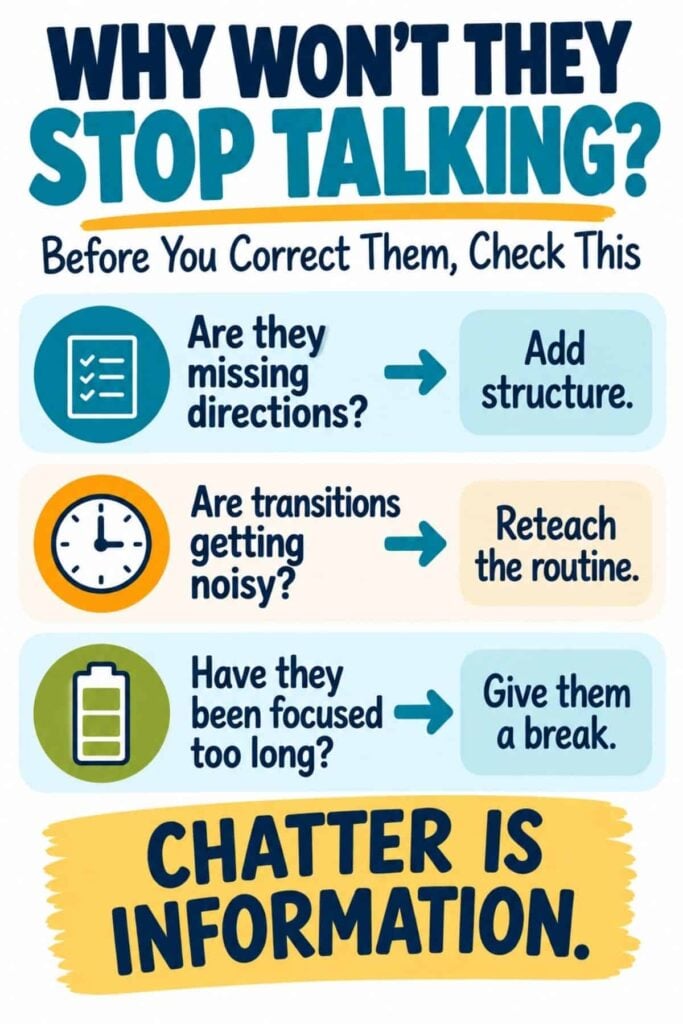
Sometimes chatter is a signal, not a discipline issue. A class that will not stop talking may be on overload. When students have been sitting and focusing for a long stretch, their attention leaks out as side conversation, and no amount of redirecting fixes tired brains.
When you sense that, give students a real break before you correct them. A quick brain break, a stretch, or a short sponge activity lets them reset and use up some energy, then you can bring them back to the harder work. Reading the difference between “will not settle” and “cannot settle right now” is one of those instincts that makes managing a chatty class much easier over time. For research-backed movement and brain break ideas, Edutopia has a helpful overview.
Frequently Asked Questions
Final Thoughts
A chatty class is often an eager, social group that needs structure more than silence. Decide whether the talking is blocking learning, give students real chances to talk, make agreements they own, and put your energy on the behavior you want and the few students who set the tone. Some years take more trial and error than others, and that is part of the work. Find the rhythm that fits this particular group, and the chatter starts working with you instead of against you.
Jessica BOschen
Jessica is a teacher, homeschool parent, and entrepreneur. She shares her passion for teaching and education on What I Have Learned. Jessica has 16 years of experience teaching elementary school and currently homeschools her two middle and high school boys. She enjoys scaffolding learning for students, focusing on helping our most challenging learners achieve success in all academic areas.