Showing 16–30 of 426 resultsSorted by popularity
-

Rated 4.96 out of 5
$2.67
Help students practice decoding words with R blends using these phonics blending cards! Designed for kindergarten and first grade instruction, plus RtI support for second grade, these cards guide students through saying each sound, blending the sounds, and reading the word fluently using dots, dotted lines, arrows, and clear visual cues.
-

Rated 4.97 out of 5
$4.75
Blending Cards for Final Blends include words common for Kindergarten and first grade reading.
-
Rated 4.93 out of 5
$2.67
Blending Cards for S Blends & Clusters include words common for Kindergarten and first-grade reading.
-
Rated 4.93 out of 5
$3.66
Blending Cards for Blending Cards for L Blends & Clusters & tw, the, qu include words common for Kindergarten and first grade reading.
-
Rated 4.95 out of 5
$7.95
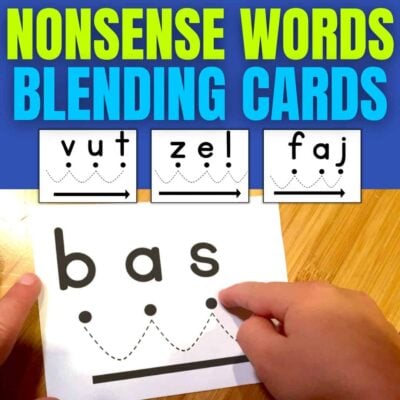
Blending Cards for CVC Nonsense Words include nonsense words common for Kindergarten reading.
-
Rated 4.88 out of 5
$5.85
Help students practice decoding long vowel and other vowel patterns with these Blending Cards for Long Vowel & Other Vowel Digraphs! Designed for kindergarten and first grade instruction, plus RtI support for second grade, these cards guide students through saying each sound, blending the sounds, and reading the word fluently using clear visual cues.
-
Rated 5.00 out of 5
$4.87
Blending Cards for R-Controlled Vowels include words common for Kindergarten and first-grade reading.
-
Rated 5.00 out of 5
$7.47
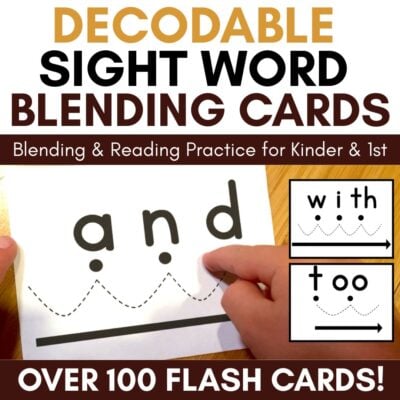
Blending Cards for Decodable Sight Words include sight words common for Kindergarten and first grade reading.
-
Sale!
Rated 5.00 out of 5
$69.75 Original price was: $69.75.$36.00Current price is: $36.00.
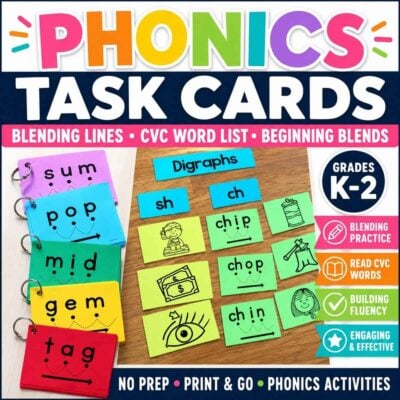
Support beginning readers with Blending Cards designed to teach smooth blending, decoding, and word reading. These printable phonics cards help students segment sounds, blend sounds together, and read words automatically using a consistent, research-based routine. Perfect for Kindergarten, First Grade, and Second Grade RtI intervention.
-
Rated 4.97 out of 5
$3.75
These Number Puzzles for Third Grade engage students in solving problems using a variety of equations, models, and strategies. Most puzzles include a context, a model / drawing, an equation, and an “answer”.
-
Rated 4.93 out of 5
$3.75
Help students start the school year with purpose using this SMART Goal Setting Craftivity! Students create meaningful school and personal goals while building a colorful classroom display perfect for Open House, Back-to-School Night, and goal-setting activities. Multiple formats, sentence frames, and a cut-and-paste option make differentiation easy.
-
Rated 5.00 out of 5
$4.29
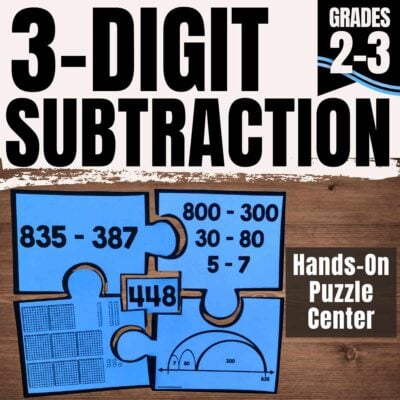
Three-Digit Subtraction Number Puzzles help students understand three different strategies to solve three-digit subtraction problems.
In these Three-Digit Subtraction Number Puzzles students match the: subtraction equation, answer, problem broken apart by place value, problem represented in base-10 blocks and as a number line. There are 20 problems that do not involve regrouping / decomposing and 20 problems that do involve regrouping / decomposing.
For the 20 problems that involve regrouping / decomposing, there are two versions: one with the base-10 blocks of of the minuend not decomposed and the other with the base-10 blocks decomposed. Chose the version that works best for your students.
-
Rated 4.96 out of 5
$3.37
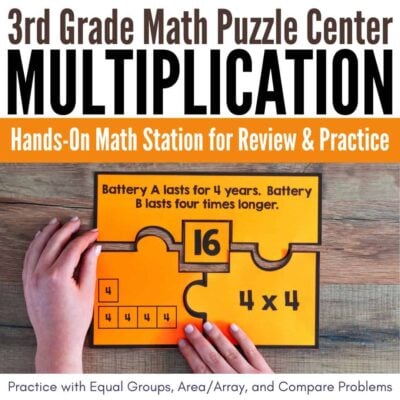
These Multiplication Number Puzzles help students interpret products of whole numbers by reading a context and identifying the expression, model / drawing, and total number. The context describes the relationship of the numbers, but doesn’t not include the question part of a word problem. The focus is on the relationship of the numbers.
-
Rated 4.95 out of 5
$3.37
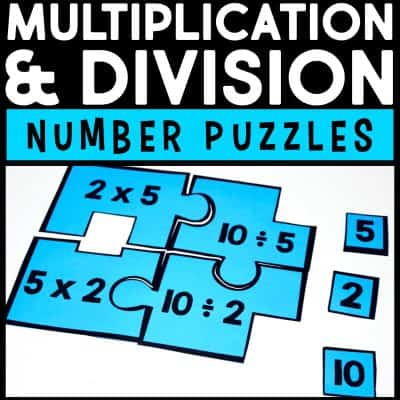
These Number Puzzles give students practice in seeing the relationship between multiplication and division. Each number puzzle has four expressions and three numbers for each of the four equations. The multiplication expressions have one product; each division expression has a quotient. These puzzles are also good for developing the concept of the commutative property and number bond relationships.
-
Rated 4.98 out of 5
$3.75
Number Puzzles for multiplication word problems and division word problems help students match a word problem with a model, an equation, and a result / answer. Word Problems are grouped by problem type. There are 35 number puzzles, 3-4 per problem type.
Models for the word problems include groups, number lines, arrays / area models, and bar models. Equations have a letter for the missing number. Multiplication word problems only have the multiplication equation. Division word problems have both the division and multiplication equations.
End of content
End of content